Yudh Abhyas 2026: India-US armies fire Dhanush, Pinaka and M777 in Bikaner joint drills
Synopsis
At the Mahajan Field Firing Range in Bikaner, Indian and US troops fired Dhanush guns, Pinaka rocket launchers and M777 howitzers side by side — then stacked counter-drone systems on top. The 22nd edition of Yudh Abhyas is becoming the most technically layered iteration yet, blending indigenous Indian firepower with US platforms in drills that mirror the combined-arms demands of modern warfare.
Key Takeaways
Indian Army and US Army conducted joint live-fire drills at Mahajan Field Firing Range, Bikaner on 22 September 2026 .
Weapons used included M777 Ultra-Light Howitzers , Dhanush guns , Pinaka multi-barrel rocket launchers , L70 air defence guns , and the M-LIDS counter-drone system.
Yudh Abhyas 2026 is the 22nd edition of the annual bilateral exercise, running since 15 September 2026 across Bikaner and Auli, Uttarakhand .
Approximately 600 personnel from each country are participating, with a focus on Integrated Battle Groups, drones, and long-range precision fires.
Four Indian Army military dogs — Rice, Victor, Jack/Zac, and Rowdy — demonstrated rappelling and hideout-entry skills to US troops.
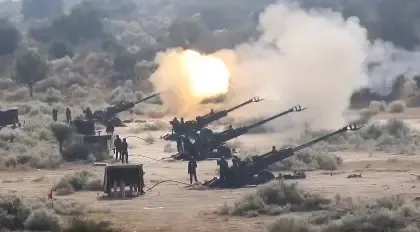
The Indian Army and the US Army conducted a major joint live-fire exercise at the Mahajan Field Firing Range in Bikaner, Rajasthan on Tuesday, 22 September 2026, as part of the ongoing bilateral exercise 'Yudh Abhyas 2026'. The drills brought together artillery units from both sides in a full-spectrum fire-support sequence — from target detection through to post-firing correction — marking one of the most intensive combined-arms days of the exercise so far.
Weapons and Systems Deployed
Artillery units fired M777 Ultra-Light Howitzers, indigenously developed Dhanush guns, and Pinaka multi-barrel rocket launchers during the live-fire drills. L70 air defence guns and the Mobile Low, Slow, Small Unmanned Aircraft Integrated Defeat System (M-LIDS) were also deployed, creating a layered counter-drone response capability against simulated threats. The combination of platforms tested both conventional fire support and emerging anti-drone architectures in a single integrated sequence.
What the Joint Drills Covered
Observation post detachments from the two armies trained together throughout the exercise. Soldiers practised target identification, coordinate relay, engagement procedures, fire commands, and post-firing corrections. The integrated drills spanned the full battlefield fire-support chain — giving troops direct exposure to each other's communication protocols, fire-control systems, and operational methods. According to the Indian Army, the training facilitates exchange of best practices and strengthens coordination to enable both forces to operate across varied environments.
This phase builds on earlier artillery activity at the same range, where only M777 Ultra-Light Howitzers had been fired two days previously — signalling a deliberate ramp-up in complexity and firepower as the exercise progresses.
About Yudh Abhyas 2026
'Yudh Abhyas 2026' is the 22nd edition of the annual India-US bilateral exercise. It commenced on 15 September 2026 and is being conducted simultaneously at two locations: the Auli Foreign Training Node in Uttarakhand and the Mahajan Field Firing Range in Rajasthan. Approximately 600 personnel from each country are participating. The exercise focuses on Integrated Battle Groups, mountain and semi-mountainous operations, drones, autonomous systems, and long-range precision fires.
Military Dogs in Action
In a related professional exchange, four Indian Army military working dogs — Rice, Victor, Jack (referred to as Zac in some accounts), and Rowdy — demonstrated specialised skills before US personnel. The canines performed drills involving entry into suspected hideouts and rappelling, showcasing their agility, training standards, and capacity to support troops in high-risk tactical situations.
Broader Significance
The Indian Army encapsulated the spirit of the exercise with the message: 'Training Together. Learning Together. Operating Better Together.' Yudh Abhyas has evolved over two decades from basic infantry exchanges into a sophisticated combined-arms laboratory. The inclusion of Pinaka — India's indigenous long-range rocket system — and M-LIDS, the US counter-drone platform, reflects the growing alignment of both armies around precision fires and unmanned aerial threat response, domains that have dominated recent conventional conflicts globally. As the exercise continues, both sides are expected to advance drills in mountain warfare and autonomous systems integration.
Point of View
Dhanush, M777, and M-LIDS in a single integrated live-fire sequence signals genuine doctrinal convergence, not just ceremonial cooperation. The inclusion of counter-drone platforms reflects a direct lesson from recent conflicts where cheap UAVs neutralised expensive artillery. What merits closer attention is whether the interoperability gains are being institutionalised — through shared SOPs, embedded liaison officers, or joint doctrine documents — or whether they remain confined to the exercise window and reset each year. India's decision to field indigenous systems alongside US platforms in a joint fires context is also a quiet signal about the direction of its defence industrial ambitions.
NationPress
23 Sept 2026
Frequently Asked Questions
What is Yudh Abhyas 2026?
Yudh Abhyas 2026 is the 22nd edition of the annual India-US bilateral military exercise, which began on 15 September 2026. It is being conducted simultaneously at the Mahajan Field Firing Range in Bikaner, Rajasthan, and the Auli Foreign Training Node in Uttarakhand, with approximately 600 personnel from each country.
Which weapons were used in the Bikaner joint firing exercise?
Artillery units fired M777 Ultra-Light Howitzers, Dhanush indigenous guns, and Pinaka multi-barrel rocket launchers. L70 air defence guns and the Mobile Low, Slow, Small Unmanned Aircraft Integrated Defeat System (M-LIDS) were also deployed to test layered counter-drone response.
What is the focus of Yudh Abhyas 2026?
The exercise focuses on Integrated Battle Groups, mountain and semi-mountainous operations, drones, autonomous systems, and long-range precision fires. Troops trained on the full battlefield fire-support chain, from target identification to post-firing corrections, to sharpen interoperability between the two armies.
What role did Indian Army dogs play in Yudh Abhyas 2026?
Four Indian Army military working dogs — Rice, Victor, Jack (also referred to as Zac), and Rowdy — performed demonstration drills for US soldiers, including entry into suspected hideouts and rappelling. The exercise highlighted their agility and ability to support troops in challenging tactical situations.
How does Yudh Abhyas 2026 build on previous editions?
The 22nd edition expands the scope of earlier exercises by integrating counter-drone platforms such as M-LIDS alongside traditional artillery systems including India's indigenous Dhanush and Pinaka. The simultaneous conduct at two geographically distinct nodes — a semi-desert range and a high-altitude training area — also marks an increase in complexity over past iterations.