Why Did Sensex and Nifty Close Lower Amid Weak Global Signals?

Synopsis
On January 19, Indian stock markets faced a downturn as heavy sell-offs in key large-cap stocks and weak global cues weighed on the benchmarks. The closing numbers reflect a cautious market atmosphere, driven by mixed quarterly earnings from major companies and global uncertainties. Discover the implications for investors and market trends.
Key Takeaways
Sensex closed at 83,246.18, down by 324.17 points.
Nifty settled at 25,585.5, falling 108.85 points.
Heavy selling in key sectors like realty, oil and gas, and media.
Immediate support identified for Nifty at 25,494.
Global uncertainties and mixed earnings contribute to market volatility.
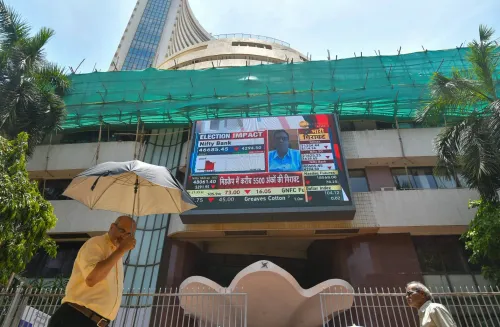
Mumbai, Jan 19 (NationPress) The Indian stock indices closed in the negative on Monday as significant sell-offs in select large-cap stocks weighed heavily on the benchmarks, amidst a backdrop of cautious global indicators.
The downturn was primarily driven by stock-specific pressures following quarterly earnings reports from major corporations like Reliance Industries, ICICI Bank, and HDFC Bank, which contributed significantly to the market's decline.
At the session's conclusion, the Sensex settled at 83,246.18, reflecting a decrease of 324.17 points or 0.39 percent. Meanwhile, the Nifty closed at 25,585.5, down by 108.85 points or 0.42 percent.
The Nifty remained under bearish influence, consistently staying below the 20 EMA throughout the trading hours.
“Immediate support is identified at 25,494 (today’s low), with a deeper support zone between 25,400 and 25,350,” stated an expert.
“The intra-day movements indicate profit booking and a prevailing weakness, making the Nifty susceptible to further declines unless a robust recovery occurs above the 25,600 to 25,700 range,” according to the analyst.
Global market sentiment was weak during the trading session, following US President Donald Trump's threats to impose tariffs on several European nations.
This warning followed opposition from some European countries to his attempt to buy Greenland, adding further uncertainty to global markets and negatively impacting investor sentiment.
Sector-wise, the real estate, oil and gas, and media sectors experienced notable selling pressure. The Nifty Realty index dipped nearly 2 percent, while the Nifty Oil & Gas index fell by approximately 1.56 percent.
The Nifty Media index also saw a significant decline, closing down 1.84 percent. However, some defensive stocks managed to attract buying interest.
The Nifty FMCG index rose by 0.67 percent, buoyed by select consumer stocks, while the Nifty Auto index posted a slight gain of 0.13 percent.
In the broader market, overall weakness was evident as the Nifty Midcap 100 index ended 0.37 percent lower, and the Nifty Smallcap index underperformed, dropping 0.99 percent.
Analysts noted that market participants remained cautious amidst mixed corporate earnings and escalating global uncertainties, resulting in a subdued closing for Indian stocks.
“As the Q3 earnings season unfolds, expect stock-specific volatility, particularly where performances have been inconsistent,” the analyst remarked.
“Considering the combination of global uncertainties and domestic factors, the markets are likely to remain in a consolidation phase,” experts concluded.
Point of View
I emphasize the importance of staying informed about market dynamics. The recent downturn in Indian equities underscores the volatility inherent in financial markets, driven by a blend of domestic and international factors. Investors must remain vigilant and agile in response to evolving market conditions.
NationPress
10 Oct 2026
Frequently Asked Questions
What caused the decline in Sensex and Nifty?
The decline was primarily due to heavy selling in major stocks like Reliance Industries, ICICI Bank, and HDFC Bank, compounded by weak global cues and mixed corporate earnings.
What are the immediate support levels for the Nifty?
Immediate support for the Nifty is at 25,494, with deeper support levels between 25,400 and 25,350.
Which sectors were affected the most?
The real estate, oil and gas, and media sectors saw the most significant selling pressure.
What should investors do in this market condition?
Investors are advised to remain cautious and look for opportunities, particularly in defensive stocks, while being prepared for stock-specific volatility.
What does the future hold for Indian equities?
The markets are expected to remain in a consolidation phase, influenced by global uncertainties and domestic triggers.