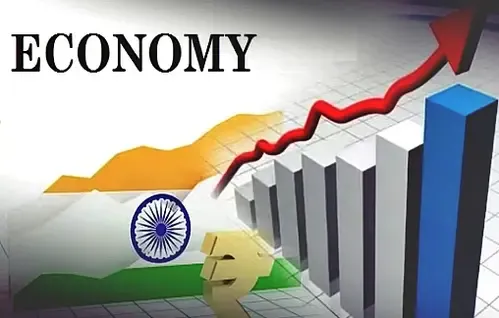
Is India set to become a $26 trillion economy by 2047-48?
Synopsis
India is gearing up to transform into a $26 trillion economy by 2047-48, with remarkable growth projections. As it aims to surpass Germany and Japan, the nation's strong IT sector and digital advancements play a pivotal role. Discover how India's ongoing economic evolution is set to impact the global landscape.
Key Takeaways
India's economy projected at $26 trillion by 2047-48 Per capita income expected to reach over $15,000 Growth driven by IT and digital innovation India to become the third largest economy by 2030 Significant digital economy growth outpacing overall GDP
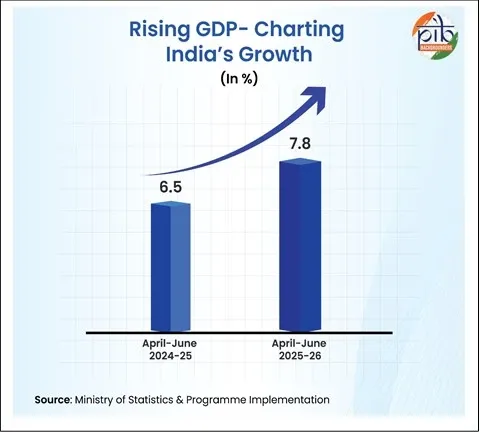
New Delhi, Dec 29 (NationPress) According to an Ernst and Young (EY) report, India is on track to become a US$26 trillion economy by 2047-48, maintaining a steady growth rate of approximately 6 percent annually. This growth is expected to elevate the per capita income to over $15,000, nearly six times its current level.
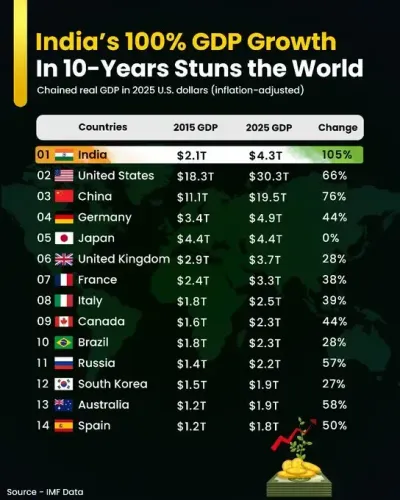
The report emphasizes several key growth enablers that enhance India’s standing in the global economy, predicting that it will surpass Germany and Japan to become the third largest economy globally by 2030, following China and the US.
India has reached a pivotal point as the fifth largest economy in the world, a status achieved largely due to its economic liberalization policies that have made it more market-driven and increased its global competitiveness. The growth forecasts for India are the highest among major economies for the upcoming decades.
In terms of services exports, India has demonstrated robust growth, with a 14 percent increase over the past twenty years, amounting to $254.5 billion in 2021-22. A significant portion of this comes from the Information Technology (IT) and Business Process Outsourcing (BPO) sectors, which contributed $157 billion in the same period.
This expansion has been fueled by both domestic and international IT firms.
Moreover, global corporations are leveraging Indian expertise through their capability centers in India, which employ over 5 million individuals. What started as a cost-saving measure has evolved into a critical source of high-quality talent and innovation. The 1,500 Global Capability Centers (GCCs) in India, which represent 45 percent of the global total, highlight the scalability and quality of these centers.
This convergence has positioned India as the “office of the world” for companies aiming for global technological adoption.
India is strategically positioned to capitalize on this success by catering to an increasing demand for skill-intensive and digitized services. Both Indian and international IT service providers are likely to focus on higher-value offerings such as consulting, experience design, as well as product development for Industry 4.0.
Additionally, most IT service firms will establish centers of excellence in India for Cloud, analytics, and AI, alongside significant advancements in IP-based platforms, fostering an ecosystem for emerging Indian hyperscalers.
In non-IT sectors, India has a unique chance to address the talent shortage faced by developed economies, particularly in education and healthcare, as services become increasingly digitized.
With a massive telecom subscriber base of 1.2 billion and 837 million internet users, coupled with the government's commitment to enhancing digital platforms, India is laying the groundwork for a thriving digital economy.
A consistent focus from the Government of India on developing a scalable Digital Public Infrastructure has yielded significant economic benefits and fostered innovation and entrepreneurship.
The report points out that from 2014 to 2019, the digital economy expanded by 15.6 percent in absolute US dollar terms, outpacing the overall growth of the Indian economy by 2.4 times.
India’s growth is vital for the global economy, as it accounts for approximately 1/6th of the world's population. By 2023, India is expected to become the most populous nation, positioning it as a major contributor to the global workforce for decades to come, according to the report.
Point of View
I recognize that India's ambitious growth trajectory is not just a national milestone but a significant global economic shift. Our policies, innovation, and talent pool position us favorably in a competitive landscape. It’s essential for us to remain committed to harnessing our potential while ensuring sustainable and inclusive growth that benefits all.
NationPress
21 Sept 2026
Frequently Asked Questions
What is the projected size of India's economy by 2047?
India is projected to become a $26 trillion economy by 2047-48.
What is the expected per capita income in 2047?
The per capita income is expected to exceed $15,000 by 2047.
Which sectors are driving India's economic growth?
The IT and BPO sectors are key drivers, alongside advancements in digital services.
How does India's digital economy compare to its overall growth?
From 2014 to 2019, India's digital economy grew by 15.6%, significantly outpacing overall economic growth.
What role does India play in the global workforce?
With a population of approximately 1.4 billion, India is set to become the largest contributor to the global workforce.