India on Track to Become the World’s 3rd Largest Economy Soon: Key Insights
Synopsis
The Bharat Progress Report 2025-26 reveals India's impressive economic growth, with significant milestones in technology and infrastructure, positioning it to soon become the third-largest economy globally. Discover the major achievements that pave the way for India’s bright future.
Key Takeaways
101 major milestones achieved in various sectors.
India's GDP reached $4.18 trillion .
Fastest-growing major economy with 8.2% growth rate .
Record GST collections of Rs 2.17 lakh crore .
Significant advancements in renewable energy and technology .
New Delhi, March 15 (NationPress) The Bharat Progress Report 2025-26, published by the NXT Foundation, emphasizes India's swift economic and technological advancement over the past year, marking the accomplishment of 101 significant milestones in areas such as digital public infrastructure, highways, railways, space, and renewable energy. These developments are steering the nation towards its ambition of becoming a developed country.
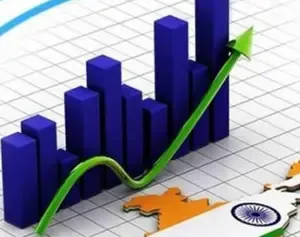
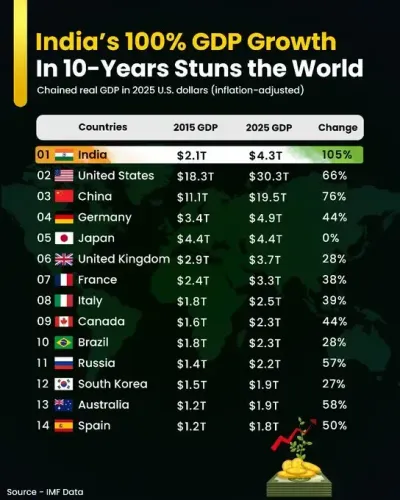
According to the report, India ascended to the position of the world’s fourth-largest economy in 2025, surpassing Japan with a nominal GDP of approximately $4.18 trillion. With a remarkable growth rate of 8.2 percent, India retains its status as the fastest-growing major economy globally, and is poised to soon become the third-largest economy.
The report outlines various high-frequency indicators that illustrate the economic growth trajectory. In April 2025, GST collections reached a historic Rs 2.17 lakh crore, while the mutual fund sector's assets under management exceeded Rs 80 lakh crore. Furthermore, cumulative foreign direct investment soared past $1.15 trillion, reflecting a surge in investor confidence.
The evolution of India's digital public infrastructure, now being emulated by other nations, is exemplified by UPI transactions exceeding Rs 21 lakh crore monthly and Aadhaar authentication crossing one billion. This has significantly fostered financial inclusion and improved the delivery of government services to underprivileged citizens transparently and efficiently.
On the infrastructure and connectivity front, notable achievements include the inauguration of the Chenab Rail Bridge, recognized as the world’s highest railway arch bridge, alongside the ongoing expansion of the Vande Bharat train network, enhancing high-speed rail connectivity. Additionally, national highways and logistics frameworks have been expanded, which is pivotal in optimizing supply chains and lowering transportation costs.
The report further accentuates India’s strides in science and advanced technology. The Space Docking Experiment (SpaDeX) undertaken by the Indian Space Research Organisation has successfully demonstrated in-orbit docking capabilities, placing India among the select nations with this advanced technology. Significant initiatives were also launched to bolster domestic expertise in semiconductors, artificial intelligence, and quantum computing, as India positions itself as an alternative to China in establishing a global manufacturing hub for high-tech electronics.
India has also made significant progress in achieving its renewable energy targets in combating climate change. The non-fossil fuel power capacity now stands at 50 percent, achieved five years ahead of the 2030 goal, driven by robust growth in solar, hydel, and wind energy. This report underscores how these milestones reflect India’s transformation into a vital contributor to global growth in the evolving world order.
Point of View
I observe that the Bharat Progress Report highlights not only India's economic achievements but also its commitment to innovation and sustainable growth. The data reflects a nation poised for further advancements, contributing significantly to the global economy.
NationPress
2 Oct 2026
Frequently Asked Questions
What is the Bharat Progress Report?
The Bharat Progress Report is an annual publication by the NXT Foundation that assesses India's economic and technological progress.
When did India become the fourth-largest economy?
India became the world's fourth-largest economy in 2025, surpassing Japan with a nominal GDP of about $4.18 trillion.
What are some key achievements mentioned in the report?
Key achievements include record GST collections, significant growth in mutual funds, and advancements in digital infrastructure and renewable energy.
How does the report reflect India's growth in technology?
The report highlights achievements like the Space Docking Experiment and developments in semiconductors and AI, showcasing India's technological capabilities.
What are India's goals related to renewable energy?
India aims to increase its non-fossil fuel power capacity to 50% by 2030, having reached this target five years ahead of schedule.