How India's SDG Approach Accelerates Local Development: Insights from NITI Aayog's Suman Bery

Synopsis
Discover how India's integration of Sustainable Development Goals into local planning enhances ownership and accelerates progress, as shared by NITI Aayog's Suman Bery at a recent workshop.
Key Takeaways
Integrating SDGs into local planning enhances ownership.
Localisation is key for tangible change .
VNRs strengthen institutional frameworks.
Robust data systems are essential for tracking progress.
Collaboration across sectors accelerates development.
New Delhi, March 24 (NationPress) The insights from India illustrate that embedding Sustainable Development Goals (SDGs) into local and state-level planning significantly enhances ownership and accelerates progress across various sectors, stated Suman K. Bery, Vice Chairman of NITI Aayog, on Tuesday.
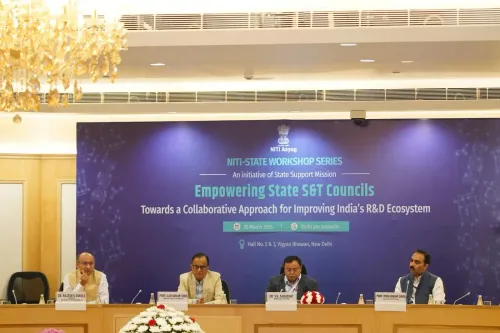
An international workshop focused on peer learning regarding Voluntary National Reviews (VNRs) and the pathways for implementing SDGs commenced in the national capital. This event gathered policymakers, experts, and government officials from both domestic and international backgrounds to explore methods of strengthening governance frameworks for achieving these global objectives.
During his keynote address, Bery emphasized that India's methodology of incorporating SDGs into state and local planning has cultivated a profound sense of ownership and enhanced collaboration, resulting in expedited developmental results.
“The localization of SDGs is instrumental in transforming global pledges into tangible changes on the ground,” he articulated.
Germany’s Ambassador to India and Bhutan, Philipp Ackermann, underscored that SDGs continue to serve as an essential global benchmark for assessing development advancements.
Moreover, UN Resident Coordinator in India, Stefan Priesner, highlighted that VNRs are maturing as critical tools to reinforce institutions, pinpoint deficiencies, and align policies, particularly in planning, financing, and data management.
Saurabh Garg, Secretary at the Ministry of Statistics and Programme Implementation, stressed the necessity of robust data systems and indicators to monitor SDG advancements and promote evidence-based policymaking across all governance tiers.
The workshop included numerous sessions addressing various facets of SDG execution.
Officials from NITI Aayog shared insights from India’s experience, with Rajib Kumar Sen, Programme Director (SDGs), noting that the VNR process fosters ongoing dialogue and collaboration among ministries, states, and stakeholders.
Discussions also encompassed regional priorities in Asia and the Pacific, focusing on fortifying institutions, enhancing inter-sector collaboration, and advancing strategies at the subnational level.
Participants assessed global progress thus far and examined how the SDG framework might evolve post-2030.
Special roundtable discussions highlighted critical issues such as gender equality, inclusive development, improved institutional coordination, and the role of data in policymaking.
Point of View
The integration of SDGs into local governance presents a transformative opportunity for India. It fosters ownership among stakeholders and accelerates progress in development, positioning the nation on a path toward achieving its global commitments.
NationPress
22 Sept 2026
Frequently Asked Questions
What are Sustainable Development Goals?
Sustainable Development Goals (SDGs) are a collection of 17 global goals set by the United Nations to address various global challenges, including poverty, inequality, and environmental sustainability.
Why is local action important for SDGs?
Local action is crucial as it ensures that the goals are tailored to specific community needs, fosters ownership, and enables quicker implementation of solutions.
What is a Voluntary National Review?
A Voluntary National Review (VNR) is a process where countries assess and present their progress towards achieving the SDGs, facilitating dialogue and exchange of best practices.
How does India track its SDG progress?
India employs robust data systems and indicators to monitor its progress on SDGs, ensuring evidence-based policymaking.
What role does NITI Aayog play in SDG implementation?
NITI Aayog is responsible for coordinating and guiding the implementation of SDGs in India, fostering collaboration among various stakeholders.