NITI Aayog launches SDG 5 reports to drive women's economic empowerment

Synopsis
NITI Aayog has launched granular State and District reports on SDG 5, co-developed with IIM Ahmedabad and the Gates Foundation, to push India's gender equality agenda below the national level — where data gaps and implementation failures have long been the real problem. With 2030 five years away, the initiative is a direct acknowledgement that broad policy targets alone have not been enough.
Key Takeaways
NITI Aayog launched SDG 5 State and District reports on 8 May 2025 in partnership with IIM Ahmedabad , the Gates Foundation , and the Gujarat government .
The reports function as policy briefs to enable district-level monitoring , gender-responsive budgeting, and targeted interventions on gender equality.
Union Minister Annapurna Devi called for high-quality data and tech-enabled monitoring; Gujarat Minister Dr.
Manisha Vakil stressed local-needs-responsive implementation.
Key discussion themes included gender-disaggregated data systems , financial inclusion, skilling, care economy support, and grassroots behavioural interventions.
Senior officials from states and UTs, central ministries, and international agencies — UNDP , UNICEF , UN Women , and the World Bank — participated in the workshop.
The initiative aims to support India's progress toward SDG 5 targets by 2030 .
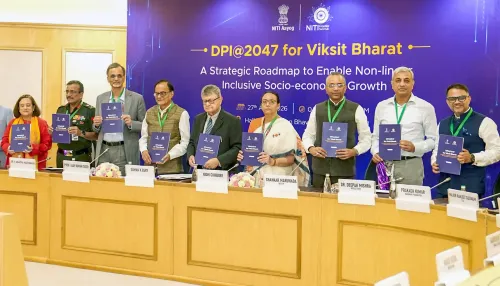
NITI Aayog, in partnership with IIM Ahmedabad, the Gates Foundation, and the Gujarat government, on 8 May 2025 organised a workshop in New Delhi to launch State and District reports on Sustainable Development Goal 5 (SDG 5) — the global benchmark for gender equality — and to accelerate district-level action on women's economic and social empowerment. The initiative marks a significant step toward embedding granular, data-driven approaches into India's gender policy architecture ahead of the 2030 SDG deadline.
What the Reports Cover
The State and District reports on SDG 5 are structured as policy briefs designed to generate insights, track progress over time, and enable more targeted interventions and budget alignment on gender equality. Officials described them as tools for moving India's gender policy conversation from broad national frameworks to actionable, district-specific strategies. The reports are intended to support gender-responsive budgeting, improved monitoring, and evidence-based decision-making at the sub-national level.
What Senior Officials Said
Annapurna Devi, Union Minister for Women and Child Development, underscored the importance of high-quality data, robust tech-enabled monitoring ecosystems, and time-bound evaluations for dynamic policymaking. Dr. Manisha Vakil, Gujarat's Minister for Women and Child Development, Social Justice and Empowerment, stressed the need for deeper convergence and targeted interventions that are responsive to local needs and ground realities. Dr. M. Srinivas, Member of NITI Aayog, noted that the reports will help identify achievements and priority areas at the district level, supporting India's progress toward the 2030 targets.
Key Themes from the Technical Sessions
Technical discussions centred on strengthening gender-disaggregated data systems, district-level monitoring frameworks, financial inclusion, skilling, care economy support, and improved access to quality employment and enterprise opportunities for women. Deliberations also highlighted the role of behavioural interventions and grassroots institutional mechanisms in addressing entrenched gender norms and enhancing women's participation in social and economic decision-making. This comes amid persistent gaps in India's gender data infrastructure, where district-level disaggregation has historically lagged behind national-level reporting.
Who Was in the Room
The workshop brought together senior officials from states and Union Territories, representatives of central ministries, and international agencies including UNDP, UNICEF, UN Women, and the World Bank. Non-governmental organisations and subject-matter experts also participated, contributing insights aimed at driving evidence-based action at the district level. The breadth of participation signals broad institutional alignment on the urgency of closing India's gender data and implementation gaps.
What Comes Next
The workshop reinforced the importance of transitioning from top-down, broad policy approaches to more granular, district-focused strategies. With the 2030 SDG deadline less than five years away, the SDG 5 State and District analysis is expected to serve as a critical reference tool for state governments designing context-specific interventions. Sustained political will and cross-ministry convergence will be essential to translating the reports' findings into measurable outcomes on the ground.
Point of View
Yet district-level data disaggregation has remained a persistent blind spot — which is precisely where implementation succeeds or fails. The involvement of the Gates Foundation and IIM Ahmedabad signals that the Centre is aware the problem is as much technical as it is political. However, launching reports and holding workshops is the easy part; the harder question is whether state governments will actually restructure budget lines and monitoring mechanisms around these findings. With 2030 approaching, the window for translating data into outcomes is narrowing fast.
NationPress
23 Sept 2026
Frequently Asked Questions
What are the NITI Aayog SDG 5 State and District reports?
They are policy briefs launched by NITI Aayog on 8 May 2025 to track India's progress on Sustainable Development Goal 5 — gender equality — at the state and district level. They are designed to enable more targeted interventions, gender-responsive budgeting, and evidence-based decision-making below the national level.
Who partnered with NITI Aayog to develop these reports?
NITI Aayog developed the reports in partnership with IIM Ahmedabad, the Gates Foundation, and the Gujarat government. The launch workshop also drew participation from UNDP, UNICEF, UN Women, and the World Bank.
Why is district-level SDG 5 monitoring important for India?
District-level monitoring is critical because gender inequality in India varies significantly across regions, and broad national targets often mask local gaps. Granular data allows state governments to design context-specific interventions and align budgets more precisely to where the need is greatest.
What key issues did the workshop discussions highlight?
Discussions focused on strengthening gender-disaggregated data systems, district-level monitoring frameworks, financial inclusion, skilling, care economy support, and grassroots behavioural interventions to address gender norms and improve women's participation in economic and social decision-making.
What is the timeline for SDG 5 targets in India?
India, like all UN member states, is committed to achieving the Sustainable Development Goals — including SDG 5 on gender equality — by 2030. The NITI Aayog reports are intended to help states and districts track and accelerate progress toward that deadline.