NITI Aayog launches DPI@2047 roadmap for India's digital growth
Synopsis
NITI Aayog's DPI@2047 is more than a policy document — it is a structural bet that India's next growth phase will be won not by inventing new technologies, but by building connective infrastructure that lets AI and open data reach every MSME, farmer, and student at scale. The two-phase plan through 2047 is the most ambitious DPI articulation India has produced.
Key Takeaways
NITI Aayog launched DPI@2047 for Viksit Bharat on 28 April 2025 , in partnership with EkStep Foundation and Deloitte .
Two phases: DPI 2.0 (2025–2035) for livelihood-led growth and DPI 3.0 (2035–2047) for broad-based prosperity.
Eight sectoral transformations target MSMEs, agriculture, education, and health under DPI 2.0.
Four execution imperatives: district-led demand aggregation, AI leverage, technology entrepreneurship, and cross-sector data unlocks.
Senior officials including Suman Bery , Nidhi Chhibber , and Prof Ajay Kumar Sood highlighted the shift from GDP-led to productivity-led growth.
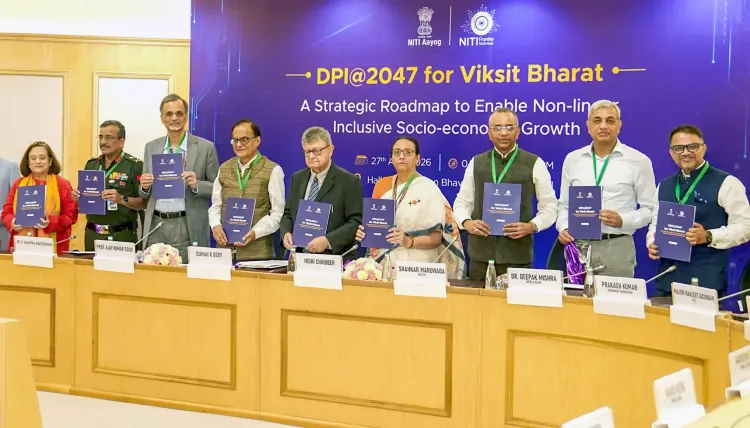
NITI Aayog on 28 April 2025 launched a strategic roadmap titled 'DPI@2047 for Viksit Bharat', charting the next phase of India's Digital Public Infrastructure (DPI) journey as a driver of inclusive, non-linear, and productivity-led growth. Developed in partnership with EkStep Foundation and Deloitte, the plan lays out a two-phase digital transformation path extending to 2047, with the immediate focus on DPI 2.0 (2025–2035).
Two-Phase Digital Transformation Path
The roadmap divides India's digital future into two chapters: DPI 2.0 (2025–2035), designed to drive livelihood-led growth at scale, and DPI 3.0 (2035–2047), aimed at enabling broad-based prosperity. DPI 2.0 is the immediate operational focus, extending India's digital rails beyond identity, payments, and welfare delivery into the engines of livelihoods, productivity, and market access.
Eight Sectoral Transformations Under DPI 2.0
Under DPI 2.0, the roadmap identifies eight sectoral transformations to address structural bottlenecks across MSMEs, agriculture, education, and health. It also strengthens systemic enablers including credit access, decentralised energy, and benefit delivery. The approach combines open digital infrastructure with trusted data flows and ecosystem-led innovation to create conditions for technologies such as AI to diffuse at scale across citizens and small enterprises.
Four Execution Imperatives
To translate intent into outcomes, the roadmap outlines four execution imperatives: district-led demand aggregation, scaling technology entrepreneurship, leveraging artificial intelligence (AI), and deploying cross-sector unlocks through better data use, digital transactions, stronger human capacity, and the democratisation of AI.
What Key Officials Said
Prof Ajay Kumar Sood, Principal Scientific Adviser to the Government of India, said technology leadership will increasingly be defined by the ability to translate science and innovation into scalable, trusted public outcomes. "India's DPI has demonstrated the power of open, interoperable systems at population scale. The next phase must build on this foundation, integrating frontier technologies with strong scientific rigour and safeguards," he said.
Suman Bery, outgoing Vice Chairman of NITI Aayog, said the focus has shifted from GDP to productivity. "The next phase of India's development will be shaped by how AI and DPI raise productivity at scale, placing it at the centre of India's development journey and helping lay the foundation for Viksit Bharat 2047," Bery noted.
Nidhi Chhibber, CEO of NITI Aayog, said that when states grow fast, India grows faster, and that DPI can become a significant enabler in accelerating inclusive growth for states. Debjani Ghosh, Distinguished Fellow at NITI Aayog, said the roadmap sets out how DPI 2.0 can move India from digital inclusion to productivity-led, livelihood-centred growth on the road to Viksit Bharat 2047.
Why This Marks a Strategic Shift
Notably, DPI 1.0 focused primarily on digital inclusion — building the foundational identity, payments, and welfare stack underpinning programmes like Aadhaar, UPI, and direct benefit transfers. The new roadmap signals a deliberate pivot: not simply building new technologies, but constructing connective infrastructure that allows innovation to travel faster and reach more people. This is the first time NITI Aayog has articulated a structured DPI trajectory aligned explicitly with the Viksit Bharat 2047 centenary vision. How swiftly state governments adopt district-led models and operationalise AI democratisation will determine whether the roadmap's ambitions translate into measurable outcomes.
Point of View
And the DPI@2047 roadmap builds credibly on that foundation. But DPI 1.0's success was largely about access; the productivity challenge is structurally harder and has eluded far wealthier economies. The roadmap's four execution imperatives are sound in theory, yet district-led aggregation and AI democratisation have both struggled to scale in past government initiatives without binding accountability structures. The real question is whether NITI Aayog can convert this into enforceable state-level commitments rather than another well-designed document that inspires conferences but underdelivers on the ground.
NationPress
19 Sept 2026
Frequently Asked Questions
What is the DPI@2047 roadmap launched by NITI Aayog?
It is a strategic document released on 28 April 2025 charting India's Digital Public Infrastructure journey through 2047, divided into DPI 2.0 (2025–2035) and DPI 3.0 (2035–2047). Developed with EkStep Foundation and Deloitte, it aims to shift India from digital inclusion to productivity-led, livelihood-centred growth.
What are the eight sectoral transformations under DPI 2.0?
The roadmap identifies eight sectoral transformations targeting structural bottlenecks in MSMEs, agriculture, education, and health, while strengthening enablers like credit access, decentralised energy, and benefit delivery. Detailed sector-by-sector guidelines are expected in subsequent implementation documents.
How does DPI 2.0 differ from DPI 1.0?
DPI 1.0 focused on digital inclusion — building identity, payments, and welfare delivery infrastructure such as Aadhaar and UPI. DPI 2.0 extends those digital rails into livelihoods, productivity, and market access, integrating AI and trusted data flows for broader economic impact.
What are the four execution imperatives outlined in the roadmap?
The four imperatives are district-led demand aggregation, scaling technology entrepreneurship, leveraging AI, and deploying cross-sector unlocks through better data use, digital transactions, stronger human capacity, and the democratisation of AI.
Who are the key stakeholders involved in the DPI@2047 roadmap?
The roadmap was developed by NITI Aayog in partnership with EkStep Foundation and Deloitte. Key officials at the launch included Principal Scientific Adviser Prof Ajay Kumar Sood, outgoing Vice Chairman Suman Bery, CEO Nidhi Chhibber, and Distinguished Fellow Debjani Ghosh.