What Roadmap Did NITI Aayog Unveil for Cutting Emissions in Cement, Aluminium, and MSME Sectors?
Synopsis
NITI Aayog has launched a pivotal roadmap for decarbonising the cement, aluminium, and MSME sectors in India, a crucial step toward achieving the ambitious $30 trillion Viksit Bharat goal. This initiative highlights strategies to significantly reduce GHG emissions, ensuring a sustainable future.
Key Takeaways
NITI Aayog has launched a roadmap for decarbonisation.
Focus on cement, aluminium, and MSME sectors.
Target of Net-Zero emissions by 2070.
Significant increase in production projected by 2047.
Proposed strategies include renewable energy and energy efficiency measures.
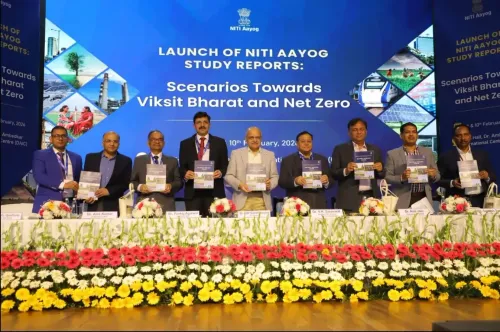
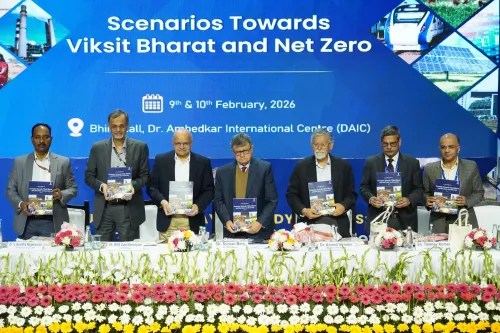
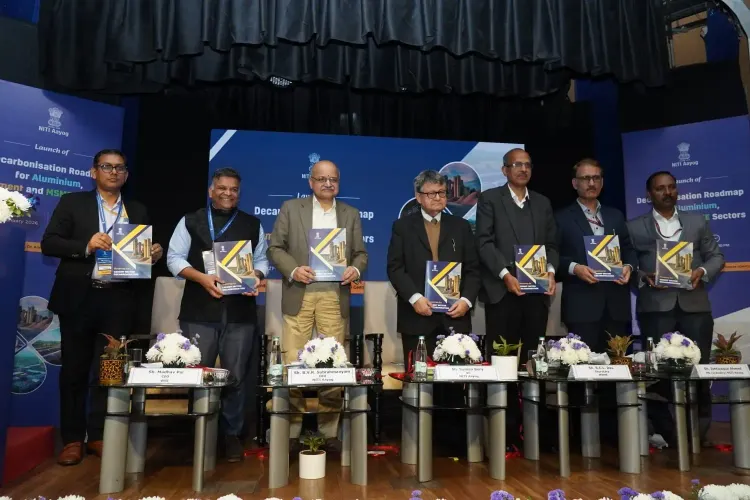
New Delhi, Jan 21 (NationPress) NITI Aayog has revealed a comprehensive roadmap aimed at the decarbonisation of the aluminium, cement, and MSME sectors in India, coinciding with the country's ambitious industrial and infrastructural expansion to achieve the Viksit Bharat goal of $30 trillion.
B.V.R. Subrahmanyam, the CEO of NITI Aayog, stated, "Approximately a year and a half ago, we initiated the Green Transition, Energy, Environment, and Climate Change division at NITI Aayog. Before this, there was no dedicated division for climate change or green transition, and we established it from scratch. Today, it stands as the largest division within NITI Aayog, comprising nearly 50 professionals, including PhDs, MBAs, and subject matter experts. Given its scale and expertise, it is arguably one of the most intellectually robust knowledge sources in the nation."
The roadmap indicates that by 2047, cement production is expected to increase fourfold, while aluminium output is projected to rise fivefold. The industrial sector currently contributes to 24 percent of national GHG emissions, necessitating a reduction to meet India's climate commitments—Net-Zero by 2070 and a 45 percent reduction in emission intensity by 2030.
Presently, cement production stands at 390 million tons (MT), with projections estimating a surge to 1743 MT by 2047. Currently, GHG emissions from cement are around 246 Mt CO2e, which accounts for 6 percent of India's total emissions, and this is projected to rise to 45 Mt CO2e by 2047.
To mitigate emissions, the NITI Aayog roadmap proposes increased utilization of Refuse Derived Fuel (RDF) from Municipal Solid Waste (MSW) as an alternative fuel in the cement industry, along with greater incorporation of clinker substitutes in cement production, and pilot projects for carbon capture and utilization (CCU).
India's annual aluminium production is currently 5 million tonnes (MT), used in photovoltaic systems, grid connectivity, electric vehicles, aerospace, and marine sectors. The country also exports 40–50 percent of its primary aluminium.
Currently, GHG emissions from the aluminium sector are approximately 83 MT CO2e, which represents 3 percent of India's total GHG emissions, projected to escalate to 376 MT CO2e by 2070.
While India's average GHG emission is 20 tCO2/tonne of aluminium, the global average is 15 tCO2/tonne, raising concerns of potential future export restrictions due to high emission intensity, especially with India's commitment to Net Zero by 2070.
The report emphasizes that aluminium is a challenging sector to decarbonise, with electricity constituting over 75 percent of emissions during the manufacturing process.
The roadmap suggests that in the short term, by 2030, power should be sourced from renewable energy. Policy recommendations include establishing a dedicated renewable energy grid for the aluminium sector, dual Central Transmission Utility-State Transmission Utility (CTU-STU), and allowing the conversion of Captive Power Plants (CPP) to independent power producers (IPP).
For the medium term (2030-2040), nuclear power is proposed as an alternative, while the long term (beyond 2040) favors Captive Thermal Power with CCUS.
The roadmap also identifies 69 million MSMEs across sectors like leather, textiles, paper, steel rerolling, foundries, chemicals, and pharmaceuticals as key players in emission reduction. These MSMEs contribute to 45.7 percent of exports and 30 percent of the gross value added to India's GDP, generating 135 million tCO2, eq. (MTCO2e) of greenhouse gas emissions, which account for 3-4 percent of India's total emissions.
To enhance energy efficiency, the roadmap proposes measures for small and medium enterprises, including green electricity for micro-units and the use of low-emission fuels like natural gas. It identifies the potential for a 55-62 percent reduction in emissions in the MSME sector over the next five years using these three key strategies.
The aim is to decrease specific energy consumption by at least 20 percent through the adoption of energy-efficient equipment such as boilers, heat pumps, heat exchangers, rolling, milling, and cooling devices. The roadmap recommends providing viability gap funding of up to 15 percent as a capital subsidy for eligible plant and machinery.
Point of View
It's crucial to acknowledge NITI Aayog's initiative as a significant milestone in India's journey towards sustainable development. The roadmap not only addresses the pressing issue of greenhouse gas emissions but also reflects a commitment to innovation and growth within the country's industrial sectors. By fostering collaboration and embracing green technologies, India can pave the way for a resilient and sustainable economy that aligns with global climate goals.
NationPress
29 Sept 2026
Frequently Asked Questions
What sectors are targeted for decarbonisation?
The roadmap focuses on the cement, aluminium, and MSME sectors for reducing emissions.
What is the target for Net-Zero emissions?
India aims for Net-Zero emissions by 2070.
How much is India's current cement production?
Currently, India produces approximately 390 million tons of cement annually.
What are the key strategies suggested for emission reduction?
Key strategies include the use of Refuse Derived Fuel, clinker substitutes, and carbon capture technology.
How many MSMEs are identified for emission reduction?
The roadmap identifies 69 million MSMEs across various sectors.