Accelerating India's Nuclear Ambitions: Insights from the SHANTI Act Workshop
Synopsis
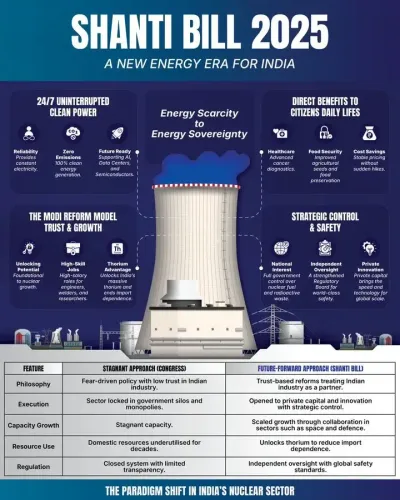
A recent workshop delved into the operational strategies of the SHANTI Act, aiming to elevate India's nuclear power capacity to 100 GW. This initiative is pivotal for achieving energy security and Net Zero targets while inviting private sector participation in clean energy.
Key Takeaways
SHANTI Act of 2025 aims to elevate nuclear capacity to 100 GW .
Focus on private sector participation in clean energy.
Emphasis on long-term fuel availability and safety.
Collaborative efforts from multiple government bodies.
Need for robust financial mechanisms to support deployment.
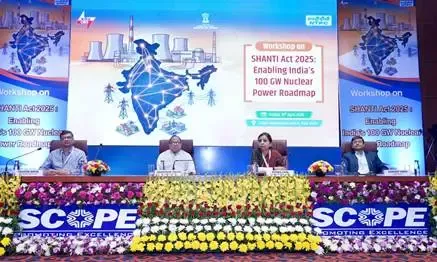
New Delhi, April 17 (NationPress) The government hosted a workshop aimed at implementing the SHANTI Act of 2025, focusing on elevating India's nuclear capacity to 100 GW to fulfill long-term energy security goals and Net Zero commitments, as stated in an official announcement on Friday.
Gurdeep Singh, Chairman and Managing Director of NTPC, underscored the critical role of nuclear energy in the energy portfolio and stressed the urgency of advancing preparatory tasks like land identification and site assessments to facilitate the prompt establishment of new nuclear facilities.
He also pointed out the necessity for collaborations in both technology and the supply chain.
Highlighting the significance of the SHANTI Act, he remarked that it paves the way for private sector involvement, enabling industries to view nuclear energy as a credible source of clean power.
Singh emphasized the need for the swift formulation of rules and guidelines to ensure expedited progress. He also stressed the importance of maintaining long-term fuel availability, prioritizing safety, and achieving comprehensive energy security objectives.
The Central Electricity Authority (CEA), in collaboration with the Ministry of Power, the Department of Atomic Energy (DAE), and NTPC Limited, organized this high-profile workshop.
Seema Jain, a Member of the Finance Department at DAE, highlighted the importance of financial readiness, establishing robust risk-sharing frameworks, and creating institutional mechanisms to support extensive nuclear deployment.
She called for the nurturing of global technological partnerships and the development of innovative financing strategies to propel the nuclear sector forward, according to the statement from the Ministry of Power.
Ghanshyam Prasad, Chairperson of CEA, reiterated that nuclear power is essential for providing reliable and continuous clean energy to meet India's increasing demand while adhering to international climate obligations.
He emphasized the need for a secure and uninterrupted supply of nuclear fuel through diversified sources and the creation of long-term procurement agreements.
In-depth discussions took place regarding the provisions of the SHANTI Act, 2025, including private sector involvement, the graded liability framework, and aligning the new act with the Electricity Act of 2003.
More than 150 representatives from state and central ministries, regulators, developers, engineering consultancy firms, academic institutions, and industry associations participated in the workshop.
Point of View
The operationalization of the SHANTI Act represents a crucial move towards enhancing India's energy independence. By engaging the private sector, the government aims to not only meet rising energy demands but also fulfill international climate commitments. The collaborative efforts from various sectors are vital for the successful implementation of this initiative.
NationPress
18 Sept 2026
Frequently Asked Questions
What is the SHANTI Act?
The SHANTI Act, enacted in 2025, aims to enhance India's nuclear energy capacity, promoting private sector participation and ensuring long-term energy security.
Why is nuclear energy important for India?
Nuclear energy is critical for India as it provides a reliable, clean energy source to meet growing demands and support environmental commitments.
What were the key topics discussed in the workshop?
The workshop focused on private sector involvement, risk-sharing mechanisms, long-term fuel availability, and aligning the SHANTI Act with existing energy laws.
Who attended the workshop?
Over 150 delegates from various sectors, including government ministries, regulators, and industry associations, participated in the workshop.
What is the goal of increasing nuclear capacity to 100 GW?
The goal is to ensure energy security and achieve Net Zero targets while providing a sustainable energy solution for India's future.