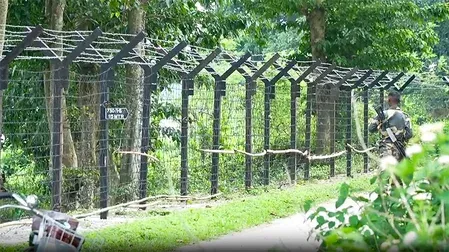
ISI spy Wahab Alam arrested in Bengal, targeted Army, Navy, Railways

Synopsis
A Pakistani national who entered India through the Nepal border in 2012 spent over a decade gathering intelligence on Indian Army, Navy, and Railways installations in the eastern sector — armed with forged Aadhaar, PAN, and voter ID cards. His arrest in West Bengal's Habra, just as he was reportedly preparing to flee to Bangladesh, has exposed a wider ISI-backed network with at least one local facilitator already in custody.
Key Takeaways
Wahab Alam , a Pakistani national, was arrested by the West Bengal STF in Habra, North 24 Parganas for espionage on behalf of Pakistan's ISI .
Alam reportedly entered India through the India-Nepal border in 2012 and operated covertly across West Bengal for over a decade.
His targets included the Indian Army , Navy , and Railways in India's eastern sector.
Forged Aadhaar , PAN , and EPIC (voter ID) cards were seized from his possession.
A second suspect, Muhammad Izaz , was arrested from Topsia, East Kolkata for allegedly procuring the forged documents.
Investigators believe Alam was preparing to flee to Bangladesh when apprehended in Habra, near the India-Bangladesh border.
Wahab Alam, a Pakistani national arrested in the Habra area of West Bengal's North 24 Parganas district, was deployed by Pakistan's Inter-Services Intelligence (ISI) to gather classified information on the Indian Army, Navy, and Railways in the country's eastern sector, according to state police insiders. The arrest, carried out by the Special Task Force (STF) of the West Bengal Police, has exposed what investigators describe as a long-running espionage operation conducted from within Indian territory.
How Alam Entered and Operated in India
During marathon interrogation sessions, Alam reportedly admitted to STF sleuths that he crossed into India through the India-Nepal border in 2012 — over a decade ago — and has since moved between multiple locations across West Bengal to avoid detection. His pattern of shifting bases, investigators say, is consistent with standard ISI tradecraft for deep-cover operatives.
Notably, Alam had been staying at the residence of Muhammad Izaz in the Topsia area of East Kolkata before relocating to Habra. According to STF sources, he moved shortly after the Special Intensive Revision (SIR) electoral roll exercise commenced in West Bengal ahead of the recently concluded Assembly elections — a timing that suggests he was monitoring law enforcement activity.
Forged Documents and Second Arrest
Following Alam's arrest, STF officers seized a set of forged Indian identity documents from his possession, including an Aadhaar card, a PAN card, and an EPIC card (voter identity card). Investigators established that these documents were procured through Izaz, who was subsequently arrested from the Topsia area and is now also in STF custody.
The seizure of multiple forged credentials points to an organised support network operating within the state — one that, according to investigators, helped Alam blend into local communities for years without detection.
Bangladesh Border Link and Ongoing Interrogation
STF sleuths believe Alam was preparing to flee to Bangladesh when he was apprehended, having shifted to Habra — a locality situated in close proximity to the India-Bangladesh border. Interrogation of both Alam and Izaz is ongoing, with investigators seeking to identify other associates in the network and determine the full extent of intelligence already transmitted to handlers in Pakistan.
The nature and volume of information Alam may have passed on regarding Indian military and railway infrastructure in the eastern sector remains under active investigation.
Political Response
West Bengal's Municipal Affairs and Urban Development Minister, Agnimitra Paul, reacted sharply to the arrest, alleging that such elements were able to establish deeper roots in the state due to what she termed 'nurturing by the previous Trinamool Congress (TMC) regime.' She urged citizens to remain vigilant and report any suspicious persons or activity to their nearest police station immediately.
The Trinamool Congress has not yet issued a formal response to the minister's remarks. As the STF widens its probe, the case underscores longstanding concerns about infiltration through India's porous northern and eastern borders.
Point of View
Moving freely between Kolkata and border districts while carrying forged Indian credentials, points to systemic gaps in both border management and local intelligence. The India-Nepal open border has long been flagged as an infiltration route, yet the SIR exercise — meant for electoral rolls, not security — appears to have inadvertently flushed out the suspect. That is a lucky break, not a system working as designed. The political blame game over TMC governance is a distraction from the harder question: how many more such operatives remain embedded, and what institutional reform will actually close the gap?
NationPress
26 Sept 2026
Frequently Asked Questions
Who is Wahab Alam and why was he arrested?
Wahab Alam is a Pakistani national arrested by the West Bengal Special Task Force (STF) in the Habra area of North 24 Parganas district. He was allegedly deployed by Pakistan's Inter-Services Intelligence (ISI) to collect information on the Indian Army, Navy, and Railways in India's eastern sector.
How did Wahab Alam enter India and evade detection for so long?
Alam reportedly admitted during interrogation that he entered India through the India-Nepal border in 2012. He evaded detection by frequently shifting his base across different parts of West Bengal and using forged Indian identity documents, including an Aadhaar card, PAN card, and voter ID card.
Who is Muhammad Izaz and what is his role in the case?
Muhammad Izaz is a second suspect arrested by the STF from the Topsia area of East Kolkata. He allegedly procured the forged Indian identity documents used by Alam, and Alam had previously stayed at Izaz's residence before relocating to Habra.
What information was Wahab Alam trying to collect?
According to state police insiders, Alam was tasked by the ISI to gather intelligence on the Indian Army, Navy, and Railways specifically in India's eastern sector. The full extent of information he may have already transmitted to handlers in Pakistan is still under investigation.
Why is the West Bengal government under political scrutiny over this arrest?
State Minister Agnimitra Paul alleged that ISI-linked operatives were able to entrench themselves in West Bengal due to what she described as 'nurturing by the previous Trinamool Congress regime.' The TMC has not yet formally responded to the allegation.