Karnataka CET Janeu Row: BJP Files Complaint, Demands Arrests
Synopsis
Seven Hindu students were allegedly forced to remove their sacred janeu thread to enter a Karnataka CET 2026 exam hall in Bengaluru. BJP leaders filed a police complaint and demanded arrests. Three Krupanidhi College staff were suspended. The incident has sparked a major political and religious rights debate in Karnataka.
Key Takeaways
Approximately seven Hindu students were allegedly forced to remove their janeu (sacred thread) at Krupanidhi College, Madiwala, Bengaluru during the Karnataka CET 2026 Physics exam on April 24 .
A formal police complaint was filed by Raghu Bhima Rao at Madiwala Police Station , with BJP's R.
Ashoka and Tejasvi Surya accompanying the victim's family to the Bengaluru Police Commissioner's office .
The Karnataka Congress government suspended three staff members of Krupanidhi College following the incident, though BJP leaders have demanded criminal arrests.
Rao stated the incident disturbed him and adversely impacted his performance in the 60-question, 60-minute Physics paper .
Ashoka accused the state government of insensitivity to Hindu religious practices and alleged police at Koramangala Police Station delayed registering the complaint for hours.
The controversy has reignited debate over religion-neutral examination protocols in Karnataka, drawing comparisons to the 2022 hijab controversy that reached the Supreme Court.
Bengaluru, April 24: The Karnataka Common Entrance Test (CET) 2026 sacred thread controversy has sharply escalated after a formal police complaint was lodged at Madiwala Police Station and the Bharatiya Janata Party (BJP) demanded the immediate arrest of three examination centre officials accused of forcing Hindu students to remove their janeu (sacred thread) before entering the exam hall. The incident, which occurred on Thursday morning at approximately 10 a.m. during the Physics paper at Krupanidhi College, Madiwala, Bengaluru, has ignited a fierce political and religious debate across Karnataka.
Police Complaint Filed, BJP Leaders Accompany Victim's Family
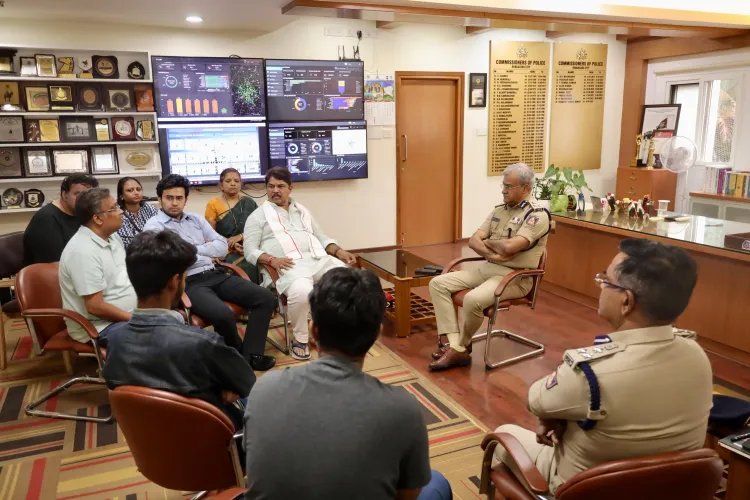
Leader of Opposition R. Ashoka and BJP National Yuva Morcha President and Bengaluru South MP Tejasvi Surya personally accompanied the victim and his parents to the office of Bengaluru Police Commissioner Seemanth Kumar Singh to submit the formal complaint. The complaint was filed by Raghu Bhima Rao, a resident of Balaji Layout, Bengaluru, and cites violations of religious rights and harassment of students during a government-mandated examination.
R. Ashoka called for the arrest of three officials allegedly involved, describing the episode as a direct attack on Hindu traditions and religious rights. He accused the Karnataka Congress government of being insensitive to the religious sentiments of students and failing to act promptly despite being informed of the incident.
Ashoka also alleged that students and their families who visited Koramangala Police Station were made to wait for hours without any response, suggesting an attempt to delay or suppress the registration of the case.
Student's Account: Distress Inside the Exam Hall
The student at the centre of the controversy, Anirudh R. Rao, described arriving at the examination centre at around 9:40 a.m. and being told he would not be permitted to enter the hall unless he removed his sacred thread. Faced with the ultimatum and under time pressure, he called his father, who was equally unsure of how to respond.
"They told me that if I did not remove it, I would not be allowed to write the exam. I called my father, and even he was unsure what to do," Anirudh said. He noted that approximately seven students were wearing the janeu that day, and several of them were compelled to remove it under similar pressure.
Anirudh stated that the distressing incident directly impacted his concentration and performance during the 60-question, 60-minute Physics paper. "After the exam, I informed my mother, who came to the centre and questioned the authorities. This is a religious matter, and we cannot remove it. It is like a part of our body," he said.
Government Action: Three Staff Members Suspended
As political pressure mounted, the Karnataka Congress government directed the suspension of three staff members of Krupanidhi College in connection with the incident. While the suspension signals an acknowledgment of wrongdoing, BJP leaders have argued it is insufficient and that criminal action must follow.
Authorities are yet to issue a detailed public explanation regarding the sequence of events, the specific instructions given to invigilators, or whether the directive to remove religious items was part of a broader anti-malpractice guideline applied without proper religious sensitivity training.
Political Fallout and Broader Implications
The incident has reignited long-standing tensions in Karnataka over the treatment of Hindu religious practices in public institutions. This controversy follows a pattern of similar disputes in the state — most notably the hijab ban controversy in 2022, which reached the Karnataka High Court and the Supreme Court. Critics now argue that the state has failed to establish consistent, religion-neutral guidelines for examination dress codes that respect all communities equally.
Opposition leaders have drawn attention to what they describe as a double standard — pointing out that while the Karnataka government faced intense scrutiny for restricting certain religious attire in educational settings in the past, incidents affecting Hindu students appear to be handled with less urgency. The BJP is expected to raise the matter in the upcoming Karnataka legislative session, using it as a mobilisation issue ahead of local body elections.
R. Ashoka warned that without strict punitive action, such incidents would recur, potentially discouraging religious minority students from appearing in competitive examinations. He demanded that the government issue clear, written guidelines to all CET examination centres specifying that religious threads, symbols, and items of faith are not to be confiscated or removed from students.
What Happens Next
The Madiwala Police are expected to formally register the First Information Report (FIR) following the complaint by Raghu Bhima Rao, and the case could invoke provisions related to hurting religious sentiments and violation of fundamental rights under the Indian Constitution. Legal experts suggest that Article 25, which guarantees freedom of conscience and the right to practise religion, may be central to any judicial proceedings.
The Karnataka government faces mounting pressure to announce a comprehensive policy review of CET examination protocols to prevent similar incidents. With the Karnataka CET 2026 results expected in the coming weeks, the controversy is unlikely to fade quickly, and the BJP has signalled it will continue to amplify the issue at both the state and national level.
Point of View
Constitutionally grounded protocols for public examinations. The same state that saw the hijab controversy dominate national headlines in 2022 is now embroiled in a mirror-image controversy affecting Hindu students, exposing the government's inability to craft consistent, fair dress-code guidelines. Three suspensions may contain the immediate political fire, but without a Supreme Court-backed, codified framework for religious expression in examination halls, Karnataka will keep producing these flashpoints — each one more politically explosive than the last.
NationPress
29 Sept 2026
Frequently Asked Questions
What happened at the Karnataka CET 2026 exam centre in Bengaluru?
During the Karnataka CET 2026 Physics paper on April 24 at Krupanidhi College in Madiwala, Bengaluru, approximately seven Hindu students were allegedly asked to remove their sacred thread (janeu) before being allowed to enter the examination hall. Students who refused were threatened with being barred from writing the exam.
Who filed the police complaint in the Karnataka CET janeu case?
The complaint was filed by Raghu Bhima Rao, a resident of Balaji Layout, Bengaluru, at Madiwala Police Station. BJP leaders R. Ashoka and Tejasvi Surya accompanied the victim's family to the Bengaluru Police Commissioner's office to formally submit the complaint.
What action has the Karnataka government taken in the CET janeu controversy?
The Karnataka Congress government directed the suspension of three staff members of Krupanidhi College in connection with the incident. However, the BJP has termed the suspension insufficient and demanded criminal arrests of the officials responsible.
How did the janeu incident affect the students during the CET exam?
Student Anirudh R. Rao stated that being forced to remove his sacred thread left him deeply disturbed and negatively affected his performance in the Physics paper. The exam required students to answer 60 questions in 60 minutes, adding to the pressure created by the situation.
What are the legal implications of the Karnataka CET janeu controversy?
Legal experts suggest the incident could involve violations of Article 25 of the Indian Constitution, which guarantees the freedom to practise religion. An FIR is expected to be registered, and charges related to hurting religious sentiments and violation of fundamental rights may be applied.