Karnataka family holds grand procession for baby girl, challenges gender bias

Synopsis
In Barwad village, Belagavi, a family turned a newborn girl's homecoming into a community event — complete with traditional music, fireworks, and jalebis — stunning neighbours who assumed the fanfare was for a boy. It is a small act with a loud message in a country still grappling with son preference and female feticide.
Key Takeaways
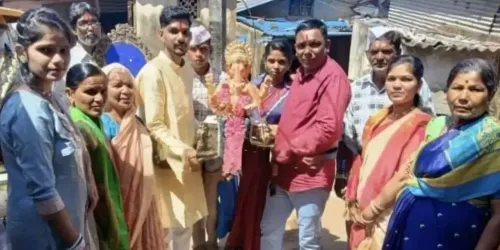
Sambhaji Thorwat and his wife Suman Thorwat of Barwad village, Belagavi , organised a grand procession to welcome their granddaughter Vaibhavi on 28 April .
The procession began at the Lakshmi Temple, Ganganagar and featured traditional instruments, rangoli, flower showers, and fireworks.
Many onlookers initially assumed the celebration was for a boy — upon learning it was for a girl, several joined the procession in support.
Jalebis were distributed across the neighbourhood following the ceremonial gruhapravesh .
The family explicitly highlighted concerns over female feticide and called on society to celebrate girl children with equal pride.
A family in Barwad village, Belagavi district, Karnataka, celebrated the birth of their granddaughter with a grand public procession on 28 April, sending a powerful message against gender discrimination and female feticide. The event drew widespread admiration from residents and has since sparked conversations about changing social attitudes toward the birth of girl children.
The Celebration
Social worker Sambhaji Thorwat and his wife Suman Thorwat organised the festive procession to welcome their newborn granddaughter, named Vaibhavi. The procession commenced from the Lakshmi Temple in Ganganagar and made its way to the Thorwat residence, accompanied by the rhythmic beats of traditional instruments — halgi, ghumke, and zhanj. Streets were decorated with rangoli, flower petals were showered on the mother and child, and fireworks lit up the occasion.
Following the ceremonial gruhapravesh, jalebis were distributed across the neighbourhood as a gesture of joy and community celebration.
The Moment That Surprised Onlookers
Initially, many residents in the locality assumed the elaborate celebration was for the birth of a boy. Upon learning that the festivities were in honour of a girl child, onlookers expressed visible surprise — and then admiration. Several people spontaneously joined the procession in a show of support, turning the family's private gesture into a community statement.
What the Family Said
Grandmother Suman Thorwat said the family believed the newborn's arrival was akin to the blessings of Goddess Mahalakshmi entering their home. Speaking on the occasion, Sambhaji Thorwat said the celebration was deliberately organised to counter the stigma often associated with the birth of girls in rural communities.
He stressed that daughters must be valued equally, noting that in a country where Goddesses Mahalakshmi, Durga, and Bharat Mata are revered, girl children too deserve to be welcomed with pride. He also raised concerns over the continuing practice of female feticide, arguing that with proper education and values, daughters can become role models for future generations.
Why This Matters
India's skewed sex ratio at birth — a persistent challenge across several states — reflects deep-rooted son preference, particularly in rural and semi-urban belts. Initiatives like the Beti Bachao Beti Padhao campaign have attempted to shift public attitudes, but grassroots actions by ordinary families often carry more immediate social weight. This is precisely the kind of community-level symbolism that advocacy groups argue can normalise the celebration of girl children in ways that government schemes alone cannot.
The Thorwat family said their initiative was meant to inspire others in society to celebrate the birth of girls with equal enthusiasm — and judging by the response in Barwad village, it appears to have done exactly that.
Point of View
Tradition, and community. By using the same rituals typically reserved for the birth of boys, they exposed the absurdity of the double standard without a single protest banner. The real question is whether such acts remain isolated feel-good stories or catalyse lasting attitudinal change. In districts where the sex ratio at birth remains alarming, it will take more than one procession — but every norm-shift starts somewhere, and Barwad village just made a credible beginning.
NationPress
25 Sept 2026
Frequently Asked Questions
Why did a Karnataka family hold a grand procession for a baby girl?
The family of social worker Sambhaji Thorwat in Barwad village, Belagavi, organised the procession to challenge gender bias and counter the stigma associated with the birth of girls. They wanted to send a public message that daughters deserve to be celebrated with the same enthusiasm as sons.
Who organised the girl child celebration in Belagavi?
Social worker Sambhaji Thorwat and his wife Suman Thorwat organised the celebration to welcome their newborn granddaughter, Vaibhavi, in Barwad village, Belagavi district, Karnataka.
What happened during the procession in Barwad village?
The procession began at the Lakshmi Temple in Ganganagar and proceeded to the Thorwat residence, featuring traditional instruments like halgi, ghumke, and zhanj, along with fireworks, flower showers, rangoli, and the distribution of jalebis after the gruhapravesh ceremony.
What social message did the Thorwat family intend to send?
The family aimed to highlight the equal value of girl children, raise awareness against female feticide, and inspire communities to celebrate the birth of daughters with pride — noting that in a country that reveres Goddesses Mahalakshmi, Durga, and Bharat Mata, girl children deserve the same reverence.
How did residents react to the girl child procession in Belagavi?
Many residents initially assumed the celebration was for a boy and were visibly surprised to learn otherwise. Upon realising it was for a girl child, several onlookers expressed admiration and spontaneously joined the procession in support.