Karnataka's CM Siddaramaiah Announces Progress on Mekedatu Project Following Supreme Court Decision
Synopsis
Karnataka's Chief Minister Siddaramaiah celebrates a legal win over the Mekedatu project, signaling a new phase of development for this crucial water initiative. With plans to advance multiple irrigation projects, the state aims to enhance water supply and tackle drought issues.
Key Takeaways
Karnataka's Mekedatu project receives legal backing from the Supreme Court.
CM Siddaramaiah outlines plans for water management initiatives.
The Yettinahole Project is progressing to address drinking water scarcity.
Significant investments in irrigation aim to support drought-prone areas.
Ongoing discussions with neighboring states to ensure smooth implementation.
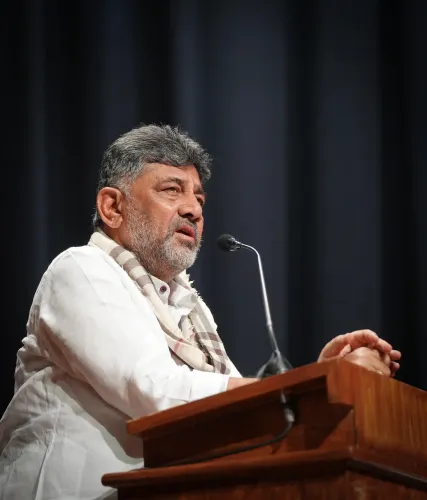
Bengaluru, March 6 (NationPress) Karnataka's Chief Minister Siddaramaiah declared on Friday that the Supreme Court's dismissal of Tamil Nadu's petitions against the contentious Mekedatu project signifies a major legal triumph for the state. He assured that the government would promptly advance with the subsequent phases of this long-awaited initiative.
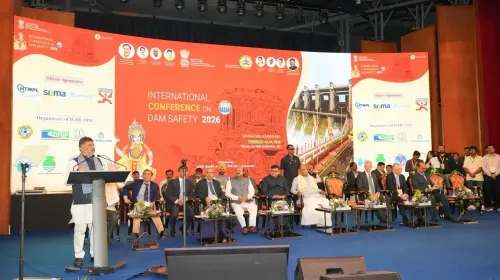
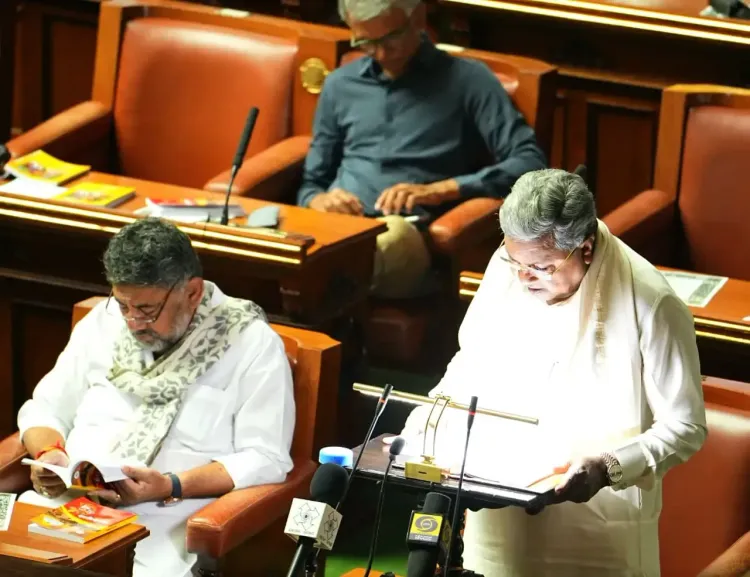
In his presentation of the 2026-27 state Budget to the Legislative Assembly, CM Siddaramaiah revealed plans to draft a revised Detailed Project Report (DPR) for the Mekedatu project, which will be submitted to the Central Government for endorsement, including requests for the use of forest land.
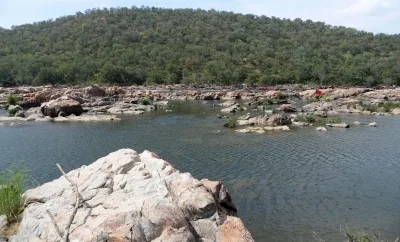
The Mekedatu Project is an envisioned ₹9,000-crore balancing reservoir and drinking water initiative on the Cauvery River in the Ramanagara district of Karnataka. Its objective is to provide 4.75 TMC of drinking water to Bengaluru and generate 400 MW of electricity.
Additionally, CM Siddaramaiah highlighted the advancements in the Yettinahole Integrated Drinking Water Project, noting that the initial phase of lift irrigation has been successfully inaugurated. The second phase, which involves the completion of 18.73 km of canal works, is on track for swift completion. A balancing reservoir with a 1.2 TMC capacity will also be constructed near Vaderahalli in Koratagere taluk to effectively store and use surplus water.
The Yettinahole Project is an ambitious ₹23,251 crore initiative aimed at redirecting 24.01 TMC of water from western streams (Yettinahole, Kadumanehole, Kerihole, Hongadahalla) in the Western Ghats to drought-affected districts like Kolar and Chikkaballapur, which are in proximity to Bengaluru.
CM Siddaramaiah also took a stand against the Centre for not following through on its budget announcement regarding the Bhadra Upper Bank Project. He criticized the Union Government for its failure to implement the ₹5,300 crore allocation from the 2023–24 Budget speech, although the Karnataka government has already invested ₹11,343 crore from its resources into the project.
Furthermore, he mentioned the resolution of a long-standing land dispute at Abbinahole village in Ajjampura taluk, which had persisted for nearly six years. This resolution will enable the completion of the 135-km Chitradurga branch canal and its feeder projects by 2027, facilitating water supply to 157 tanks.
The Upper Bhadra Project is a significant ongoing lift irrigation scheme in central Karnataka, targeting to irrigate 2,25,515 hectares and fill 367 tanks in drought-prone areas like Chikmagalur, Chitradurga, Tumkur, and Davangere. With a revised cost exceeding ₹21,000 crore, it is the first project in Karnataka to receive national project status, featuring a 29.9 TMC lift from the Bhadra reservoir.
Highlighting irrigation advancements in North Karnataka, CM Siddaramaiah mentioned that under the Upper Krishna Project (UKP) Stage-III, plans are underway to raise the height of the Almatti dam from 519.6 metres to 524.256 metres.
The government has approved revised compensation rates for land acquisition necessary for the project and associated canal networks, setting compensation at ₹30 lakh per acre for dry land and ₹40 lakh for irrigated land. The process for negotiated land acquisition settlements is slated to commence this year.
The Karnataka government aims to elevate the Almatti Dam from 519.6 metres to 524.256 metres, increasing its storage capacity from 123 TMC to 300 TMC. This Phase-3 initiative intends to irrigate 5.94 lakh hectares, although it meets substantial opposition from Maharashtra and Telangana over concerns of flooding and reduced downstream water supply.
Additionally, CM Siddaramaiah announced that the replacement of 33 deteriorated gates at the Tungabhadra dam would be finalized before the monsoon season. To combat the reduction of storage capacity due to silt buildup in the reservoir, the government is exploring various options, including constructing a balancing reservoir near Navali in Koppal district.
CM Siddaramaiah noted that discussions will occur with neighboring Andhra Pradesh and Telangana, aiming for a feasible alternative with the agreement of the Tungabhadra Board.
Regarding the Kalasa-Banduri Nala projects in the Mahadayi basin, he mentioned that the state has consistently sought forest clearance from the Union Ministry of Environment and the National Board for Wildlife for the past two years, but approval is still pending.
He remarked that contracts for these projects have already been awarded, and construction will commence immediately upon receiving the necessary forest clearances from the Centre. The delays in approvals are adding to the financial strain on the state government, he added.
The Kalasa-Banduri Project represents a long-standing effort by the Karnataka government to channel water from the tributaries of the Mahadayi River (Kalasa and Banduri) into the Malaprabha River basin, aiming to provide drinking water to the arid districts of Belagavi, Dharwad, Bagalkot, and Gadag.
Point of View
Alongside other irrigation initiatives, is essential for the state's sustainable development. While the legal victory is noteworthy, it remains crucial to monitor the project's implementation and its potential impact on regional water disputes.
NationPress
27 Sept 2026
Frequently Asked Questions
What is the Mekedatu project?
The Mekedatu project is a proposed ₹9,000-crore balancing reservoir and drinking water project on the Cauvery River, aimed at supplying 4.75 TMC of drinking water to Bengaluru and generating 400 MW of power.
What did CM Siddaramaiah announce regarding water projects?
CM Siddaramaiah announced the progress of the Mekedatu project and the Yettinahole Integrated Drinking Water Project, among other irrigation initiatives, to enhance water supply in Karnataka.
Why was there opposition to the Mekedatu project?
The Mekedatu project faced opposition from Tamil Nadu, which filed petitions against it, citing concerns over water sharing and regional disputes.
What is the Upper Bhadra Project?
The Upper Bhadra Project is a major lift irrigation scheme in central Karnataka aimed at irrigating 2,25,515 hectares and filling 367 tanks in drought-prone districts.
What are the expected outcomes of the Yettinahole Project?
The Yettinahole Project aims to divert water from western streams to drought-prone districts, ensuring a more reliable water supply for areas near Bengaluru.