Katihar Station Confrontation Highlights Coordination Failures in Bihar's Liquor Ban
Synopsis
An altercation between the Excise Department and the GRP at Katihar Railway Station raises critical questions about the enforcement of Bihar's liquor prohibition. The incident underscores the need for better communication and coordination among enforcement agencies.
Key Takeaways
Incident at Katihar Railway Station exposes coordination issues.
Excise Department and GRP clash due to lack of communication.
Importance of better cooperation among enforcement agencies.
Katihar's location makes it a sensitive area for liquor smuggling.
Future raids will involve improved coordination .
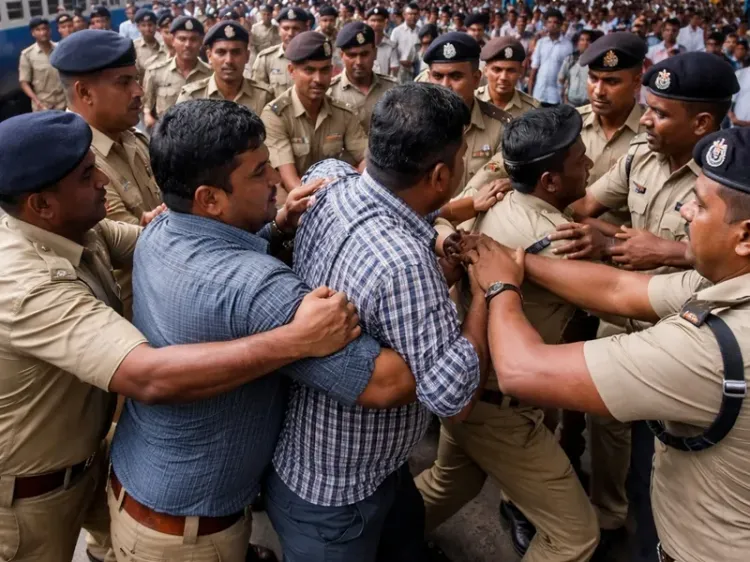
Patna, March 20 (NationPress) An unexpected confrontation at Katihar Railway Station has unveiled significant coordination issues between enforcement bodies in Bihar, where strict prohibition laws are in place. A team from the Excise Department, acting on a credible tip-off regarding the transport of liquor via the Haate Bazaar Express, arrived at the station to initiate a raid.
However, the situation quickly deteriorated into chaos as a physical altercation ensued between the Excise personnel and the Government Railway Police (GRP).
A video capturing the alleged misconduct towards the excise officials has rapidly gained traction online.
Excise officials stated that they acted on urgent intelligence and were unable to notify the GRP beforehand due to time constraints.
This lack of communication led to distrust among railway police officers.
Subhash Singh, Excise Superintendent, commented: “We had specific intelligence about liquor being unloaded. Due to the urgency of the situation, we couldn't provide prior notice. This matter has now been discussed with higher authorities, and future operations will be better coordinated.”
Conversely, Railway DSP Arun Kumar Akela described the event as a misunderstanding, emphasizing that: “We were not informed in advance. The team was in plain clothes, which raised suspicion. An investigation is underway, and necessary actions will be taken.”
Both the GRP and the Excise Department have launched a joint investigation into the incident.
Officials from both agencies have recognized that improved communication is vital to prevent such clashes in the future.
This incident has ignited a broader discussion. If enforcement agencies cannot effectively collaborate, it raises serious concerns regarding the enforcement of prohibition laws.
Katihar, a significant railway junction near the West Bengal border, is viewed as a sensitive area for liquor smuggling routes.
This incident not only highlights a singular altercation but also points to a larger issue of coordination, communication, and accountability among enforcement agencies.
For the enforcement of prohibition to succeed in Bihar, seamless collaboration between departments may be just as essential as rigorous execution.
Point of View
It is imperative to view this incident through a lens of accountability and efficiency. The clash between the Excise team and GRP not only reflects a breakdown in communication but also poses significant questions about the efficacy of prohibition enforcement in Bihar. A collaborative approach among agencies is essential for the success of these laws.
NationPress
22 Sept 2026
Frequently Asked Questions
What caused the altercation at Katihar Railway Station?
The altercation occurred due to a lack of communication between the Excise Department and the Government Railway Police, resulting in a misunderstanding during a raid on suspected liquor transport.
What are the implications of this incident for liquor prohibition in Bihar?
This incident highlights serious coordination issues among enforcement agencies, raising concerns about the effectiveness of prohibition laws in Bihar.
What steps are being taken to prevent such incidents in the future?
Both the Excise Department and GRP have acknowledged the need for better communication and are planning future operations with improved coordination.
Why is Katihar considered sensitive for liquor smuggling?
Katihar is a major railway junction located near the West Bengal border, making it a critical point for liquor smuggling routes.
What was the reaction from the Excise Superintendent regarding the incident?
Excise Superintendent Subhash Singh stated that urgent intelligence led to the raid without prior notification to the GRP, emphasizing the need for better coordination in future operations.