Thunchan Smrithi: Kerala Lok Bhavan opens 10,000-book public library
Synopsis
A collection of more than 10,000 books — long scattered across Lok Bhavan's corridors — has been given a public identity. Named after the father of Malayalam literature, Thunchan Smrithi is Kerala's newest attempt to turn an institutional archive into a living cultural resource, and the Governor's ambition to grow it into a full knowledge centre signals this is only the beginning.
Key Takeaways
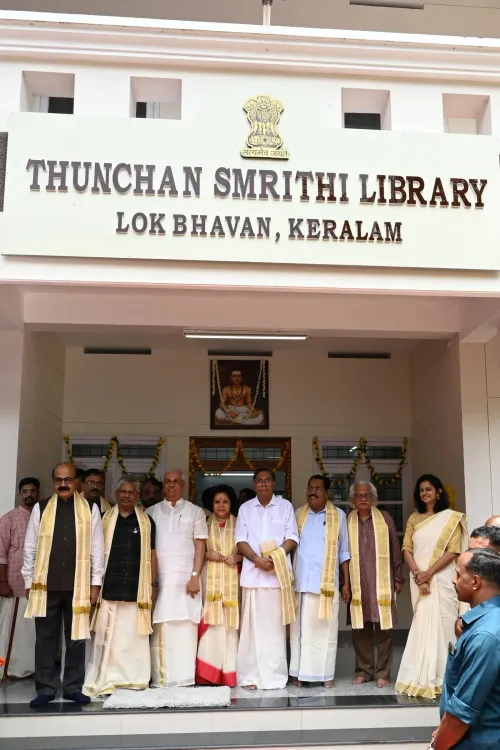
Kerala Governor Rajendra Vishwanath Arlekar inaugurated Thunchan Smrithi at Lok Bhavan , Thiruvananthapuram , on 21 August .
The library houses more than 10,000 books — over 4,000 in Malayalam and around 6,000 in English , plus works in other Indian languages.
It is named after Thunchath Ramanujan Ezhuthachan , widely regarded as the father of the Malayalam language and literature.
The collection, previously dispersed across Lok Bhavan, has been consolidated, catalogued and housed in a new building adjacent to the main entrance of Raj Bhavan .
The library is open to readers, researchers, students, teachers and writers, with the Governor's stated goal of developing it into a knowledge and cultural centre.
Kerala Governor Rajendra Vishwanath Arlekar on 21 August inaugurated 'Thunchan Smrithi', a dedicated public library at Lok Bhavan in Thiruvananthapuram, housing more than 10,000 books drawn from the institution's own collection. The library, named after Thunchath Ramanujan Ezhuthachan — widely regarded as the father of the Malayalam language — marks a shift from a dispersed institutional archive to an open knowledge resource for readers, researchers, students, teachers and writers.
What the Library Houses
The collection comprises more than 4,000 Malayalam books and approximately 6,000 English titles, alongside works in several other Indian languages. Subjects span literature, history, culture, philosophy and science. Many of these volumes had previously been stored across different locations within Lok Bhavan; they have now been consolidated, systematically catalogued and housed in a new building adjacent to the main entrance of Raj Bhavan.
The Governor's Vision
Arlekar said the aim was to develop Thunchan Smrithi into a knowledge and cultural centre that reflects Kerala's rich heritage and diversity. He stressed that the books should not remain a preserved institutional collection confined to the Raj Bhavan premises, but should instead be put to meaningful use by society at large.
Voices from Kerala's Literary World
The inauguration drew several of Kerala's prominent literary and cultural figures. Filmmaker Adoor Gopalakrishnan said the decision to name the library after Ezhuthachan was particularly meaningful, given his seminal place in the history of Malayalam language and literature. Poet V. Madhusoodanan Nair expressed hope that the library would grow into an important knowledge centre for scholars and students researching Kerala's history, literature and culture. Writer George Onakkoor noted that the Governor's personal interest in reading, language and regional literature had been a major inspiration behind the initiative. Rosemary added that bringing books, reading and literature together could help create more vibrant cultural spaces.
Significance and What Comes Next
The naming of the library after Ezhuthachan — whose contributions in the 16th century laid the grammatical and literary foundations of modern Malayalam — lends the initiative strong cultural symbolism. This comes amid a broader push across Indian states to make government-held knowledge resources publicly accessible. Arlekar's stated vision of expanding Thunchan Smrithi into a full cultural centre suggests the current inauguration is a starting point rather than a finished project. Scholars and literary organisations are expected to engage with the space as it develops its programming and outreach.
Point of View
However, is whether the space develops active programming — lectures, research fellowships, curated access — or remains a well-catalogued room. Kerala has no shortage of libraries; what it needs are knowledge institutions that generate new scholarship, not merely store old books.
NationPress
5 Oct 2026
Frequently Asked Questions
What is Thunchan Smrithi at Lok Bhavan?
Thunchan Smrithi is a public library inaugurated on 21 August at Lok Bhavan, Thiruvananthapuram, by Kerala Governor Rajendra Vishwanath Arlekar. It houses more than 10,000 books — including over 4,000 Malayalam titles and around 6,000 English works — consolidated from Lok Bhavan's own collection and made accessible to readers, researchers, students, teachers and writers.
Who is the library named after and why?
The library is named after Thunchath Ramanujan Ezhuthachan, a 16th-century scholar widely regarded as the father of the Malayalam language and literature. Filmmaker Adoor Gopalakrishnan noted that the choice of name was particularly meaningful given Ezhuthachan's seminal role in shaping Malayalam's literary and linguistic identity.
Where exactly is the library located?
Thunchan Smrithi is housed in a new building adjacent to the main entrance of Raj Bhavan in Thiruvananthapuram, Kerala. The books were previously stored at various locations within Lok Bhavan before being brought together, catalogued and shifted to this dedicated space.
Who can access the Thunchan Smrithi library?
The library is intended for readers, researchers, students, teachers and writers. Governor Arlekar stated that the books should not remain confined to the Raj Bhavan premises but should be put to meaningful use by society at large.
What subjects and languages does the collection cover?
The collection spans literature, history, culture, philosophy and science. It includes more than 4,000 Malayalam books, around 6,000 English titles, and works in several other Indian languages, built up over the years through gifts and acquisitions by Lok Bhavan.