What Is Khaleda Zia's Complex Legacy and Troubled Relationship with India?
Synopsis
Khaleda Zia's political journey as Bangladesh's first female Prime Minister was marked by significant tensions in India-Bangladesh relations. This article delves into her legacy, her adversarial stance towards India, and the evolving dynamics of diplomacy in the region.
Key Takeaways
Khaleda Zia was the first female Prime Minister of Bangladesh.
Her tenure coincided with turbulent India-Bangladesh relations .
Zia opposed key agreements that she believed compromised Bangladesh's sovereignty.
Her foreign policy included seeking defense cooperation with China .
Her legacy remains a topic of significant discussion and analysis.
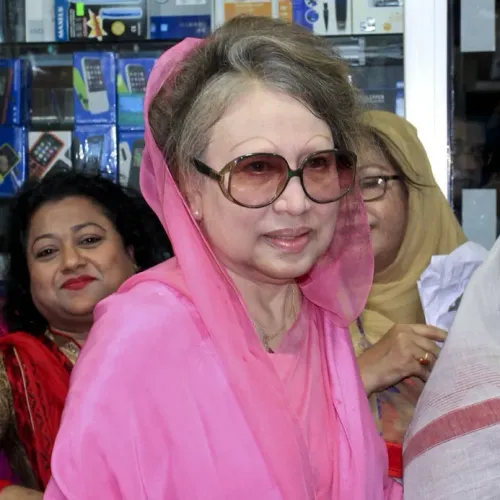
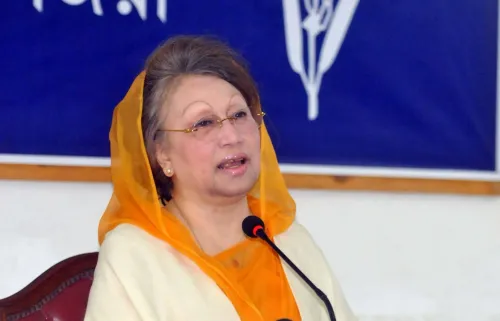
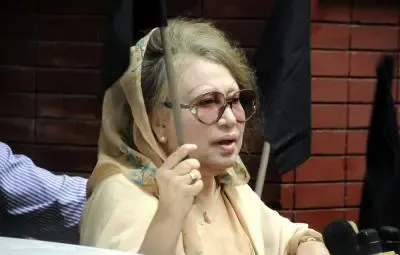
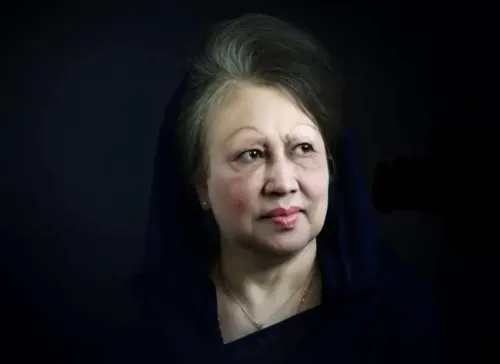
Dhaka, Dec 30 (NationPress) The legacy of Khaleda Zia as the Prime Minister of Bangladesh is intertwined with some of the most tumultuous times in India–Bangladesh relations, characterized by evident friction and numerous lost strategic opportunities between these neighboring countries.
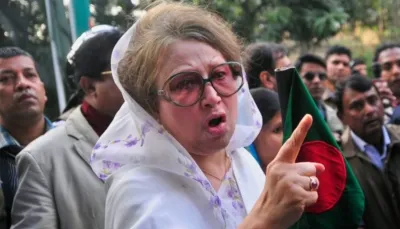
Khaleda Zia, who served as Prime Minister three times and was the long-standing chairperson of the Bangladesh Nationalist Party (BNP), passed away early Tuesday morning at the age of 80 after battling a prolonged illness.
Her demise concludes a political trajectory that has significantly influenced Bangladesh's post-independence narrative for over 40 years.
Emerging from a predominantly private life, she became the country's inaugural female Prime Minister and a pivotal character in its history following independence.
Khaleda Zia was born in 1945 in Jalpaiguri, located in the Greater Dinajpur region of undivided India. Following India's partition, her family relocated to what was then East Pakistan.
In 1960, she married Ziaur Rahman, a captain in the Pakistani Army who later led a rebellion against Pakistani forces during the 1971 Bangladesh Liberation War.
Ziaur Rahman subsequently became the President of Bangladesh in 1977 and established the BNP in the subsequent year.
After Ziaur Rahman's assassination on May 30, 1981, the BNP faced a significant crisis, leading senior leaders and party members to encourage Khaleda Zia to step into a leadership role.
She was appointed Vice-President of the party on January 12, 1984, and was elected chairperson on May 10 of the same year, maintaining her role through successive party councils in 1993, 2009, and 2016, culminating in a nearly 41-year leadership tenure.
Following the BNP's victory in the 1991 parliamentary elections, she was inaugurated as Bangladesh's first female Prime Minister.
She was re-elected for a second consecutive term after the controversial 1996 elections, which were boycotted by major opposition parties.
Her third term commenced on October 10, 2001.
During her initial years in office, Khaleda Zia took a cautious, often adversarial stance towards New Delhi, which influenced bilateral relations for over a decade.
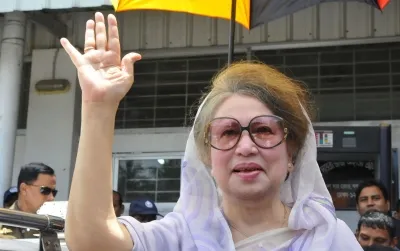
Zia consistently opposed transit and connectivity initiatives with India, both during her prime ministership and later as Leader of the Opposition, a position she held twice between 1996 and 2014.
As Prime Minister, she categorically denied India transit rights through Bangladeshi territory to access its northeastern states, asserting that such agreements would endanger Bangladesh's security and sovereignty.
Moreover, she claimed that allowing Indian trucks to operate on Bangladeshi roads without tolls amounted to “slavery.”
Her opposition extended to diplomatic agreements as well.
Zia was against the renewal of the 1972 Indo-Bangladesh Friendship Treaty, considered crucial from a military perspective by strategic analysts.
She contended that the treaty had “shackled” Bangladesh and limited its autonomy.
Positioning her BNP as a “guardian of Bangladesh's interests,” Zia repeatedly framed her policies as a defense against what she termed Indian domination.
This rhetoric persisted even in later years. At a rally in Dhaka in 2018, while Sheikh Hasina served as Prime Minister and Zia as Leader of the Opposition, she criticized Hasina for exempting India from transit duties.
Another significant source of discord during Zia's administration was India's Farakka Barrage, operational since 1975 to redirect water from the Ganges into the Hooghly River via a feeder canal.
While the barrage aids in reducing silt, enhances navigability around Kolkata Port, and provides fresh water to the city, Zia argued that it robbed Bangladesh of its rightful share of Ganges water.
In 2007, she accused India of deliberately opening sluice gates to exacerbate flooding in Bangladesh.
Her foreign policy decisions further intensified tensions.
In 2002, Zia actively sought defense cooperation with China.
India perceived this as a direct strategic challenge and responded with increased diplomatic pressure, including accusations that the BNP government was harboring separatist groups and terrorists active in India's northeastern states.
Zia had previously labeled insurgent groups like ULFA and NSCN as “freedom fighters.”
During her tenure, India alleged that anti-India terrorist organizations operated freely within Bangladeshi territory. The 2004 Chittagong arms haul, intended for Indian insurgents, incidents of minority violence in Bangladesh, and a near-total lack of cooperation on counter-terrorism efforts further deteriorated relations.
Relations began to improve only after Zia left office. However, her attitude towards India demonstrated signs of change after 2012 when she visited Delhi to meet then-Prime Minister Manmohan Singh.
During this visit, she vowed that any future BNP administration would take action against terrorist groups utilizing Bangladeshi soil to target India. This trip, made at India's invitation, was largely interpreted as a strategic shift in BNP's approach ahead of the 2014 elections.
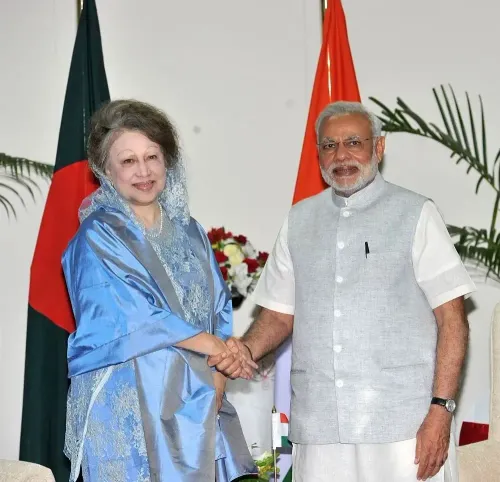
This outreach continued post-2014, including meetings with Prime Minister Narendra Modi.
PM Modi met Zia in Dhaka in June 2015 during his Bangladesh visit while she was serving as Leader of the Opposition.
Despite these interactions, underlying tensions remained.
Between 2016 and 2024, Zia frequently reverted to anti-India rhetoric, accusing New Delhi of supporting authoritarianism and highlighting unresolved matters like border killings.
These stances sharply contrasted with the more conciliatory strategies adopted by Sheikh Hasina's Awami League.
A significant thaw was observed after August 2024, following Sheikh Hasina's ousting, when the BNP indicated a commitment to “equal and respectful” relations with India while distancing itself from the Islamist Jamaat-e-Islami.
Thus, Khaleda Zia's political narrative remained characterized by confrontation and a complex engagement with Bangladesh's most significant neighbor.
Point of View
It is crucial to recognize Khaleda Zia's profound impact on Bangladesh's political landscape and its relations with India. While her legacy is multifaceted, it is evident that her policies and rhetoric significantly shaped the dynamics between these neighboring countries, contributing to ongoing discussions about sovereignty, security, and regional cooperation.
NationPress
11 Oct 2026
Frequently Asked Questions
What was Khaleda Zia's political significance?
Khaleda Zia was Bangladesh's first female Prime Minister and a pivotal figure in shaping the country's post-independence narrative over four decades.
How did Khaleda Zia's policies affect India-Bangladesh relations?
Zia's adversarial stance towards India during her tenure led to significant tensions and missed opportunities for strategic collaboration.
What was the Indo-Bangladesh Friendship Treaty?
The 1972 treaty is viewed as crucial for military cooperation, which Zia opposed, arguing it compromised Bangladesh's sovereignty.
What role did Zia's foreign policy play?
Zia's pursuit of defense ties with China was seen as a strategic challenge by India, further complicating bilateral relations.
How has Zia's legacy been viewed over time?
While her legacy is complex and contentious, it is marked by significant contributions to Bangladesh's political landscape and its foreign relations.