Is the Rapid Rise of Quick-Commerce Threatening Kirana Shops' Income?
Synopsis
The rise of quick-commerce platforms like Blinkit and Zepto is severely impacting local kirana shops in India, threatening their income and livelihood. The Federation of Retailer Association of India (FRAI) calls for government intervention to protect these businesses and ensure fair competition in the evolving market.
Key Takeaways
Many kirana shops are closing due to competition from quick-commerce platforms.
FRAI represents around 80 lakh small retailers in India.
Government intervention is needed to support small businesses.
Quick-commerce platforms are altering consumer behavior significantly.
Local kirana shops are vital to community commerce.
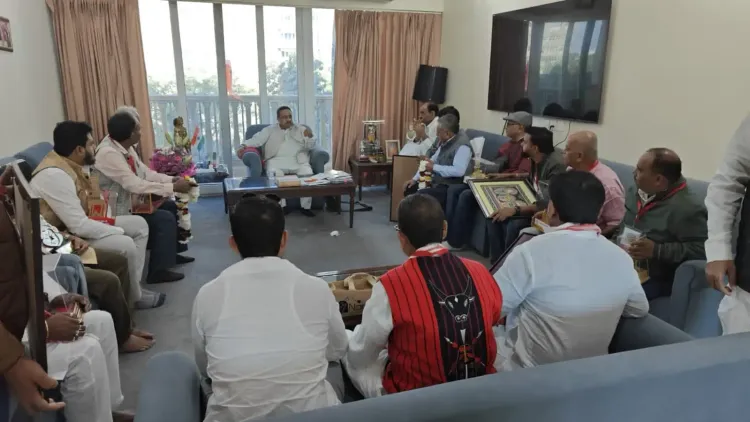
New Delhi, Dec 10 (NationPress) The swift expansion of e-commerce and quick-commerce platforms in India is leading to a significant drop in income and livelihoods for numerous local grocery and kirana shop proprietors, stated the Federation of Retailer Association of India (FRAI) on Wednesday.
The federation represents approximately 80 lakh micro, small, and medium retailers across the nation, comprising 42 retail associations. They urged the government to recognize the immediate necessity for enhanced support for small retailers who are confronting an existential crisis due to the increasing influence of e-commerce and quick commerce.
According to FRAI, market research indicates that around two lakh Kirana stores shut down last year as consumers gravitated towards quick commerce services like Blinkit and Zepto.
Moreover, a December 2024 study conducted by JP Morgan on offline grocery stores in Mumbai revealed that 60 percent of these stores experienced a downturn in sales volume due to the rapid proliferation of dark stores operated by quick commerce platforms.
In recent years, digital platforms have transformed consumer habits through substantial discounts, promises of rapid delivery, and aggressive promotional efforts, leaving small retailers struggling to compete on an uneven playing field. Consequently, many kirana shops are experiencing severe declines in foot traffic and sales, according to FRAI.
“Small retailers and kirana shopkeepers are facing an unparalleled challenge as e-commerce and quick-commerce platforms reshape the market landscape. These family-run businesses, established over generations, are now fighting for survival against competitors with substantial financial resources and assertive marketing strategies,” noted Abhay Raj Mishra, Member and National Coordinator, Indian Sellers Collective and Honorary Spokesperson for FRAI.
He emphasized the necessity for government intervention to cultivate a fair, competitive marketplace and equip local retailers with the appropriate technology. Compounding the issue is the way that large, frequently foreign-funded e-commerce and quick-commerce enterprises interact with the small-retailer ecosystem.
Instead of enabling shop owners to expand their independent businesses, many of these platforms are relegating them to roles as delivery personnel or last-mile service agents. This transition undermines and diminishes entrepreneurship, transforming once-independent proprietors into gig-economy workers with unpredictable incomes and minimal protections.
“Given this concerning trend, an urgent demand exists for a well-structured support model that safeguards the interests of small retailers and local entrepreneurs,” FRAI pointed out.
Without timely intervention, the backbone of India’s informal retail sector is at risk of collapse, jeopardizing the livelihoods of millions of small-scale shop owners who have historically been central to community commerce.
At the event held here, retailers called on the government to provide local Kirana stores with a dedicated technology platform to enable them to compete on equal terms with quick-commerce firms. They acknowledged the rising consumer demand for faster delivery, enhanced convenience, and competitive pricing and expressed their willingness to adopt digital tools to boost efficiency and improve customer service.
Point of View
It is clear that the rise of quick-commerce poses a significant challenge to traditional kirana shops. While innovation and convenience are essential in our fast-paced world, the government must ensure that small retailers are not left behind in this digital transformation. Supporting these businesses is crucial for maintaining community commerce and economic stability.
NationPress
30 Sept 2026
Frequently Asked Questions
What is quick-commerce?
Quick-commerce refers to rapid delivery services provided by e-commerce platforms that promise to deliver goods to consumers within a very short timeframe, typically within an hour.
How are kirana shops affected by quick-commerce?
Kirana shops are experiencing a decline in customer footfall and sales as consumers prefer the convenience of quick-commerce platforms, leading to a significant loss of income for these small retailers.
What measures is FRAI suggesting for small retailers?
FRAI is urging the government to provide stronger support for small retailers, including the development of dedicated technology platforms that would allow them to compete fairly with quick-commerce companies.
What is the significance of kirana shops in India's economy?
Kirana shops play a crucial role in India’s informal retail economy, providing employment and serving as vital community hubs for commerce.
What can be done to support kirana shop owners?
Government intervention is essential to create a competitive environment, provide technological support, and protect the interests of small retailers against the overwhelming presence of large e-commerce platforms.