MoES Secretary visits Maitri Station in Antarctica to review polar operations
Synopsis
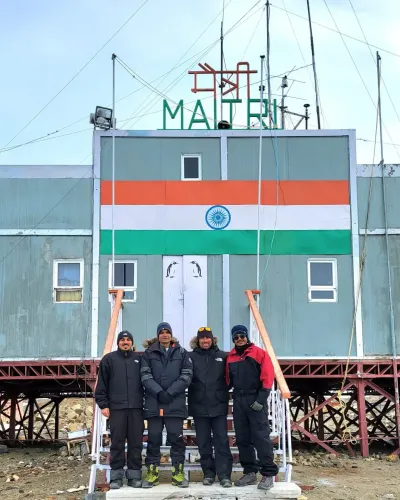
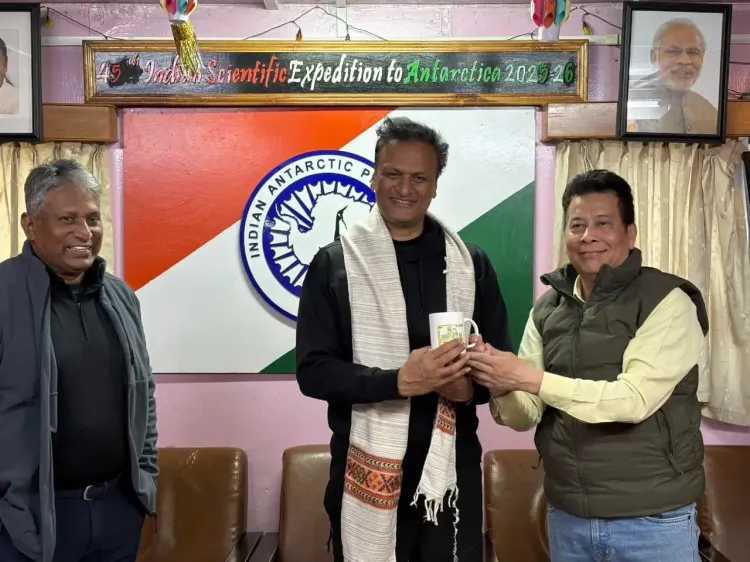
India's top earth sciences official visited the Maitri Research Station in Antarctica — a base operational since 1989 and capable of hosting 25 scientists — to review conditions and engage with the stationed team. The visit by MoES Secretary Srinivas Kumar Tummala signals that India's Antarctic programme is receiving renewed senior-level policy attention.
Key Takeaways
MoES Secretary Srinivas Kumar Tummala visited India's Maitri Research Station in Antarctica to review operational conditions and meet stationed researchers.
The delegation included S.
Gopal Krishna (Joint Secretary, IFD) and Shailendra Saini (Group Director, Antarctic Operations).
Maitri was established in 1989 , named by former PM Indira Gandhi , and can accommodate nearly 25 personnel .
The station is located in the Schirmacher Oasis, Queen Maud Land , and supports studies across atmospheric, chemical, biological, earth, and medical sciences.
Lake Priyadarshini , one of nearly 40 nearby lakes , serves as the station's primary freshwater source; Russia's Novolazarevskaya Station is roughly 5 km away.
The visit, per NCPOR , reaffirmed India's commitment to advancing polar science and strengthening its Antarctic research capabilities.
Ministry of Earth Sciences (MoES) Secretary Srinivas Kumar Tummala visited India's Maitri Research Station in Antarctica as part of an official delegation, reviewing operational conditions and interacting with researchers and scientists stationed at the base. The visit, confirmed by the National Centre for Polar and Ocean Research (NCPOR), underscores India's continued commitment to strengthening its polar science programme.
Who Was in the Delegation
Tummala was accompanied by S. Gopal Krishna, Joint Secretary, Integrated Finance Division (IFD), MoES, and Shailendra Saini, Group Director (Antarctic Operations). The delegation inspected the facility and held discussions with the Indian contingent that had arrived at the base earlier this month.
An oceanographer by training, Tummala previously headed the Indian Ocean Tsunami Warning and Mitigation System (IOTWMS) Secretariat under the UNESCO Intergovernmental Oceanographic Commission in Perth, Australia, before taking charge as MoES Secretary earlier this year. During the visit, he shared technical insights with the deployed team.
About Maitri Research Station
Established in 1989 by a designated team of the Indian Army, Maitri is India's second Antarctic research base, following Dakshin Gangotri, which was set up in 1983. The station was named by former Prime Minister Indira Gandhi. Built of wooden logs, it can accommodate nearly 25 personnel at a time and supports multi-disciplinary studies spanning atmospheric, chemical, biological, earth, and medical sciences.
Situated in the rocky Schirmacher Oasis in Queen Maud Land, the station is equipped with a GPS station, a seismometer, a meteorological monitoring station, and an analytical laboratory, along with living amenities designed to withstand Antarctica's harsh climate.
Key Infrastructure and Surroundings
Of the nearly 40 lakes in the surrounding area, Lake Priyadarshini — located directly opposite the station — serves as the primary freshwater source for the expedition team. Russia's Novolazarevskaya Station is situated roughly five kilometres away, and a nearby airfield jointly serves both the Indian and Russian bases. While parts of Antarctica draw tourists, entry to research stations such as Maitri remains restricted.
What the Visit Signals
According to NCPOR, which oversees India's Antarctic Programme, the high-level visit reaffirmed the country's intent to advance polar science and bolster its research and operational capabilities in the region. Notably, this comes as India continues to deepen its scientific footprint across both polar regions, with ongoing work at its Arctic base as well. The visit signals sustained institutional attention to India's Antarctic assets at the senior policy level.
Point of View
Not the secretary rank. That Tummala, an oceanographer with a UNESCO background, made the trip personally suggests MoES may be reassessing the station's scientific mandate or its operational readiness ahead of budget cycles. India's polar ambitions have grown on paper — a third Antarctic base, Bharati, is in operation since 2012 — but the gap between headline announcements and ground-level infrastructure at these remote outposts has historically been wide. Whether this visit translates into a concrete resource push or remains a symbolic reaffirmation is the real question NCPOR's next annual report will need to answer.
NationPress
19 Nov 2026
Frequently Asked Questions
Why did the MoES Secretary visit Maitri Research Station in Antarctica?
MoES Secretary Srinivas Kumar Tummala visited Maitri to review operational conditions and interact with the Indian scientific contingent stationed there. According to NCPOR, the visit reaffirmed India's commitment to advancing polar science and strengthening its Antarctic research capabilities.
What is Maitri Research Station and when was it established?
Maitri is India's second Antarctic research base, established in 1989 by a designated Indian Army team. Located in the Schirmacher Oasis in Queen Maud Land, the station was named by former Prime Minister Indira Gandhi and can accommodate nearly 25 personnel at a time.
What scientific work does Maitri Station support?
Maitri supports multi-disciplinary research spanning atmospheric, chemical, biological, earth, and medical sciences. The station is equipped with a GPS station, a seismometer, a meteorological monitoring station, and an analytical laboratory.
Who oversees India's Antarctic programme?
The National Centre for Polar and Ocean Research (NCPOR) oversees India's Antarctic Programme, including the Maitri Research Station. NCPOR confirmed the high-level delegation visit and its significance for India's polar science ambitions.
What is the significance of Lake Priyadarshini near Maitri Station?
Lake Priyadarshini, situated directly opposite Maitri station, serves as the primary freshwater source for the expedition team. It is one of nearly 40 lakes in the surrounding Schirmacher Oasis area.