Is Mohan Bhagwat Advocating for a ‘Swadeshi’ Economic Model?
Synopsis
RSS Chief Mohan Bhagwat champions a 'Swadeshi' economic framework, emphasizing voluntary global interdependence free from coercion. His vision promotes local production while balancing self-reliance, environmental sustainability, and traditional values, urging families to prioritize Indian languages and products.
Key Takeaways
Promotes local production and self-reliance.
Encourages sustainable practices and environmental ethics.
Advocates for the use of traditional languages and attire.
Stresses the importance of family discussions on cultural values.
Urges mindful consumption to support the local economy.
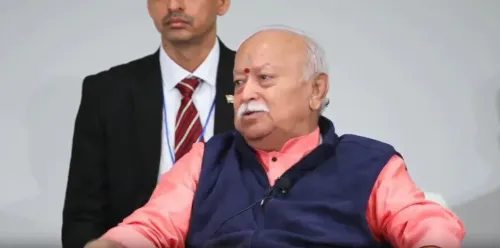
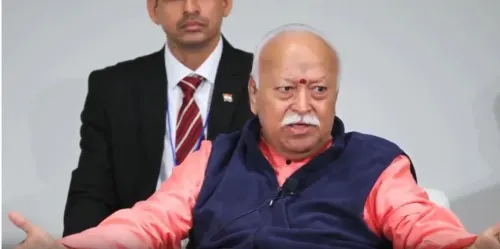
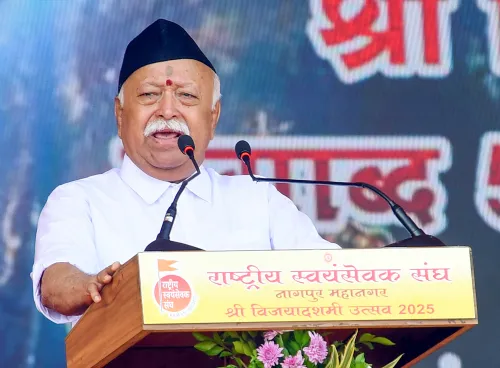
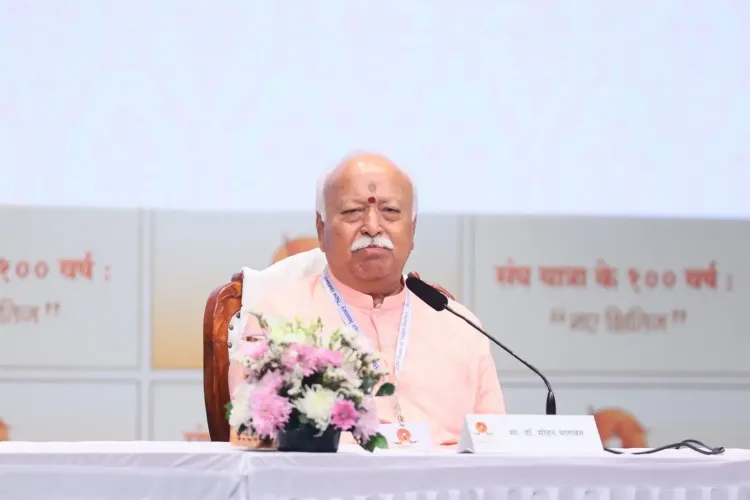
Mumbai, Feb 7 (NationPress) RSS Chief Mohan Bhagwat strongly advocated for a "Swadeshi" economic framework on Saturday, asserting that while global interdependence is a reality, it should be voluntary and devoid of coercion, rather than stemming from trade conflicts or tariff-induced pressures.
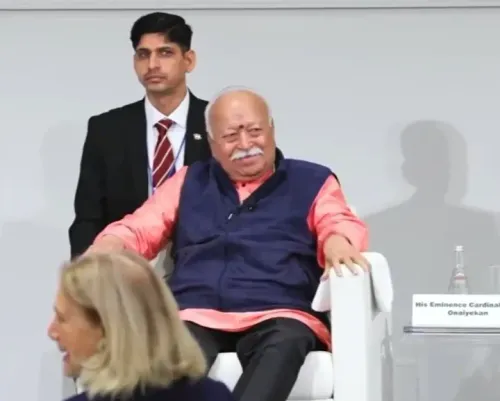
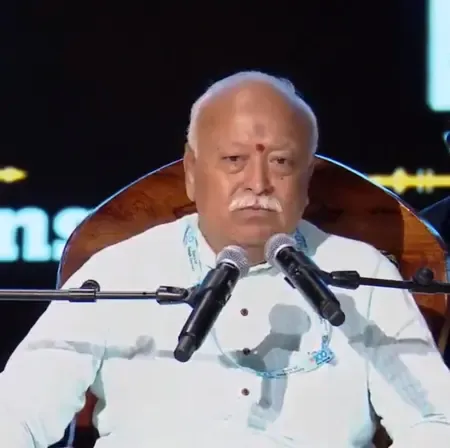
Speaking at the two-day New Horizons lecture series commemorating the RSS Centenary Year, Bhagwat addressed an audience of over 900 distinguished guests, including actors Salman Khan and Ranbir Kapoor, alongside notable scientists, industrialists, and artists.
He highlighted that international commerce should occur based on a nation’s own decisions. While acknowledging the world's inherent interdependence, he cautioned against it devolving into "helplessness" or "compulsion." This statement was a clear reaction to the rising trend of tariff escalations, particularly from the US, which he claimed are frequently employed as pressure tactics. Bhagwat clarified that Swadeshi does not equate to isolationism or a complete ban on imports, but rather follows a straightforward hierarchy that prioritizes local goods, selective imports, and the safeguarding of livelihoods.
“If items can be produced in your own village or country, refrain from purchasing them from overseas. Import only what is essential for life and cannot be made domestically. Procuring goods that are readily available locally "damages local vendors" and the domestic economy,” he stated.
Bhagwat proposed a development model that harmonizes three core elements: self-reliance, environmental sustainability, and Dharma-based economics. He encouraged families to embrace fundamental "Swadeshi" practices in their daily lives, which encompass Bhasha (Language), Bhusha (Attire), Bhraman (Tourism), Bhojan (Food), and Bhavan (Home/Living). “Utilize your mother tongue or native Indian languages at home,” he urged.
The RSS chief recommended minimizing the dependence on foreign languages for everyday family communication. He stressed the importance of choosing Indian garments and traditional attire, asserting that donning "Swa" (self-originating) clothing supports local weavers and the domestic textile sector.
“Explore Indian locales and heritage sites before considering journeys abroad. Design your home in accordance with Indian traditions and environmental ethics,” he advised.
Bhagwat encouraged families to explore domestic spiritual and cultural landmarks to preserve the "country's wealth within its borders." He famously illustrated the "Shikanji vs Cola" analogy to elucidate Swadeshi at the dining table. “If a drink like lemonade (Shikanji) can be prepared at home, there is no need to purchase foreign carbonated soft drinks,” he remarked.
The RSS chief championed the use of products made in one's own village, city, or state. “If a product is accessible locally, purchasing a foreign brand is considered detrimental to the local vendor,” he noted. Advocating for environmental Swadeshi, he urged families to cut down on plastic use and revert to traditional, sustainable Indian household practices.
Bhagwat underscored the significance of regular "family dialogues" to shield children from being swayed by "unfamiliar" or "foreign" ideologies that do not resonate with Indian values. He contrasted Indian familial values with Western ones, asserting that in Bharat, a woman’s status is anchored in the "nurturer" role (Matri Shakti), which ought to be honored at home as society's foundation.
The RSS president’s message was “Innovate for Bharat, produce in Bharat, and let the world come to you. Our prosperity should be constructed on our own strengths (Swa-shakti), so that even if the world closes its doors, Bharat continues to flourish.”
Point of View
It is vital to recognize the significance of Mohan Bhagwat's message for a 'Swadeshi' economic model. This approach not only seeks to enhance national self-reliance but also encourages sustainable practices. By resonating with traditional Indian values, it paves the way for a balanced economic framework that prioritizes local industries, fostering growth even in the face of global challenges.
NationPress
5 Oct 2026
Frequently Asked Questions
What is the 'Swadeshi' economic model advocated by Mohan Bhagwat?
The 'Swadeshi' economic model promotes prioritizing local production and selective imports while advocating for self-reliance and environmental sustainability.
What does Bhagwat say about imports?
He suggests importing only essential goods that cannot be produced domestically, emphasizing that buying local supports the economy.
How does Bhagwat propose families adopt 'Swadeshi' practices?
He encourages families to use local languages, wear traditional attire, and prefer local products, fostering cultural integrity.
What are the three pillars of the development model Bhagwat discusses?
The three pillars include self-reliance, environmental sustainability, and Dharma-based economics.
What is the significance of family dialogues according to Bhagwat?
Regular family dialogues are essential to prevent children from adopting foreign ideologies that conflict with Indian values.