How Many MSMEs Have Been Supported by Export Facilitation Centres from 2022-23 to 2024-25?
Synopsis
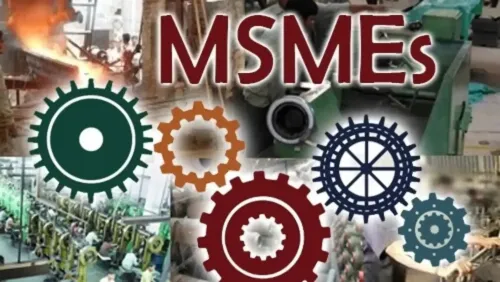
Discover the significant support extended to MSMEs through Export Facilitation Centres, aiding 11,222 businesses from 2022-23 to 2024-25. This initiative offers crucial mentorship and resources to enhance the export ecosystem, ensuring MSMEs thrive in global markets.
Key Takeaways
11,222 MSMEs have been assisted through EFCs.
65 Export Facilitation Centres are operational across India.
The Trade Connect ePlatform offers vital trade information.
The EPM framework enhances the export ecosystem.
Third-party evaluations will ensure compliance and effectiveness.
New Delhi, Dec 2 (NationPress) The Parliament revealed on Tuesday that a remarkable 11,222 MSMEs have received support from Export Facilitation Centres throughout the nation from 2022-23 to 2024-25. The Ministry of Micro, Small and Medium Enterprises has set up 65 Export Facilitation Centres (EFCs) nationwide to offer MSMEs crucial mentoring, guidance, and handholding assistance for exporting their products and services, as stated by Minister of State for Commerce and Industry, Jitin Prasada, in a written response during the Lok Sabha session.
Moreover, the Directorate General of Foreign Trade (DGFT) has introduced the Trade Connect ePlatform as a digital tool aimed at providing exporters, including MSMEs, with essential information regarding trade agreements, market requirements specific to different countries, compliance norms, buyer-seller connections, and global e-commerce guidance.
This platform also consolidates resources from the Department of Commerce, Indian Missions overseas, Export Promotion Councils, Commodity Boards, and various other relevant institutions to deliver sector-specific support and knowledge resources, the minister elaborated.
To bolster MSMEs in relation to trade finance, export certifications, export logistics, and accessing international markets in a well-structured manner, the government has approved the Export Promotion Model (EPM) as a comprehensive framework to enhance the overall export ecosystem, stated Prasada.
The EPM offers support through NIRYAT PROTSAHAN, which concentrates on facilitating trade finance for MSME exporters, and NIRYAT DISHA, which provides non-financial assistance, including support for export quality and compliance, market access interventions, logistics facilitation, and measures to build the export ecosystem.
The EPM framework includes provisions for third-party evaluations for monitoring purposes. These evaluations will follow the current Central evaluation guidelines set forth by NITI Aayog, the Department of Expenditure, and other relevant framework instructions regarding independent assessments of Central Sector schemes.
Such provisions aim to guarantee that monitoring, impact assessment, and governance remain aligned with established standards, according to the minister.
Point of View
It is imperative to highlight the government's commitment to supporting MSMEs, which are the backbone of the economy. The establishment of Export Facilitation Centres and the Trade Connect ePlatform demonstrates a proactive approach to enhancing the export capabilities of these enterprises. This initiative not only strengthens the economy but also ensures that MSMEs are equipped to compete on a global scale.
NationPress
21 Sept 2026
Frequently Asked Questions
What are Export Facilitation Centres?
Export Facilitation Centres (EFCs) are established by the Ministry of Micro, Small, and Medium Enterprises to provide support and guidance to MSMEs for exporting their products and services.
How many MSMEs have been supported?
11,222 MSMEs have received support from EFCs from 2022 to 2025 .
What is the Trade Connect ePlatform?
The Trade Connect ePlatform is a digital interface launched by the Directorate General of Foreign Trade to provide exporters with essential information on trade agreements and market requirements.
What is the role of NIRYAT PROTSAHAN?
NIRYAT PROTSAHAN focuses on facilitating trade finance for MSME exporters.
How does the EPM framework support MSMEs?
The EPM framework provides comprehensive support for trade finance, export certifications, and logistics, enhancing the export ecosystem for MSMEs.