NDA Advances Legislative Agenda as PM Modi Calls for Unity on Women's Bill and Delimitation
Synopsis
The NDA pushes forward with significant legislative measures aimed at amending the Constitution and redrawing constituency boundaries, as PM Modi urges against politicizing the Women's Reservation Bill. This pivotal moment in Parliament underscores the urgent need for cooperation across party lines.
Key Takeaways
The Constitution (One Hundred and Thirty-First Amendment) Bill aims to increase Lok Sabha seats to 850.
The Delimitation Bill seeks to redraw constituency boundaries based on population changes.
The women's reservation law is linked to the successful passage of the Delimitation Bill.
The Opposition expresses significant concerns over the impact of these Bills on federal representation.
PM Modi emphasizes the importance of unity across parties for democratic strength.
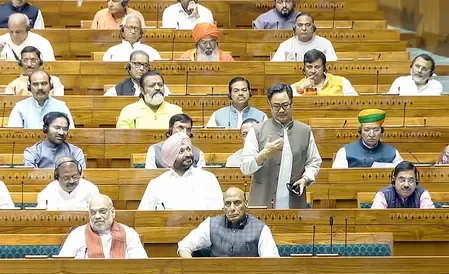
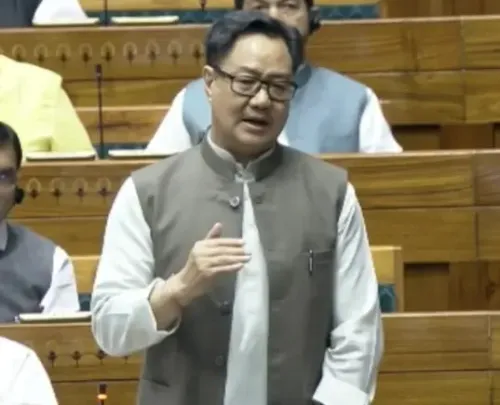
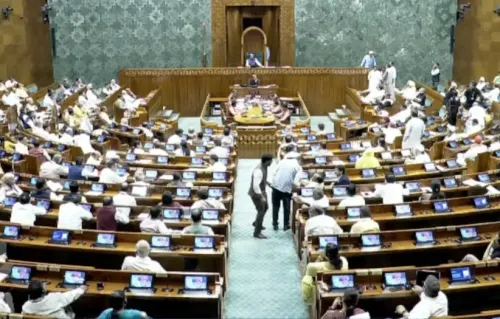
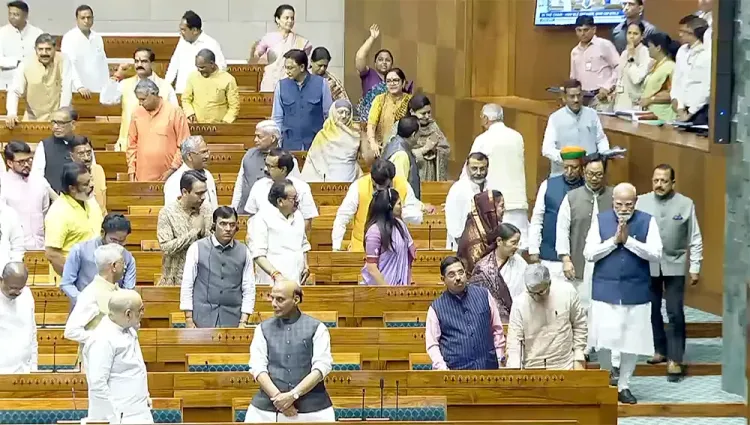
New Delhi, April 16 (NationPress) On Thursday, the Union government commenced discussions on the Constitution (One Hundred and Thirty-First Amendment) Bill, 2026, along with the Delimitation Bill, while Opposition members in the Lok Sabha called for a division prior to this move.
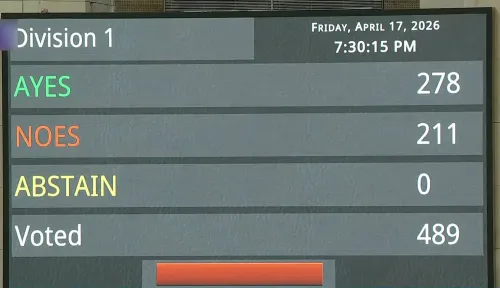
Among the 333 Lok Sabha MPs present, 207 supported and 126 opposed the introduction of the Bill. This has resulted in a significant legislative confrontation within the Lok Sabha as Parliament holds a three-day special session.
For the legislation to pass after the debate, it must receive approval from a minimum of two-thirds of the members present and voting. According to Article 368, barring certain provisions, the Constitution can be amended when the Bill is approved “by a majority of the total membership of that House and by a majority of not less than two-thirds of the members of that House present and voting.”
Afterward, the President will provide assent to the Bill.
The Lok Sabha currently has a strength of 540, with three seats unoccupied. This indicates that if all members participate in the voting on Friday, at least 360 votes are essential for the Bill's passage.
The ruling National Democratic Alliance (NDA) holds approximately 292 seats in the Lok Sabha, maintaining a working majority. The Opposition INDIA bloc and its allies control about 229 seats, while other parties account for 12.
Furthermore, seven independent MPs were elected to the Lok Sabha.
The Bharatiya Janata Party (BJP) is the principal party within the NDA, with 240 members, followed by the Telugu Desam Party with 16 seats, and the Janata Dal (United) with 12.
Within the Opposition bloc, parties with notable representation include Congress with 98 seats, the Samajwadi Party with 37, the Trinamool Congress with 28, and the Dravida Munnetra Kazhagam (DMK) with 22 seats.
This numerical distribution sets the stage for a competitive debate over the Constitution (One Hundred and Thirty-First Amendment) Bill, 2026, the Jammu & Kashmir Laws (Amendment) Bill, 2026, and the Delimitation Bill, 2026, all scheduled for voting in the current special Parliament session.
This Bill aims to increase the Lok Sabha's strength from 543 to 850 seats and is associated with implementing the 33 percent women’s reservation law. Although the women’s reservation law was enacted in 2023, it has not been operationalized due to the necessity for a new delimitation exercise.
The government is now seeking to amend relevant provisions to facilitate its implementation ahead of the 2029 Lok Sabha elections.
The Jammu & Kashmir Laws (Amendment) Bill, 2026, is designed to clarify the assemblies of Delhi, Jammu & Kashmir, and Puducherry, aiming to align representation with the expanded Lok Sabha structure.
The Delimitation Bill, 2026, is intended to redraw constituency boundaries to accurately represent population shifts. The last Census was conducted in 2011, with the next one scheduled for 2021, but it was postponed due to the COVID-19 pandemic.
The Opposition coalition is unified against delimitation, labeling it an “attack on federalism” and warning of disproportionate advantages for Hindi-speaking northern states. Southern states like Tamil Nadu, Kerala, and Telangana strongly oppose it due to concerns over reduced representation compared to northern states such as Uttar Pradesh and Bihar.
The NDA and INDIA bloc have been strategizing their floor coordination to suit their respective agendas.
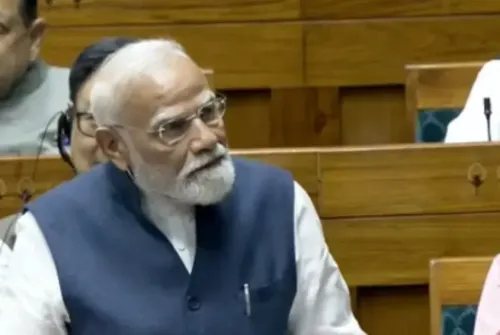
In a statement in the House, Prime Minister Narendra Modi staunchly defended the women’s quota. He challenged the Opposition's claims, urging members to refrain from politicizing the issue.
“Those who resist the women's quota Bill will face repercussions for a long time ahead,” PM Modi stated, emphasizing that if all parties collaborate, the outcome will not favor any single party but will enhance the nation’s democracy.
Frequently Asked Questions
What is the main purpose of the Constitution (One Hundred and Thirty-First Amendment) Bill?
The main objective of this Bill is to expand the Lok Sabha's strength from 543 to 850 seats while operationalizing the 33 percent women’s reservation law.
What does the Delimitation Bill aim to achieve?
The Delimitation Bill intends to redraw constituency boundaries to accurately reflect population changes since the last Census was conducted in 2011.
How many votes are required for the Bill to pass?
For the Bill to pass, it requires at least 360 positive votes if all 540 Lok Sabha members are present.
What are the concerns of the Opposition regarding the Delimitation Bill?
The Opposition is concerned that the Delimitation Bill may disadvantage southern states and is being viewed as an attack on federalism.
Who is the main proponent of the women's quota in Parliament?
Prime Minister Narendra Modi is the leading advocate for the women’s quota in the ongoing discussions.