Is North Korea Right to Accuse South Korea of Drone Incursions?
Synopsis
Tensions escalate as North Korea accuses South Korea of drone incursions, threatening severe consequences. This provocative claim adds to the already strained inter-Korean relations amid ongoing efforts for dialogue. Will diplomatic ties ever mend, or is a standoff imminent? Stay tuned as the situation develops.
Key Takeaways
North Korea claims South Korea violated its airspace with drones.
South Korea denies these accusations, asserting no drone activity occurred.
The situation reflects ongoing tensions between the two Koreas.
North Korea depicts South Korea as a hostile entity.
There are ongoing investigations into the alleged drone incursions.
Seoul, Jan 10 (NationPress) North Korea asserted on Saturday that South Korea violated its sovereignty through drone incursions in September of the previous year and earlier this week, warning that Seoul should be prepared to 'pay a high price' for what it termed a provocation.
However, South Korea's defense ministry dismissed Pyongyang's assertion, stating that the South's military did not deploy drones on the dates claimed by the North.
A representative from the General Staff of the Korean People's Army issued a statement labeling South Korea as 'the most hostile' enemy, claiming that Seoul has consistently engaged in provocative actions while simultaneously extending overtures for dialogue with Pyongyang, as reported by the Korean Central News Agency (KCNA).
"The Republic of Korea (ROK) should be prepared to pay a high price for once again violating the sovereignty of the DPRK with a drone," the spokesperson mentioned, using South Korea's official designation. The acronym DPRK stands for the North's official title, the Democratic People's Republic of Korea.
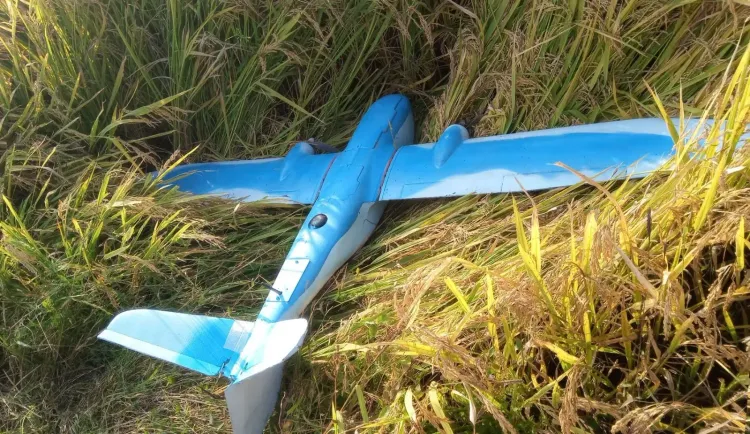
On January 4, North Korea's military allegedly captured and tracked an aerial target moving northwards from the sky over South Korea's Ganghwa County, Incheon, and targeted it with specialized electronic warfare tools, causing it to crash in Muksan-ri near Kaesong, the KCNA stated.
It was also reported that on September 27, a drone launched from South Korea's border city of Paju fell into Jangphung County, Kaesong, after being brought down by the North's electronic systems. The drone was reportedly returning after breaching the airspace over Phyongsan County, North Hwanghae Province.
The spokesperson highlighted that the drone that crashed this week was outfitted with surveillance technology, citing North Korea's assessment that the drone was intended to record significant North Korean sites while covering a distance of 156 kilometers for over three hours.
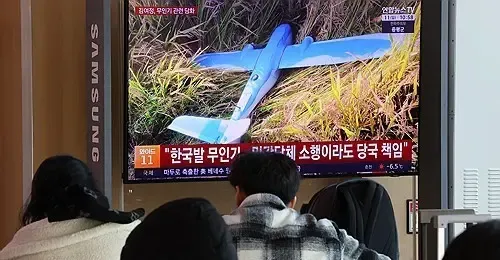
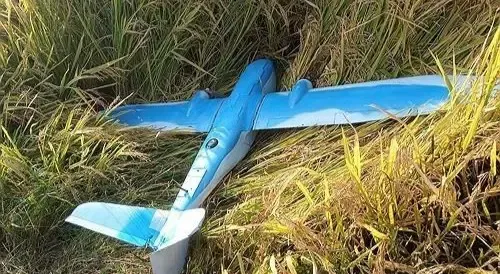
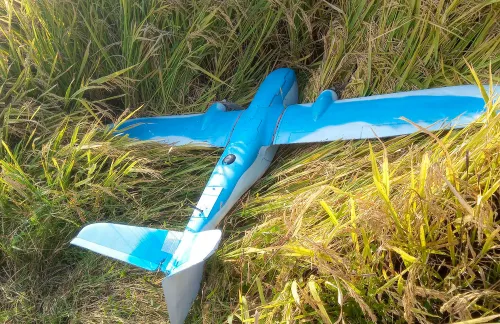
North Korea published images of the wreckage from the drones, including recording devices and footage believed to have been captured by the unmanned aerial vehicles. It characterized South Korea as a 'perfect copy of Kiev's lunatics', drawing a parallel between the South and Ukraine's struggle against Russia.
Pyongyang accused the South Korean military of orchestrating the drone infiltrations, asserting that these drones maneuvered freely over regions where the South Korean Army's radar systems designed for detecting low-altitude targets and anti-drone equipment are stationed.
"The ROK is the enemy most hostile towards us, a reality that cannot change, and if it attacks, it must be prepared for a collapse," the spokesperson stated. "The ROK military warmongers will certainly pay dearly for their unpardonable frenzy."
In response to an inquiry by Yonhap News Agency, Defense Minister Ahn Gyu-back categorically rejected North Korea's claim as 'absolutely false', pointing out that the drones depicted in the photos released by the North do not belong to the South Korean military.
The defense ministry announced that South Korean President Lee Jae Myung has mandated a 'thorough' investigation into the issue, and relevant government bodies are currently verifying the information.
Experts have analyzed that the drones presented by the North do not seem to be military-grade aerial vehicles, suggesting they are likely constructed from inexpensive components unsuitable for military applications.
In October 2024, North Korea reported that South Korean drones carrying anti-North Korea propaganda leaflets were spotted over Pyongyang three times that month, threatening to retaliate if such flights occurred again, as reported by Yonhap News Agency.
There are suspicions that the South Korean military sent drones over Pyongyang during former President Yoon Suk Yeol's administration, seemingly to provoke North Korea and potentially use it as a pretext for his martial law attempt in December 2024.
North Korea's allegations regarding drone infiltrations emerged as North Korean leader Kim Jong-un has proclaimed inter-Korean relations as those between 'two states hostile to each other.'
Since taking office in June, the South Korean administration under President Lee has been striving to mend relations with North Korea and reinitiate dialogue.
Experts believe that North Korea is solidifying its hardline approach towards Seoul ahead of an important party congress expected in January or February. The North is anticipated to formulate a five-year policy framework encompassing diplomatic, economic, military, and other facets.
"North Korea is likely to embed the 'two hostile states' perspective in the ruling party's regulations at the upcoming party congress and aim to amend the constitution to formalize it during a crucial parliamentary session in the first half of the year," stated Hong Min, a senior researcher at the Korea Institute for National Unification.
Point of View
We must maintain an unbiased perspective. The escalating tensions between North and South Korea require careful attention, as they affect regional stability and international relations. Our commitment is to provide accurate reporting while fostering understanding and encouraging dialogue.
NationPress
19 Sept 2026
Frequently Asked Questions
What are the recent accusations from North Korea against South Korea?
North Korea has accused South Korea of violating its sovereignty with drone incursions, claiming these actions warrant significant repercussions.
How has South Korea responded to these accusations?
South Korea's defense ministry has firmly rejected the claims, stating that its military did not operate drones on the dates mentioned by North Korea.
What evidence has North Korea provided regarding the drone incursions?
North Korea released photos of drone debris and alleged surveillance footage captured by these drones, claiming they were used for reconnaissance.
What is the current state of inter-Korean relations?
Inter-Korean relations are tense, with North Korea asserting that ties are characterized by hostility, even as South Korea seeks to mend relations and engage in dialogue.
What are experts saying about the drones involved?
Experts suggest that the drones reported by North Korea do not appear to be military-grade and may be constructed from inexpensive materials.