How is Poland Enhancing Cooperation with India in Green Tech and Defence?
Key Takeaways
Poland and India are enhancing cooperation in defence and green technology .
The ICT sector presents mutual growth opportunities.
A strategic partnership agreement was signed, marking a significant milestone.
Poland is transitioning its energy sector towards renewables.
Joint ventures in military technology are under discussion.
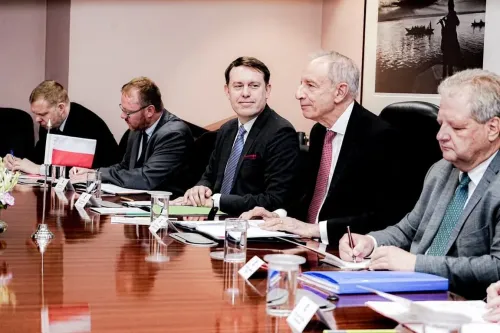
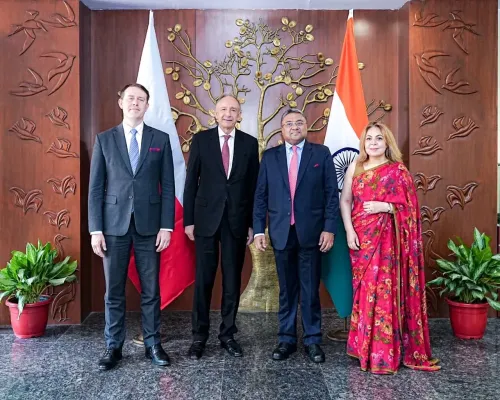
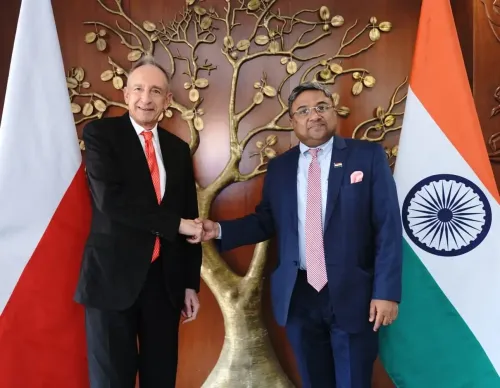
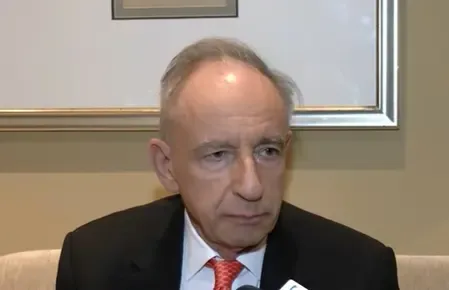
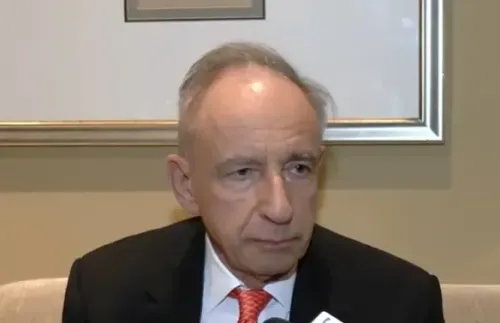
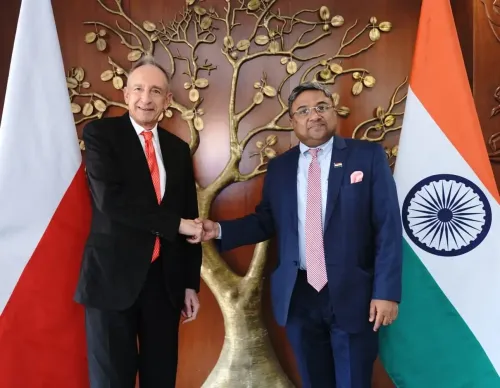
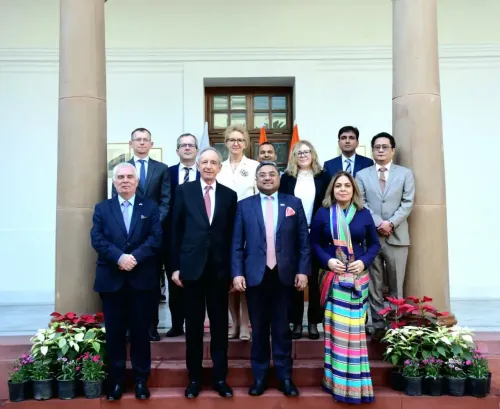
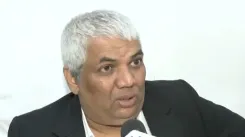
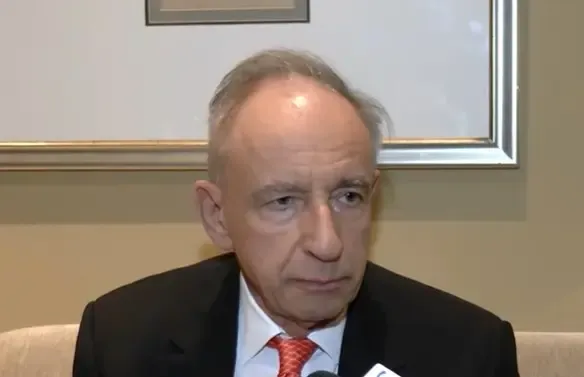
New Delhi, Feb 6 (NationPress) Poland's Deputy Foreign Minister Władysław Bartoszewski acknowledged India's remarkable economic development and increasing global prominence while expressing the European nation's interest in strengthening relations with India across various sectors, particularly in defence cooperation and green technology.
In an interview with IANS, Bartoszewski discussed the evolving India-Poland relations, opportunities for trade and investment, global geopolitical dynamics, and the leadership of Prime Minister Narendra Modi. He underscored that bilateral relations are improving and praised India’s swift economic changes, technological advancements, and strategic significance globally.
Here is the full interview:
IANS: What is your perspective on the trajectory of India-Poland relations?
Władysław Bartoszewski: The relationship between India and Poland is on an upward path. We formalized a strategic partnership with Prime Minister Modi in 2024 during his inaugural visit to Poland as Prime Minister in 45 years. It was a fruitful visit. We've also finalized a Free Trade Agreement with the European Union, of which we are a member. I recently returned from discussions at the Foreign Ministry focusing on practical steps involving military collaboration, digital industry partnerships, security matters, IT investments in advanced technologies, space cooperation, and beyond.
Next month, our Deputy Minister for Digital Affairs will visit. I will return in March, along with our Deputy Minister for Development and Technology. We are expecting our Prime Minister to visit Delhi later this year, and we're also discussing visits by various officials, including Dr. S. Jaishankar to Poland.
We're discussing a broad spectrum of cooperation encompassing business, politics, and security. The potential is vast. Recently, two astronauts—one from India and one from Poland—successfully orbited, serving as a testament to our future collaboration.
IANS: What are Poland's trade and investment priorities with India?
Władysław Bartoszewski: We are interested in various sectors, notably the ICT sector, which contributes approximately 9% to India's GDP and 7% to ours, making it a natural synergy.
Poland is advanced in digital technologies that facilitate public services. We conduct most official business digitally, expanding our e-government initiatives, an area where India also excels.
We are exploring advancements in military technology with several Indian firms and discussing potential joint production in Poland and India under the Make in India initiative.
We're also engaged in discussions around green technologies, which are crucial for India. Poland is proficient in water treatment, and I recall a Polish company working on sewage management in Mumbai.
Our energy sector is rapidly transitioning from coal to renewable sources, including nuclear energy. We are in the process of constructing a nuclear power plant and investigating small modular reactor technologies. Furthermore, we are investing significantly in offshore wind farms and biogas production.
Our robust agricultural sector accounts for around 50% of our exports. Agricultural by-products can be utilized for biogas, representing a stable renewable energy source. We are also keen to learn from India's experience in green hydrogen and energy storage.
Additionally, we aim to collaborate with India in coal mining, leveraging our extensive experience, especially in open-cast mining.
IANS: What is your view on the recent India-US trade agreement?
Władysław Bartoszewski: It's preferable to have a trade deal than to lack one. Generally, tariffs do not foster prosperity as they are ultimately borne by consumers when importers pass on the costs. Lower tariffs yield better outcomes.
It is encouraging that India and the United States have reached an agreement that significantly reduces previously proposed tariffs.
IANS: Do you believe India secured a more advantageous trade deal with the US than other nations? If yes, why?
Władysław Bartoszewski: India is a formidable economic force, currently ranked fourth in global GDP. Prime Minister Modi has signaled India's ambition to ascend to the third position soon. With a market of nearly 1.5 billion people, India is technologically advanced and rapidly evolving. Ignoring a country with such potential is unwise.
India is also a democratic nation that recently conducted the largest democratic election globally, making it an excellent partner for trade and relations.
IANS: India has asked Poland to assist in addressing terrorism in the region. What is your response?
Władysław Bartoszewski: We are already addressing state-sponsored terrorism near our borders. We experienced two terrorist attacks on our trains; thankfully, no casualties occurred, but it was a close call that could have escalated into a significant scandal.
IANS: How do you view India's potential role in resolving the war in Ukraine?
Władysław Bartoszewski: India is not engaged in the Ukraine conflict nor involved in negotiations to resolve it. Ending the war depends on President Putin withdrawing his colonial forces from Ukraine.
Historically, Russia ruled Ukraine as a colony in the 18th and 19th centuries and seeks to do so again. Poland opposes all forms of colonialism and neo-imperialism.
IANS: What is your assessment of Prime Minister Modi's leadership and its global implications?
Władysław Bartoszewski: Prime Minister Modi is an exceptional leader, charismatic and successful, as evidenced by his multiple electoral victories. He has dramatically transformed India and possesses an ambitious vision for the country.
We are greatly impressed by his leadership and accomplishments. I can personally attest that he is a charming and personable individual. Many Indians share this sentiment, as they are inspired by his vision, which has propelled India from a time of poverty to becoming the world's fourth-largest economy.
IANS: How do you perceive the current situation in West Asia, especially tensions between Iran and the US?
Władysław Bartoszewski: I believe a full-scale conflict will be avoided. An agreement between the US and Iran appears possible as Iran is currently in a weakened state.
Iran struggles to effectively utilize its proxies, such as Hamas or Hezbollah, which are disorganized, alongside domestic protests against the Ayatollah regime.
I foresee a peaceful resolution and do not anticipate a major conflict in the region at this time.
IANS: What is your perspective on China's involvement in the Ukraine conflict and tensions concerning Iran?
Władysław Bartoszewski: I view China's role in the Ukraine war negatively and communicate this to our Chinese counterparts. Reports indicate that a significant majority of dual-use components in Russian weapon systems are supplied by China, exacerbating the conflict.
Additionally, China is a major purchaser of Russian oil and gas, providing essential revenue that supports Russia's military efforts. We address this issue with the Chinese during discussions.
While China claims not to supply dual-use materials, we disagree with this assertion.
IANS: What is your view on NATO's evolving role and its implications for non-member countries like India?
Władysław Bartoszewski: NATO was established in 1949 as a defensive alliance to safeguard Western European nations from potential Soviet aggression. Eastern European countries later joined NATO for similar reasons against Russian hostility.
Russia asserts that it should control all of Eastern Europe, a claim we reject. We are sovereign nations, members of the UN, and like India, advocate for resolving disputes through international law rather than military force.
NATO has no intention of aggression. Finland and Sweden, previously neutral for over 200 years, joined NATO due to perceived threats from Russia's policies.
NATO member countries maintain strong ties with India, including the US, France, Germany, and Poland. We acknowledge India's global role. Previously, I mentioned how Prime Minister Modi urged President Putin against using tactical nuclear weapons in Ukraine in late 2022, with President Xi Jinping echoing a similar message. This illustrates India's positive contributions to global affairs, a role I expect to continue.
Point of View
Focusing on cooperation in defence and green technology. It emphasizes India's rising global stature and Poland's strategic interests, showcasing a collaborative approach towards addressing emerging challenges. Our commitment to fostering international relationships remains paramount, and we aspire to further strengthen our alliances.
NationPress
16 Sept 2026
Frequently Asked Questions
What sectors are Poland focused on in its cooperation with India?
Poland is particularly interested in defence cooperation and green technology , alongside advancements in ICT and military technology, aiming for joint production initiatives.
What recent agreements have been made between India and Poland?
A strategic partnership agreement was signed during Prime Minister Modi's visit to Poland, alongside a Free Trade Agreement with the European Union .
How does Poland view India's role in global affairs?
Poland recognizes India as a significant economic power and a democratic nation, valuing its contributions to global stability and international relations.
What challenges does Poland face regarding terrorism?
Poland has experienced state-sponsored terrorism near its borders and remains vigilant in addressing these threats.
What is Poland's stance on the Ukraine conflict?
Poland believes the war in Ukraine will only end with a withdrawal of Russian forces, asserting that independent nations like Ukraine must not be subjugated.