Why Are VHP and Bajrang Dal Protesting Against Atrocities on Hindus in Bangladesh?
Synopsis
In a significant protest in Agartala, members of VHP and Bajrang Dal rallied against the alleged atrocities faced by Hindus in Bangladesh. They called for urgent government intervention to safeguard minority rights amidst rising violence. A tragic incident involving a young Hindu man's murder has intensified concerns, prompting protests that highlight ongoing tensions in the region.
Key Takeaways
Protest against atrocities: Hundreds rallied for intervention on behalf of Hindus in Bangladesh.
Escalating violence: Incidents of targeted violence have reportedly surged.
Humanitarian appeal: Call for refugee status for marginalized Hindus.
Political tensions: Protests highlight complex regional dynamics.
Need for dialogue: Emphasis on mutual respect among communities.
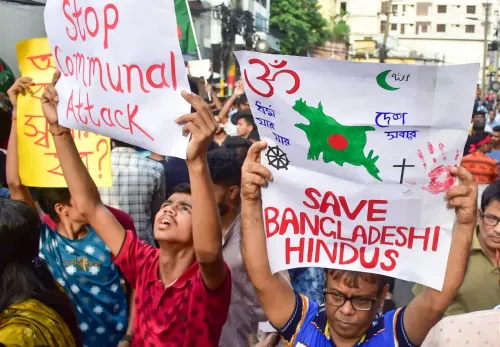
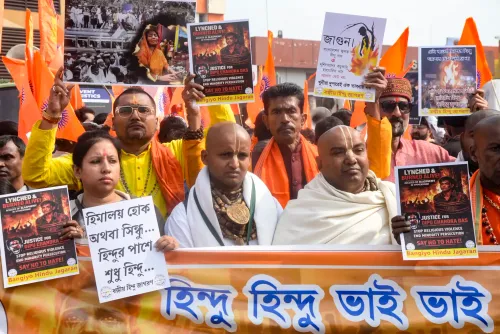
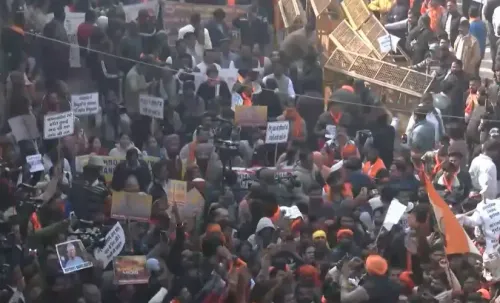
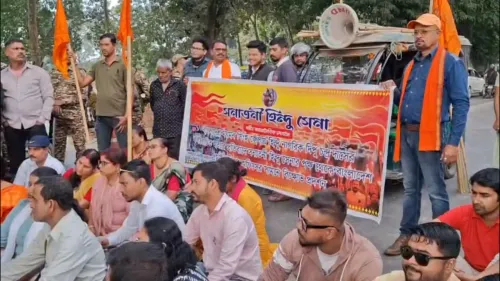
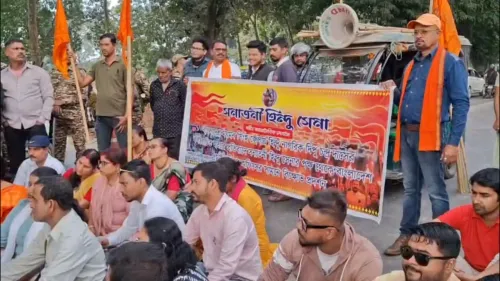
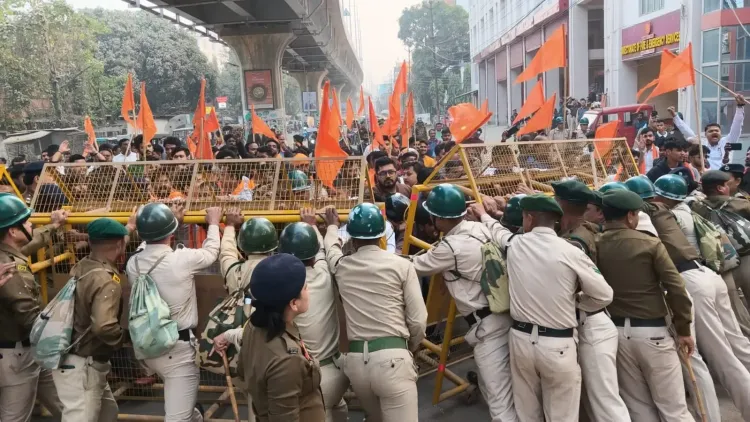
Agartala, Dec 24 (NationPress) Hundreds of members from Vishwa Hindu Parishad (VHP) and Bajrang Dal organized a protest rally in Agartala, urging the Indian government to intervene regarding what they termed as escalating atrocities against minority Hindus in the neighboring Bangladesh.
The demonstrators claimed that since the overthrow of the Sheikh Hasina government in August of the previous year, there has been a surge in violence targeted at Hindus in Bangladesh.
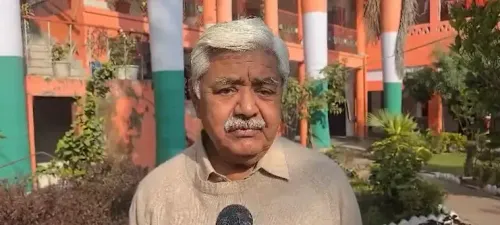
Sankar Ray, Secretary of the VHP Tripura chapter, stated that the conditions have deteriorated in recent months, leading to ongoing protests in Tripura.
“The world is aware that extensive atrocities are being committed against Hindus in Bangladesh. Several months ago, we protested in front of the Bangladesh Assistant High Commission here. Now, such targeted violence has become commonplace in the neighboring country,” Ray communicated to the media.
He further claimed that recently, two media outlets were set on fire, several prominent cultural organizations' offices were vandalized, and a Hindu youth, Dipu Chandra Das, was murdered by a radical mob based on what he described as false accusations.
The 27-year-old Das, who was employed in a garment factory in Bangladesh, was dragged through the streets, brutally beaten to death by an enraged mob, and then his corpse was set ablaze after being tied to a tree in Mymensingh.
He was accused of blasphemy by a coworker, which incited the murderous mob, composed of radicals and extremists, to invade the factory, drag him into the streets, and kill him mercilessly.
The VHP leader expressed that the protest was aimed at attracting the attention of the Indian government towards these incidents.
Ray called upon the Indian government to take “direct action” to safeguard Hindus in Bangladesh and demanded robust measures against radical factions.
He also made a humanitarian appeal for the Indian government to permit the entry of marginalized Hindus from Chittagong, who, he claimed, were living in dire conditions, to come to Tripura and live with dignity.
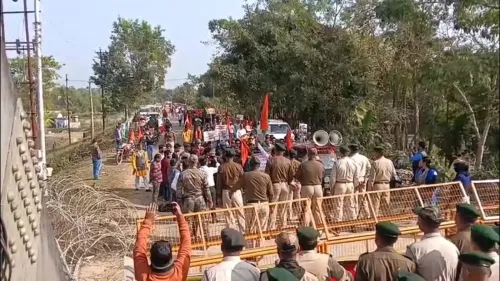
The protest march commenced from the Agartala Town Hall area and was intended to proceed towards the Integrated Check Post at the Agartala-Akhaura (Bangladesh) border.
However, large police contingents, led by senior officials, halted the march about a kilometer before the border check post, near the police headquarters, citing security concerns.
A brief confrontation occurred between VHP and Bajrang Dal protesters and police personnel during the attempt to advance, though the situation was later controlled.
No injuries were reported during the scuffle. This has marked the third protest rally against Bangladesh in Agartala in recent days, as Tripura is bordered by Bangladesh on three sides, with an international border extending 856 kilometers.
Previously, last week, the youth wing of the Tipra Motha Party (TMP), an ally of the ruling BJP, along with Sanatani Hindu Sena activists, held demonstrations near the Bangladesh Assistant High Commission (AHC) in Agartala, denouncing the attacks on minorities in Bangladesh and recent statements from leaders in the neighboring country allegedly claiming parts of India's Northeast region.
Numerous organizations and political parties in Tripura condemned the alleged lynching of a Hindu man in Bangladesh and accused the interim government there of failing to prevent atrocities against religious minorities.
Suraj Debbarma, President of the Youth Tipra Federation (YTF), which led protests on December 19, stated that National Citizen Party (NCP) leader Hasnat Abdullah, along with others, has been consistently making unfounded “anti-India” remarks and promoting activities hostile to India.
Debbarma also mentioned that in recent days, protests and demonstrations have occurred in front of the Indian High Commission in Dhaka and other locations in Bangladesh, where participants reportedly chanted “anti-India” slogans.
“NCP leader Hasnat Abdullah claimed earlier this week that they aim to seize India's 'Seven Sisters' and the Siliguri Corridor, integrating the region into their country,” he added.
Point of View
It is crucial to approach the situation with a balanced perspective, recognizing the complexities involved. While the protests highlight the urgent need to address the safety of religious minorities, it is equally important to engage in dialogue that fosters mutual respect and understanding between communities, ensuring that political tensions do not exacerbate existing divides.
NationPress
19 Sept 2026
Frequently Asked Questions
What prompted the protests in Agartala?
The protests were prompted by claims of escalating violence against Hindus in Bangladesh, particularly following the removal of the Sheikh Hasina government.
What specific incidents were highlighted during the protest?
Protesters highlighted the murder of a young Hindu man, Dipu Chandra Das, and the vandalization of cultural organizations as part of their concerns.
What demands were made by the protesters?
Protesters demanded the Indian government to take direct action to protect Hindus in Bangladesh and to allow marginalized Hindus from Chittagong to seek refuge in Tripura.
How did the police respond to the protests?
The police halted the march near the border check post, citing security concerns, and a brief scuffle ensued, but the situation was brought under control.
What is the background of the tension between India and Bangladesh?
The tension stems from historical and ongoing issues related to minority rights, political statements, and territorial claims made by leaders in Bangladesh.