How Does Digital Governance Fuel Revenue Growth in Rajasthan?

Synopsis
Discover how Rajasthan's government is leveraging digital governance to enhance revenue growth and efficiency. With innovative measures and technology-driven reforms, the state has seen a remarkable increase in revenue collection, marking a significant achievement in fiscal management.
Key Takeaways
Rajasthan's revenue growth has reached 12.60% this year.
Digital governance has enhanced transparency and compliance.
Rajasthan has implemented an Integrated Tax Management System to simplify processes.
Effective measures against illegal activities have boosted revenue.
Innovative technology solutions have streamlined public services.
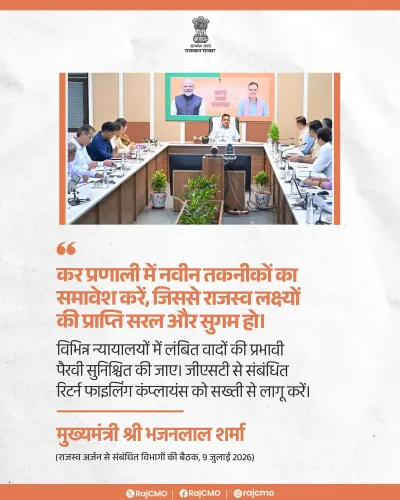
Jaipur, Dec 17 (NationPress) The state of Rajasthan has reached remarkable achievements in revenue reform and growth through digital transformation and technology-driven governance, as reported by officials on Wednesday.
The implementation of digital systems has significantly boosted transparency and compliance in vital sectors such as GST, stamps and registration, excise, mining, energy, and transport.
Efforts to combat fake billing, illegal mining, and revenue leakages have enhanced enforcement, resulting in improved efficiency in revenue collection and a more robust fiscal position for the state.
Due to ongoing structural reforms in both tax and non-tax revenue, along with digital monitoring and data-informed action plans, Rajasthan's total revenue for the fiscal year 2024-25 has seen a growth of 12.60 percent compared to the previous year.
Thanks to extensive reforms, rigorous monitoring, and the effective use of technology and analytics, the state has recorded an additional revenue of over Rs 14,200 crore compared to last year.
Strict measures against fake billing, illegal mining, and other irregularities have been pivotal in ensuring consistent revenue growth.
The Commercial Taxes Department has enhanced revenue intelligence-based analysis and produced more than 45 data-driven reports, which have helped in identifying and preventing fake billing.
High-risk taxpayers have been closely monitored using e-way bill matching, return profiling, and advanced IT tools, while fraudulent registrations have been detected and nullified.
Innovative solutions like the Integrated Tax Management System (ITMS) have streamlined return filing for traders, leading to a significant improvement in compliance and transparency.
Over the past two years, the Excise Department has conducted intensive intelligence-driven operations against illegal liquor manufacturing, transportation, and sales. Substantial amounts of illicit liquor have been seized, illegal distilleries have been dismantled, and stringent actions have been taken against smuggling networks.
Technological advancements such as the e-Excise system, QR-based tracking, digital permits, and comprehensive supply chain monitoring have enhanced transparency and compliance.
The launch of an e-lottery system for liquor shop allocation has removed human intervention, ensuring a fair and corruption-free licensing process.
Digital initiatives like e-registration, e-GRAS, Raj Stamp, and the 181 Helpdesk have expedited the registration process, making it faster, simpler, and more transparent. In the last two years, over 50 lakh documents have been registered, generating revenue exceeding Rs 20,599 crore.
The state government has rationalized DLC rates based on road width and actual construction costs while providing significant concessions in stamp duty for intra-family property transfers, women's joint ownership, purchases of small flats, TDR transactions, and debt assignments.
Several amnesty schemes have also been introduced to address long-standing disputes related to land tax and stamp duty, offering relief to industries and the general public.
To enhance service delivery, 10 mini sub-registrar offices have been developed as model offices, and the process to upgrade the remaining 106 offices has commenced.
Point of View
I believe that Rajasthan's journey towards digital governance serves as a significant example for other states. The integration of technology in public administration not only enhances transparency but also builds trust among citizens. It's imperative that such models are adopted and adapted nationwide to foster economic growth and stability.
NationPress
1 Oct 2026
Frequently Asked Questions
What are the key digital initiatives in Rajasthan's governance?
Rajasthan has implemented several digital initiatives such as e-registration, e-GRAS, and an Integrated Tax Management System (ITMS) to enhance transparency and compliance in various sectors.
How much revenue growth has Rajasthan achieved recently?
In the fiscal year 2024-25, Rajasthan reported a revenue growth of 12.60% compared to the previous year, driven by extensive reforms and digital monitoring.
What measures are in place to curb illegal activities?
The state has taken strict actions against fake billing, illegal mining, and has conducted intelligence-driven operations against illegal liquor production and sales.
How has technology improved tax compliance?
Through advanced IT tools and data-driven reports, the state has significantly improved tax compliance by monitoring high-risk taxpayers and streamlining return filing.
What benefits have been provided to the public through reforms?
Reforms include significant concessions in stamp duty, amnesty schemes for land tax disputes, and the establishment of model sub-registrar offices to improve service delivery.