Is the Congress-Left Alliance on Shaky Ground Amid Rising Religious Tensions in Bengal?
Click to start listening
Synopsis
Amidst rising political tensions and upcoming elections in Kerala and West Bengal, the once-cooperative relationship between Congress and the Left is facing uncertainty. As grassroots movements call for changes and potential new players enter the fray, the landscape for the 2026 elections grows increasingly complex.
Key Takeaways
- The alliance between Congress and the Left is under strain.
- BJP's influence is growing in local politics.
- Grassroots demands are reshaping party strategies.
- Upcoming elections are critical for party identities.
- Potential new players could further complicate the landscape.
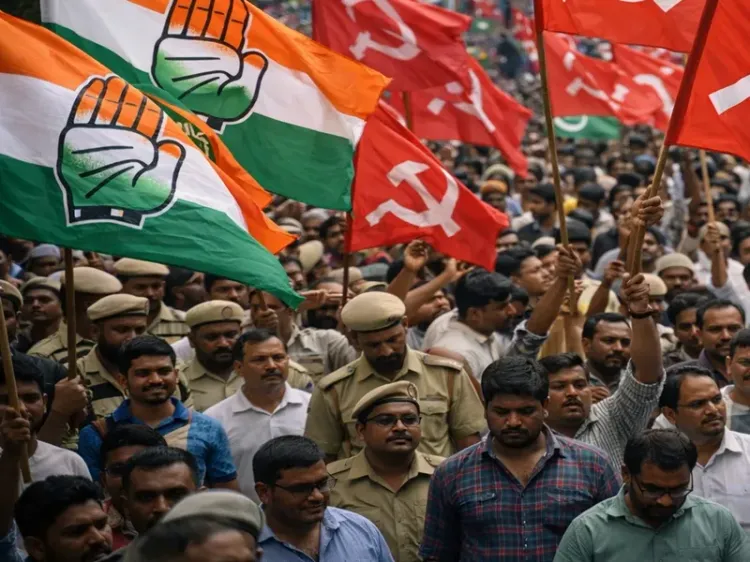
New Delhi, Dec 17 (NationPress) Recently, the Communist Party of India (Marxist) in Kerala dismissed the possibility of collaborating with the Congress to counter the rising dominance of the Bharatiya Janata Party (BJP) in local governance. Meanwhile, a split between the two parties is anticipated in West Bengal, where they previously joined forces against the ruling Trinamool Congress.
It is noteworthy that all three political entities opposing the BJP are members of the Indian National Developmental Inclusive Alliance (INDIA) coalition.
In Kerala, the ruling Left Democratic Front (LDF) is spearheaded by the CPI (M), while the Congress represents the main faction of the Opposition coalition, the United Democratic Front (UDF).
The UDF performed better in the recent local body elections in Kerala compared to the LDF, as the BJP emerged as a potential third force with significant success in Thiruvananthapuram.
In West Bengal, the BJP has become the primary Opposition, surpassing both the Congress and the Left from the Assembly.
Notably, Assembly elections are set to occur in both Kerala and West Bengal the following year. In West Bengal, the Congress is signaling its intention to primarily contest independently after facing setbacks in previous elections.
The Left Front is fragmented, with the CPI(M) appearing indecisive, while some of its partners remain resistant to a formal alliance with the Congress.
These factions have highlighted that electoral outcomes indicate their votes consolidated in favor of their alliance partners, but not with Congress voters.
For numerous Congress officials and supporters, accusations of oppression during the Left's governance are hindering vote consolidation.
Conversely, the current generation of Communists or their supporters have little recollection of the pre-1977 Congress governance in West Bengal. Despite the Congress-Left partnership, they opted to contest separately in six Assembly constituencies that required repolls last year after the sitting MLAs were elected to the Lok Sabha.
Senior Congress leaders have reportedly urged their members to prepare for greater self-reliance rather than another seat-sharing agreement.
This indicates a strategic realignment following recent unsatisfactory performances and a desire to re-establish the party's base in the state.
With the upcoming 2024 repoll contest in mind, Left Front allies like the All India Forward Bloc and the Revolutionary Socialist Party have opposed sharing seats with the Congress and are calling for larger seat allocations if negotiations proceed.
Reports from the ground and media portray the situation as uncertain, with grassroots demands for a more equitable number of seats and recent electoral insights—especially from Bihar—instilling caution on both sides. Both Congress and the Left are sensitive to which party concedes which seats after recent defeats.
While the Congress aims to revitalize its identity rather than be overshadowed, smaller Left allies fear further marginalization within any broad coalition. Votes against the Trinamool and BJP risk further fragmentation if Asaduddin Owaisi's All India Majlis-e-Ittehadul Muslimeen (AIMIM) joins the race, either independently or in partnership with a political group soon to be launched by the builders of the Babri Masjid.
However, if polarisation along religious lines occurs and Muslim votes fragment, the ruling party could face significant uncertainty.
Point of View
The evolving dynamics between the Congress and Left parties reflect deeper electoral trends in India. As voter sentiments shift and new alliances form, the necessity for collaboration against dominant forces like the BJP becomes ever more critical. The upcoming elections will not only redefine state politics but will also set the tone for national discourse.
NationPress
17/12/2025
Frequently Asked Questions
What is the current status of the Congress-Left alliance in Bengal?
The alliance appears to be weakening, with both parties signaling intentions to contest independently due to past electoral disappointments.
How has the BJP influenced local politics in Kerala and West Bengal?
The BJP has emerged as a significant opposition force, particularly in West Bengal, where it has surpassed both Congress and the Left in the Assembly.
What factors are causing divisions within the Left Front?
The Left Front is experiencing fragmentation, with factions divided on the possibility of forming a formal alliance with Congress.
What are the implications of the upcoming elections for these parties?
The upcoming elections could redefine party dynamics and influence voter consolidation against the BJP and Trinamool Congress.
What role do grassroots movements play in these political developments?
Grassroots movements are demanding fairer representation and influencing party strategies, reflecting the electorate's changing sentiments.