Will South Korea Reduce Carbon Emissions at International Airports by 10% by 2030?

Synopsis
South Korea is taking significant steps to combat climate change by targeting a 10% reduction in carbon emissions at international airports by 2030. The plan includes expanding the use of sustainable aviation fuel and improving airport operations. Discover how these initiatives will shape the future of air travel in South Korea.
Key Takeaways
South Korea targets a 10% reduction in airport carbon emissions by 2030 .
Expansion of sustainable aviation fuel (SAF) is a key focus.
Projected emissions are set to rise to 29.8 million tons by 2030 .
Government support for airlines will offset high SAF costs.
A new aircraft maintenance hangar is planned at Incheon International Airport .
Seoul, Dec 21 (NationPress) South Korea is committed to reducing carbon emissions at its international airports by 10 percent by the year 2030, while also increasing the utilization of sustainable aviation fuel (SAF), as highlighted in a government report published on Sunday.
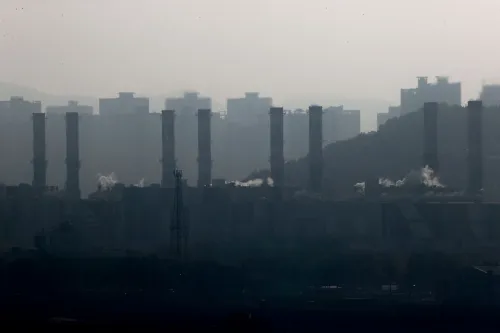
The strategy for the period 2026-2030, developed by the ministries of transport, environment, and industry, projects that carbon emissions at the country's international airports will escalate to 29.8 million tons in 2030, marking a 28 percent increase from the 23.3 million tons reported this year.
The government aims to achieve a 10 percent reduction, equating to 2.87 million tons, according to the Yonhap news agency.
The report indicates that this reduction can be realized through the adoption of SAF, minimizing standby times during takeoff and landing, and enhancing operational efficiency at airports.
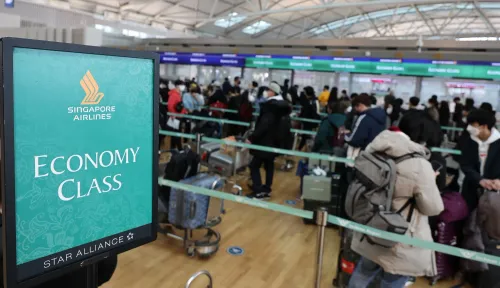
As part of these initiatives, international flights departing from South Korea will be mandated to utilize SAF for at least 1 percent of their fuel, with plans to increase this share to between 3 percent and 5 percent following 2030.
To alleviate the financial burden on airlines, the South Korean government is considering measures to assist with costs, as SAF is currently priced at approximately three times that of conventional jet fuel.
In related developments, Korean Air is set to construct a state-of-the-art aircraft maintenance hangar at Incheon International Airport, the main entry point to South Korea. This project is part of a 176 billion-won (approximately US$119.2 million) joint investment with the airport operator, as announced by the airline.
The new hangar, situated within the airport's High Tech Aviation Complex, will facilitate airframe inspections, component evaluations, heavy maintenance, and aircraft modifications. Covering an area of 69,299 square meters, it will have the capacity to accommodate two wide-body and one narrow-body aircraft simultaneously. Construction is scheduled to commence in 2027, with operations anticipated to begin in late 2029.
Korean Air stated that this facility will enhance its maintenance, repair, and overhaul (MRO) capabilities in preparation for the launch of an integrated carrier following its acquisition of rival Asiana Airlines Inc.
Point of View
I stand with the nation's commitment to environmental sustainability. South Korea's proactive measures to reduce carbon emissions and invest in sustainable aviation fuel reflect a responsible approach to combat climate change, ensuring a healthier planet for future generations.
NationPress
27 Sept 2026
Frequently Asked Questions
What is South Korea's carbon emission reduction target for international airports?
South Korea aims to reduce carbon emissions at its international airports by 10 percent by 2030 .
What fuel will South Korea promote for aviation?
The country will expand the use of sustainable aviation fuel (SAF) for international flights.
How much are projected carbon emissions expected to rise by 2030?
Projected carbon emissions are expected to reach 29.8 million tons by 2030 , a 28 percent increase from this year.
What measures will the government take to support airlines?
The government plans to ease the financial burden on airlines by assisting with costs related to SAF , which is currently priced much higher than conventional jet fuel.
When is the construction of the new aircraft maintenance hangar expected to begin?
Construction of the new hangar at Incheon International Airport is set to start in 2027 .