Kerala Assembly session: Satheesan outmanoeuvres Vijayan in debut as CM
Synopsis
Kerala's first Assembly session under the new dispensation produced a striking role reversal: Chief Minister V.D. Satheesan, a career legislator who never held a ministerial post before becoming CM, outclassed a visibly off-balance Pinarayi Vijayan. With LDF unable to even convene its legislature party meetings, the Opposition's debut was defined more by self-inflicted wounds than by government missteps.
Key Takeaways
Satheesan emerged as the clear political winner of Kerala's first Assembly session of the new term, held in Thiruvananthapuram .
Opposition Leader Pinarayi Vijayan , 82 , struggled to adapt after a decade as Chief Minister, with several LDF strategies backfiring.
Rajan's muddy-water protest stunt collapsed after the sample was traced to a roadside pothole.
The Finance Bill controversy over low-alcohol beverage tax concessions was neutralised when it emerged the Business Advisory Committee — including Vijayan and Rajan — had itself cleared the Bill.
An unresolved CPI(M)–CPI dispute over the Deputy Leader of the Opposition post has blocked LDF legislature party meetings entirely.
The 140-member House stands at UF 102, Left 35, BJP 3 .
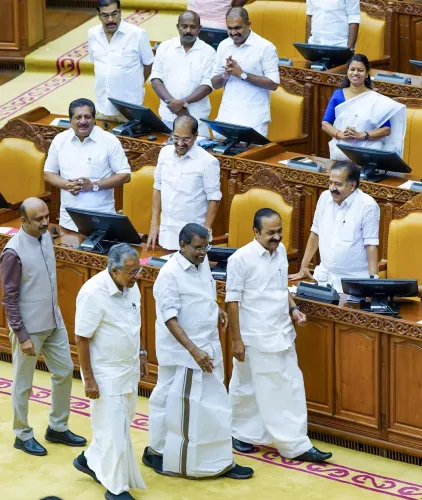
Chief Minister V.D. Satheesan emerged as the dominant force in the first session of Kerala's newly-elected Assembly, outpacing Opposition Leader Pinarayi Vijayan, who struggled to find his footing on the Opposition benches after a decade of unchallenged authority as Chief Minister. The session, which concluded in Thiruvananthapuram, delivered a political verdict few analysts had anticipated.
A Dramatic Reversal of Roles
For nearly ten years, Vijayan had commanded the Kerala Assembly with a dominance that successive Opposition leaders — including Ramesh Chennithala and later Satheesan himself — could rarely dent. The switch in positions has, however, fundamentally altered the political dynamic. The 82-year-old veteran found several of his interventions blunted, with Opposition strategies repeatedly backfiring and inadvertently strengthening the ruling United Front's hand.
Satheesan, despite having spent over 25 uninterrupted years in the Assembly without ever holding a ministerial post before assuming the Chief Minister's Office, demonstrated a confident grasp of legislative procedure and floor tactics. He consistently converted Opposition pressure into moments of advantage for the government.
Opposition Missteps That Defined the Session
CPI leader K. Rajan's bid to embarrass the government — displaying a bottle of muddy water, claiming police had used it against protesters — unravelled after it emerged that the sample had been collected from a roadside pothole. The episode drew ridicule rather than sympathy.
A second flashpoint arose during the debate on the Finance Bill incorporating tax concessions for low-alcohol beverages. The Opposition accused the government of covertly inserting the provision. Treasury benches countered by pointing out that the Business Advisory Committee — which included both Pinarayi Vijayan and K. Rajan — had itself cleared the Bill for direct consideration without referring it to the Subject Committee. Satheesan then delivered the session's most effective rebuttal, noting that the same legislative route had been used by the previous Left Democratic Front (LDF) government under former Finance Minister K.N. Balagopal, effectively neutralising the charge.
Internal LDF Divisions Compound the Problem
The Opposition's difficulties were compounded by unresolved internal friction. An ongoing dispute between the Communist Party of India (Marxist) (CPI(M)) and the Communist Party of India (CPI) over the post of Deputy Leader of the Opposition has prevented the LDF legislature party from holding even routine meetings during the session. The absence of coordinated floor strategy, senior Opposition figures privately concede, has repeatedly squandered opportunities to corner the government.
Assembly Arithmetic and What Lies Ahead
The 140-member House now seats the United Front (UF) with 102 members, the Left with 35, and the Bharatiya Janata Party (BJP) with 3. With such a commanding majority, the government has structural comfort — but Satheesan's performance suggests he intends to use legislative skill, not just numbers, to define his tenure. If the opening session is a reliable signal, Kerala's political script has undergone a sharp reversal, with the once-dominant Vijayan navigating unfamiliar terrain and Satheesan firmly setting the Assembly's tone.
Point of View
And the CPI(M)–CPI turf war over a single post signals that the coalition's internal contradictions, long suppressed by incumbency, are now fully exposed. Satheesan, meanwhile, is rewriting a familiar narrative: that long legislative tenure without executive experience is a handicap. His command of procedure suggests the opposite. The real test will come when the government faces genuine accountability moments — not Opposition own-goals.
NationPress
2 Oct 2026
Frequently Asked Questions
What happened in Kerala's first Assembly session under Chief Minister Satheesan?
Chief Minister V.D. Satheesan dominated the session, repeatedly turning Opposition attacks to the government's advantage, while Opposition Leader Pinarayi Vijayan struggled to make an impact from the Opposition benches. Internal LDF divisions and a series of tactical missteps compounded the Opposition's difficulties throughout the session.
Why did the LDF's muddy-water protest backfire?
CPI leader K. Rajan displayed a bottle of muddy water in the Assembly, claiming police had sprayed it on protesters. The move backfired when it emerged the sample had been collected from a roadside pothole, turning the episode into a source of embarrassment for the Opposition rather than a political weapon.
What was the Finance Bill controversy in the Kerala Assembly?
The Opposition accused the government of covertly inserting tax concessions for low-alcohol beverages into the Finance Bill. The charge was neutralised when the Treasury benches pointed out that the Business Advisory Committee — which included Pinarayi Vijayan and K. Rajan — had itself cleared the Bill for direct consideration, and that an identical route had been used by the previous LDF government under K.N. Balagopal.
What is the internal dispute within the LDF Opposition in Kerala?
The CPI(M) and CPI are locked in an unresolved dispute over the post of Deputy Leader of the Opposition. The standoff has prevented the LDF legislature party from holding meetings during the Assembly session, leaving the Opposition without a coordinated floor strategy.
What is the current composition of the Kerala Assembly?
The 140-member Kerala Assembly currently has the United Front with 102 seats, the Left with 35 seats, and the BJP with 3 seats, giving the ruling United Front a commanding legislative majority.