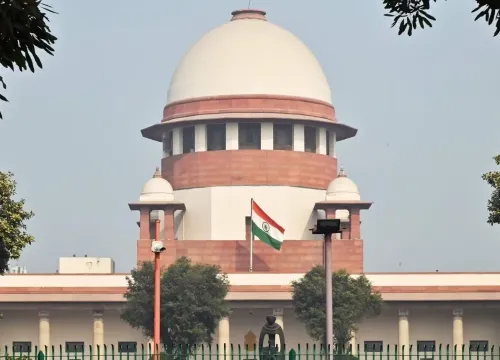
SC grants bail in murder case after 4-year custody, cites Article 21 violation
Synopsis
The Supreme Court has once again drawn a hard line: even in a murder case, four years in custody without a single witness examined is a constitutional violation. The ruling spotlights India's undertrial crisis, where over 75% of prison inmates are awaiting trial — and where serious charges have long been used to justify indefinite detention.
Key Takeaways
Supreme Court granted bail to Sahil Manoj Machare on 5 May 2025 after nearly 4 years of custody in a Kolhapur murder case.
Despite charges being framed in 2024 , not a single witness had been examined in the trial.
The bench of Justices J.B.
Pardiwala and Vijay Bishnoi held that prolonged incarceration without trial progress violates Article 21 of the Constitution.
The Bombay High Court had denied bail in March 2026 , citing the gravity of the offence and prima facie evidence.
The apex court set aside the High Court order and directed release subject to conditions imposed by the trial court.
India's undertrial population accounts for over 75% of total prison inmates, according to government data.
The Supreme Court of India has granted bail to Sahil Manoj Machare, an accused in a murder case from Kolhapur, Maharashtra, who had spent nearly four years in judicial custody without a single witness being examined in his trial. A bench of Justices J.B. Pardiwala and Vijay Bishnoi ruled on 5 May 2025 that the prolonged incarceration without trial progress amounted to a violation of the fundamental right to a speedy trial under Article 21 of the Constitution.
Background of the Case
Machare was arrested on 1 November 2022 following a case registered at Shahapur Police Station in Kolhapur under Sections 302 and 34 of the Indian Penal Code (IPC). According to the prosecution, the incident occurred during a family gathering in village Tardal, where the victim was allegedly attacked with a sharp weapon and later declared dead. A charge sheet was filed in September 2023, and charges were framed by the trial court in 2024 — yet not a single witness had been examined as of the Supreme Court's order.
What the Supreme Court Said
The Justice Pardiwala-led bench was unequivocal in its observations.
Point of View
Consistent with a growing body of apex court precedent, challenges that hierarchy directly. The more uncomfortable question it raises is structural: why did it take a Supreme Court SLP for a man to get bail after four years and zero witness examinations? The answer lies in a trial court and High Court culture that still treats prolonged custody as an acceptable status quo in serious cases, rather than a constitutional emergency. Until that culture shifts — through judicial accountability mechanisms, not just periodic apex court interventions — such rulings will remain necessary but insufficient.
NationPress
21 Sept 2026
Frequently Asked Questions
Why did the Supreme Court grant bail in this murder case?
The Supreme Court granted bail because the accused, Sahil Manoj Machare, had been in judicial custody for nearly four years since November 2022, and not a single witness had been examined in his trial despite charges being framed in 2024. The court held this constituted a violation of the right to a speedy trial under Article 21 of the Constitution.
What is Article 21 and how does it apply to bail?
Article 21 of the Indian Constitution guarantees the right to life and personal liberty, which the Supreme Court has interpreted to include the right to a speedy trial. When a trial stagnates and an accused remains in prolonged custody without progress, courts can treat it as an infringement of Article 21 and consider bail even in serious cases like murder.
What was the Bombay High Court's reasoning for denying bail?
The Bombay High Court, in a single-judge order by Justice Sachin S. Deshmukh in March 2026, denied bail citing the gravity of the murder charge, prima facie evidence of the applicant's involvement, and the potential impact on the administration of justice. It also held that trial proceedings were under progress and dismissed the delay argument.
Who is Sahil Manoj Machare and what is the case against him?
Sahil Manoj Machare is the petitioner in a murder case registered at Shahapur Police Station in Kolhapur, Maharashtra, under Sections 302 and 34 of the IPC. He was arrested on 1 November 2022 after the victim was allegedly attacked with a sharp weapon during a family gathering in village Tardal. Machare argued his name did not appear in the FIR and no weapon was recovered from him.
What happens next after the Supreme Court's bail order?
The trial court will now set the specific bail conditions for Machare's release. The underlying murder trial in Kolhapur is expected to proceed, with the Supreme Court's order implicitly pressing the trial court to expedite witness examination.