Shinde compares Modi's Viksit Bharat mission to Gandhi, Patel's freedom movement
Synopsis
At PM Modi's birthplace in Vadnagar, Maharashtra Deputy CM Eknath Shinde likened Modi's Viksit Bharat mission to Gandhi and Patel's mass movement for independence — and launched the 'Seva Sankalp Abhiyan' on Modi's 76th birthday. The campaign, backed by an Amit Shah directive, aims to push welfare delivery to every poor household ahead of India's 2047 centenary target.
Key Takeaways
Maharashtra Deputy CM Eknath Shinde launched the 'Seva Sankalp Abhiyan' in Vadnagar, Gujarat on 17 September 2026 to mark PM Modi's 76th birthday .
Shinde compared Modi's Viksit Bharat goal to the mass movements led by Mahatma Gandhi and Sardar Vallabhbhai Patel during the freedom struggle.
He credited the Modi government with moving India from the 10th to the 4th largest global economy , with a target to become the third largest .
The campaign was inspired by Union Home Minister Amit Shah 's call at an NDA meeting to mark the birthday through welfare outreach.
Shinde cited welfare schemes — LPG connections, housing, bank accounts, tap water — as evidence of policy translated into grassroots impact.
The Viksit Bharat by 2047 mission remains the NDA government's central long-term development narrative.
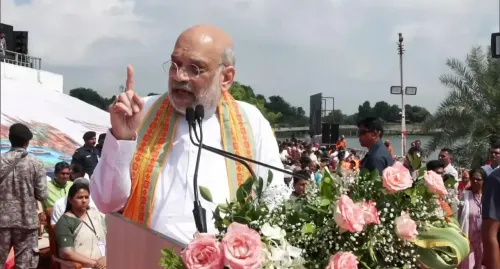
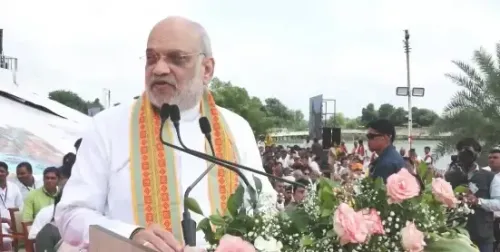
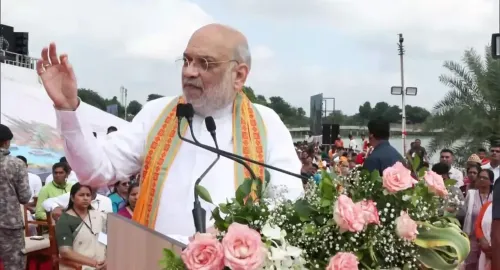
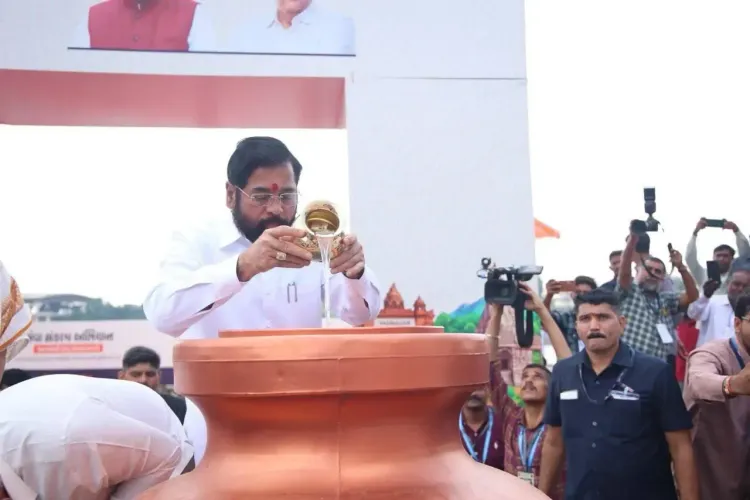
Maharashtra Deputy Chief Minister Eknath Shinde on Thursday, 17 September 2026, drew a pointed historical parallel between India's independence movement and Prime Minister Narendra Modi's development agenda, arguing that just as Mahatma Gandhi and Sardar Vallabhbhai Patel transformed national resolve into a mass movement for freedom, Modi has elevated the 'Viksit Bharat' goal into a nationwide mission. Shinde made the remarks in Vadnagar, Gujarat — the Prime Minister's birthplace — where he launched the 'Seva Sankalp Abhiyan' to mark Modi's 76th birthday and 25 years in public service.
Launch of Seva Sankalp Abhiyan
The campaign was flagged off at Vadnagar as part of birthday celebrations organised by Shiv Sena and the Maharashtra government. Shinde delivered greetings on their behalf, framing the occasion as more than a ceremonial tribute. According to Shinde, the event was inspired by a call from Union Home Minister Amit Shah during an NDA meeting to mark the Prime Minister's birthday by ensuring welfare benefits reach every poor citizen across the country.
'The spark ignited in Vadnagar has today become a revolution for India, and it will serve as the voice of a Viksit Bharat by 2047,' Shinde remarked at the event.
Key Achievements Cited by Shinde
Shinde credited the Modi-led government with moving India from the 10th to the 4th largest global economy, with ambitions of becoming the third largest. He cited flagship programmes — Make in India, Startup India, Standup India, and Atmanirbhar Bharat — as drivers of that economic ascent. He also pointed to the repeal of Article 370 and enhanced defence capabilities as foundational steps toward a secure India.
On the welfare front, Shinde highlighted schemes delivering LPG gas connections, permanent housing, bank accounts, and tap water to common citizens, arguing that a policy's true success lies in its ground-level implementation rather than its announcement. He added that India's growing stature in BRICS, the Global South, digital technology, and international diplomacy had been recognised through civilian honours conferred on the Prime Minister by multiple nations.
Heritage, Technology and the Road to 2047
Shinde also noted what he described as a complementary relationship between heritage restoration — citing the Ram Temple and Kashi Vishwanath Dham — and the adoption of modern technologies including artificial intelligence, suggesting this balance reflects a governing philosophy that preserves cultural values while embracing innovation.
Highlighting the Prime Minister's personal journey, Shinde described the trajectory from Vadnagar to Varanasi as symbolic of a path 'from service to dedication, resolve to transformation, and transformation to a Viksit Bharat.' He measured Modi's stature, he said, 'not by his age, but by his achievements — a height as tall as the Himalayas and a depth of service as deep as the Arabian Sea.'
Broader Political Context
The event underscores the ruling coalition's effort to build a narrative around Modi's governance legacy ahead of future electoral cycles. The Viksit Bharat by 2047 goal — India's centenary of independence — has become a central plank of the Bharatiya Janata Party (BJP)-led NDA government's long-term messaging, and Thursday's launch signals an organised grassroots push to deepen its reach. Whether the Seva Sankalp Abhiyan translates into measurable welfare delivery or remains largely symbolic will be closely watched by political observers.
Point of View
Lending it an almost sacred legitimacy that is difficult to critique without appearing anti-nationalist. The Seva Sankalp Abhiyan, pitched as welfare outreach, is also clearly a political mobilisation exercise, with Amit Shah's directive from an NDA meeting as its acknowledged origin. The Viksit Bharat 2047 target is a compelling long-horizon frame, but the gap between headline numbers — India at fourth in GDP — and ground-level welfare indices remains a live vulnerability. The campaign's real test is not the birthday launch but the last mile: whether welfare schemes cited by Shinde have, in fact, saturated the poorest households.
NationPress
17 Sept 2026
Frequently Asked Questions
What is the Seva Sankalp Abhiyan launched in Vadnagar?
The Seva Sankalp Abhiyan is a nationwide campaign launched on 17 September 2026 in Vadnagar, Gujarat, to mark Prime Minister Narendra Modi's 76th birthday and 25 years in public service. It was organised by Shiv Sena and the Maharashtra government, with a stated aim of ensuring welfare benefits reach every poor citizen.
Why did Eknath Shinde compare Modi to Gandhi and Patel?
Shinde argued that just as Mahatma Gandhi and Sardar Vallabhbhai Patel transformed national resolve into a mass freedom movement, Modi has converted the Viksit Bharat development goal into a nationwide mission. The comparison was made during the Seva Sankalp Abhiyan launch in Vadnagar on Modi's 76th birthday.
What economic achievements did Shinde attribute to the Modi government?
Shinde credited the Modi-led government with lifting India from the 10th to the 4th largest global economy, with ambitions of reaching third place. He also cited Make in India, Startup India, Standup India, and Atmanirbhar Bharat as flagship drivers of this growth.
What is the Viksit Bharat 2047 goal?
Viksit Bharat — meaning 'Developed India' — is the Modi government's long-term development vision targeting a fully developed nation by 2047, India's centenary of independence. It encompasses economic growth, welfare delivery, infrastructure, and India's global standing.
Who directed the birthday campaign and why?
According to Shinde, Union Home Minister Amit Shah called on NDA leaders during a party meeting to celebrate PM Modi's birthday by ensuring welfare scheme benefits reach every poor citizen, which became the organising principle behind the Seva Sankalp Abhiyan.