How Does Somnath Temple Reflect the Eternal Spirit of India?
Synopsis
Prime Minister Modi highlights the significance of Somnath Temple, a symbol of India's resilience against adversity, as it prepares to mark 1,000 years since its first attack. Discover how this historic site represents the enduring spirit of the nation and the continuous journey towards greatness.
Key Takeaways
Somnath Temple symbolizes the resilience of the Indian spirit.
The year 2026 marks significant milestones for the temple.
Historical invasions have shaped the temple's legacy.
Faith and goodness can overcome hate and fanaticism.
Somnath serves as a reminder of India's enduring cultural heritage.
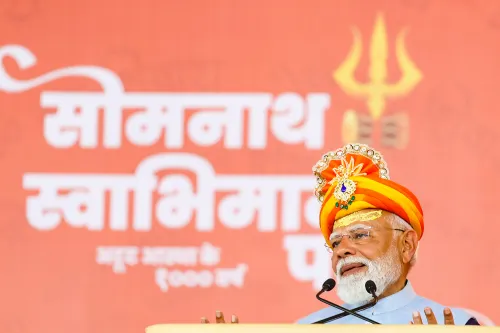
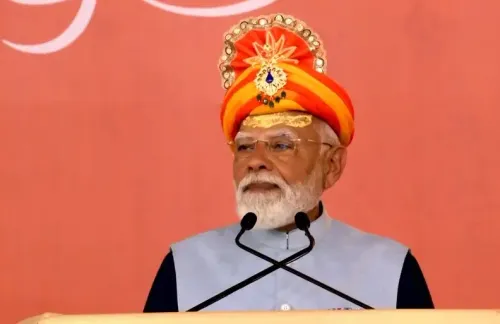
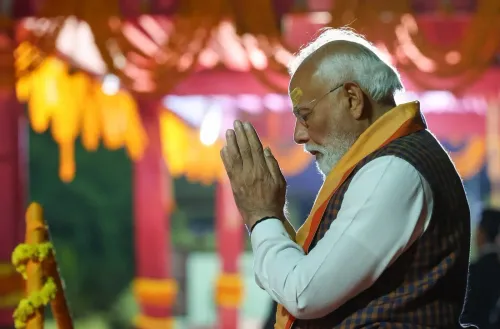
New Delhi, Jan 5 (NationPress) Prime Minister Narendra Modi emphasized that the Somnath Temple serves as an eternal testament to the Indian spirit, claiming that while hate and fanaticism can destroy momentarily, the faith and belief in the power of goodness can create everlasting strength.
He highlighted that the year 2026 will mark a millennium since the initial assault on the Somnath Temple by invaders in January 1026.
Reflecting on the temple's history and its repeated destruction by invaders over the centuries, the Prime Minister asserted that Somnath epitomizes India's unyielding civilizational spirit, standing resilient against numerous attacks and overwhelming challenges.
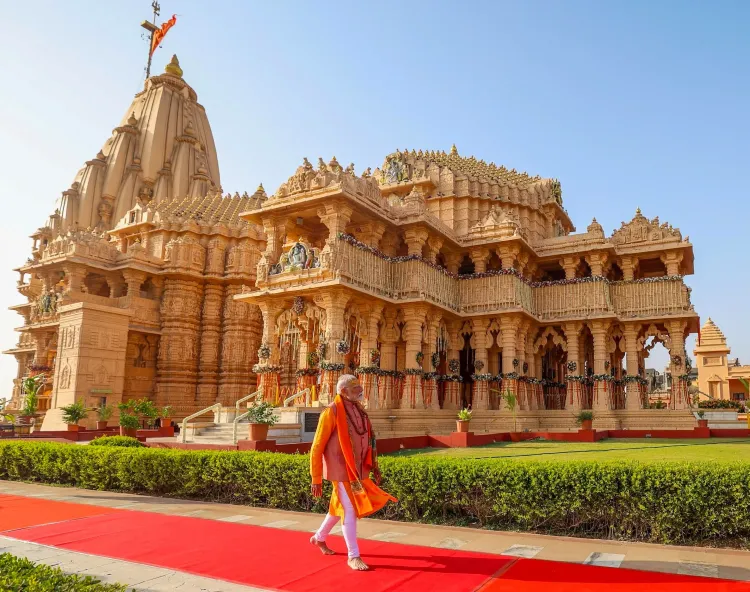
In a comprehensive blog post, PM Modi stated, "Somnath… just the mention of this name evokes a profound sense of pride within us. It is the eternal declaration of India's essence. This magnificent temple is located on the western coast of India in Gujarat, at a site called Prabhas Patan."
He mentioned that the Dwadasha Jyotirling Stotram refers to the 12 Jyotirlingas scattered across India and indicated that this stotram symbolizes the cultural and spiritual significance of Somnath as the inaugural Jyotirling.
Quoting a Sanskrit verse, the Prime Minister explained that merely witnessing the Somnath Shivling "frees an individual from sins, fulfills rightful desires, and grants access to heaven after death."
Recalling the time when Somnath, honored by millions, faced foreign invasions, PM Modi remarked that the invaders aimed at destruction, not devotion. He dubbed 2026 as a pivotal year for the shrine, marking 1,000 years since the temple's first attack.
"In January 1026, Mahmud of Ghazni launched an assault on this temple, attempting to obliterate a significant emblem of faith and civilization through a violent invasion. Yet, after a thousand years, the temple remains as glorious as ever due to the countless endeavors to restore Somnath to its former splendor," he stated.
He also noted another essential milestone in 2026, which will mark 75 years since the temple's reopening to devotees.
"On May 11, 1951, in the presence of then President of India, Dr Rajendra Prasad, the restored Somnath Temple reopened its doors," the Prime Minister recalled.
Describing the ferocity of the first invasion, PM Modi said, "The first assault on Somnath a millennium ago in 1026 unleashed cruelty upon the townsfolk and wreaked havoc on the shrine, as recorded in numerous historical accounts. Reading them evokes deep sorrow, with each line resonating grief and cruelty that time has not diminished."
He mentioned that the attack significantly impacted Bharat's morale, given Somnath's profound spiritual significance and its coastal location, which bolstered a society known for its economic affluence and maritime trade.
"Yet, I am proud to assert that the narrative of Somnath, after a thousand years, is not defined by destruction but by the unwavering courage of millions of children of Bharat Mata," PM Modi remarked.
Addressing the repeated assaults on the temple during the medieval era, the Prime Minister noted these events initiated attempts to subjugate the Indian populace and culture.
"However, with each attack, valiant men and women arose to defend it, often making the ultimate sacrifice. Time and again, the people of this remarkable civilization rebuilt and revitalized Somnath," he stated.
PM Modi paid homage to Ahilyabai Holkar for her contributions to restoring various temples across India, including Somnath and Kashi Vishwanath.
"We are privileged to be nurtured by the same land that fostered great figures like Ahilyabai Holkar, who made noble efforts to ensure devotees could again worship at Somnath," he said.
He also reminisced about Swami Vivekananda's visit to Somnath in the 1890s, quoting his 1897 lecture in Chennai, where Vivekananda expressed that temples like Somnath reveal more about India's history and spirit than volumes of books.
Quoting Vivekananda, PM Modi said such temples bear the marks of "a hundred attacks and a hundred regenerations," symbolizing the national vitality that continually arises stronger from destruction.
The Prime Minister mentioned that the sacred duty of reconstructing Somnath after Independence fell to Sardar Vallabhbhai Patel. He recalled that Patel's visit to the site during Diwali in 1947 profoundly affected him, leading to the decision to rebuild the temple at its original location.
"On May 11, 1951, a magnificent Somnath Temple was inaugurated for devotees in the presence of Dr Rajendra Prasad," he said.
PM Modi observed that then Prime Minister Jawaharlal Nehru was not in favor of the event and did not wish for top constitutional authorities to be associated with it.
"The great Sardar Sahib did not live to witness this historic occasion, but the realization of his dream stood tall before the nation. The then Prime Minister, Pandit Jawaharlal Nehru, was not particularly supportive of this development. He believed that this event would portray India negatively. Nevertheless, Dr Rajendra Prasad remained steadfast, and the rest is history," he added.
He stated that no discussion regarding Somnath is complete without acknowledging K.M. Munshi, who strongly backed Sardar Patel. Munshi's writings, including the book Somanatha: The Shrine Eternal, are "immensely informative and enlightening," PM Modi noted, adding that the title itself reflects India's civilizational belief in the eternity of spirit and ideas.
"No better example of our civilization's indomitable spirit exists than Somnath, which stands gloriously, overcoming obstacles and challenges," the Prime Minister said.
He added that the same spirit is evident in modern India, now regarded as one of the brightest centers of global growth after overcoming centuries of invasions and colonial exploitation.
"Our value systems and the resolve of our people have positioned India at the forefront of global attention. The world views India with hope and optimism, eager to invest in our innovative youth. Our arts, culture, music, and festivals are achieving global recognition. Yoga and Ayurveda are making a worldwide impact, and solutions to significant global challenges are emerging from India," he wrote.
PM Modi also underscored that Somnath has historically united individuals from diverse backgrounds. He recalled that centuries ago, the Jain monk Kalikal Sarvagna Hemchandracharya visited Somnath and, after praying there, recited a verse praising liberation from worldly afflictions.
"Even today, Somnath possesses the same ability to awaken something profound within the mind and soul," the Prime Minister remarked.
He concluded by stating that a millennium after the initial assault, the sea at Somnath continues to roar with the same force.
"The waves that touch the shores of Somnath narrate a story. No matter the circumstances, like the waves, it kept rising repeatedly," he stated.
"The aggressors of the past have become dust in the wind, remembered solely for their destruction. They are mere footnotes in history, while Somnath remains radiant, reminding us of the eternal spirit that could not be diminished by the attack of 1026. Somnath is a song of hope that teaches us that while hate and fanaticism may cause destruction temporarily, faith and conviction in goodness can create eternally," PM Modi added.
Drawing a broader lesson for the nation, the Prime Minister stated that if Somnath could rise repeatedly after relentless assaults, India too can reclaim the glory it possessed a thousand years ago.
"With the blessings of Shree Somnath Mahadev, we advance with renewed determination to build a Viksit Bharat, guided by our civilizational wisdom and working for the betterment of the entire world," he said.
Point of View
It is critical to acknowledge the significance of Somnath Temple as a symbol of India's enduring spirit. The Prime Minister's reflections remind us of the resilience and strength of our civilization, encouraging unity and hope in the face of challenges. The narrative of Somnath is not just about a temple but about the collective identity and aspirations of the nation.
NationPress
19 Sept 2026
Frequently Asked Questions
What is the historical significance of Somnath Temple?
Somnath Temple holds immense historical significance as it symbolizes India's rich cultural heritage and resilience against invasions. It is known for its repeated destruction and restoration, reflecting the enduring spirit of the Indian civilization.
When was Somnath Temple first attacked?
Somnath Temple was first attacked in January 1026 by Mahmud of Ghazni, marking a significant event in Indian history.
What milestones are being celebrated in 2026 concerning Somnath Temple?
The year 2026 will mark 1,000 years since the first attack on Somnath Temple and 75 years since its restoration and reopening to devotees in 1951.
Who played a vital role in the reconstruction of Somnath Temple after Independence?
Sardar Vallabhbhai Patel played a crucial role in the reconstruction of Somnath Temple after Independence, emphasizing its importance to the Indian identity.
How does Somnath Temple unite people from diverse backgrounds?
Somnath Temple has historically brought together individuals from various backgrounds, symbolizing unity and shared cultural values within India's diverse society.