Karnataka hijab row: Sri Rama Sene to distribute saffron shawls in schools from June 1
Synopsis
Sri Rama Sene's plan to distribute saffron shawls in Karnataka schools from June 1 is a direct counter to the Congress government's new notification permitting hijabs while banning saffron shawls — a selective exclusion that Hindu groups argue is discriminatory. With schools reopening on the same date, the 2022 flashpoint is primed to reignite.
Key Takeaways
Sri Rama Sene chief Pramod Muthalik announced on 21 May that the organisation will distribute saffron shawls in Karnataka schools and colleges from 1 June 2025 .
The Karnataka Congress government's new notification lifts the hijab ban and permits select religious symbols but explicitly excludes saffron shawls.
Muthalik alleged the notification reverses the BJP government's 2022 circular and could trigger communal tensions.
The Vishwa Hindu Parishad (VHP) has also opposed the government's decision.
Authorities are on alert, recalling the 2022 hijab controversy that disrupted law and order statewide.
Separately, Sri Rama Sene has written to the Union Home Ministry over beef exports worth an alleged ₹50,000 crore annually.
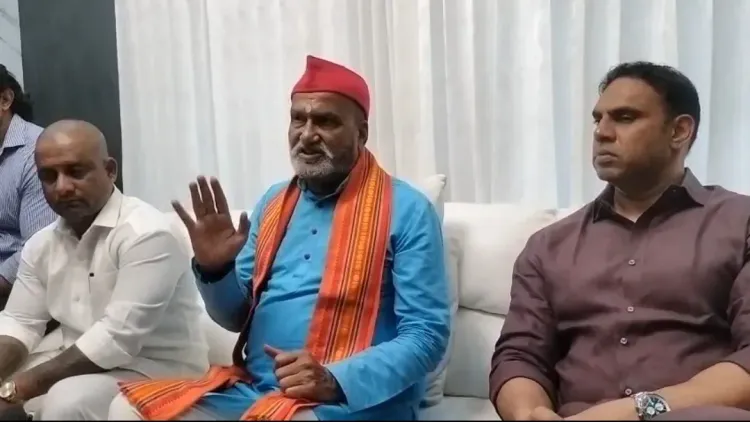
Sri Rama Sene chief Pramod Muthalik on Thursday, 21 May announced that his organisation would distribute saffron shawls to students in schools and colleges across Karnataka beginning 1 June, escalating tensions over the state government's decision to lift restrictions on hijabs and permit select religious symbols in educational institutions. The announcement, made in Davanagere, comes as the hijab-versus-saffron-shawl controversy threatens to resurface ahead of the new academic year.
What the Karnataka Government Decided
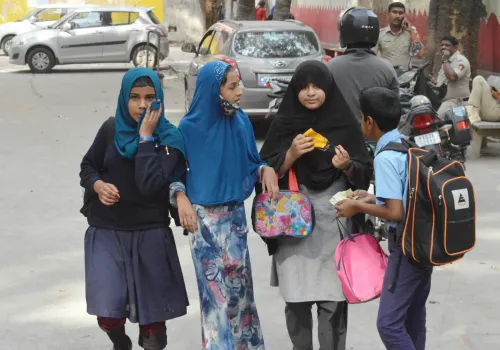
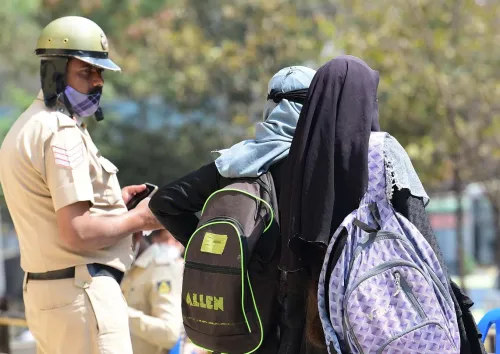
The Congress government in Karnataka recently issued a notification lifting the earlier ban on hijabs in schools and colleges, while also permitting limited religious symbols — including turbans, kada, tilak, holy ash, Cross, and kalawa — on school and college premises. Crucially, the notification explicitly rules out saffron shawls, a distinction that Hindu organisations have sharply contested.
Muthalik alleged that the new notification effectively reverses the Bharatiya Janata Party (BJP) government's 2022 circular, which had prohibited religious attire in classrooms. 'The BJP government's 2022 notification has been withdrawn and the Congress government has issued a new notification allowing hijabs in schools and colleges,' he claimed.
Sri Rama Sene's Objections
Muthalik argued that school uniforms were introduced specifically to eliminate visible markers of religion, caste, and class among students. 'Forty years ago, the Congress government itself implemented a uniform policy across the country so that there would be no discrimination among students. But now they have broken that principle by permitting hijabs,' he said.
He further contended that if hijabs were permitted, saffron shawls must be granted equal standing. 'If hijabs are allowed inside schools and colleges, saffron shawls will also have to be allowed,' he asserted. Muthalik also alleged that the government's move was politically motivated, claiming it was aimed at pacifying Muslim voters following what he described as communal tension during a recent bypoll in Davanagere. He warned the decision could 'lead to conflict and even communal riots.'
VHP and Other Hindu Organisations Join Opposition
The Vishwa Hindu Parishad (VHP) has also voiced opposition to the government's notification, adding institutional weight to the pushback from Hindu groups. Despite the state government's explicit prohibition on saffron shawls, multiple Hindu organisations have reportedly indicated they will continue to support students who choose to wear them to educational institutions.
Authorities are said to be closely monitoring developments, particularly with schools and colleges scheduled to reopen after summer vacation on 1 June.
2022 Controversy: A Flashback
The current standoff echoes Karnataka's 2022 hijab controversy, which severely strained law and order across the state. At the time, the Al-Qaeda network's then-leader, Ayman al-Zawahiri, released a video praising student Muskan Khan, who had shouted 'Allahu Akbar' after being heckled by a crowd in Mandya. Zawahiri called upon Indian Muslims to resist what he described as oppression — an intervention that drew widespread condemnation and heightened the controversy's national profile.
Separate Demand on Beef Exports
Separately, Muthalik said Sri Rama Sene had written to the Union Home Ministry and the Animal Husbandry Department demanding action on beef exports. 'Every year, beef worth nearly ₹50,000 crore is exported. Worshipping cows on one hand and exporting beef on the other is not right,' he said, warning of a major protest campaign against the Central government on the issue.
With schools set to reopen on 1 June, the situation in Karnataka is expected to sharpen — and the state government will face pressure to enforce its notification uniformly across all communities.
Point of View
But the optics hand Sri Rama Sene and VHP a ready-made grievance heading into the new academic year. Karnataka has been here before — the 2022 controversy cost the state weeks of disruption and drew international attention it did not want. The real question is whether the government has a credible enforcement plan or is simply issuing notifications and hoping the situation de-escalates on its own.
NationPress
20 Sept 2026
Frequently Asked Questions
Why is the Karnataka hijab-saffron shawl controversy flaring up again?
The controversy has resurfaced after the Karnataka Congress government issued a notification lifting the ban on hijabs in schools and colleges while permitting select religious symbols such as turbans, kada, and tilak — but explicitly excluding saffron shawls. Sri Rama Sene and the VHP have called this discriminatory and announced counter-measures including distributing saffron shawls from 1 June.
What exactly did the Karnataka government's new notification say?
The notification permits students to wear hijabs and limited religious symbols including turbans, kada, tilak, holy ash, Cross, and kalawa in educational institutions. It specifically rules out saffron shawls, reversing the BJP government's 2022 circular that had broadly restricted religious attire in classrooms.
Who is Pramod Muthalik and what has he announced?
Pramod Muthalik is the chief of Sri Rama Sene, a Hindu nationalist organisation based in Karnataka. He announced on 21 May in Davanagere that his organisation would distribute saffron shawls to students in schools and colleges across the state beginning 1 June, in protest against the new government notification.
What happened during the 2022 Karnataka hijab controversy?
In 2022, the hijab row severely disrupted law and order across Karnataka after colleges began enforcing restrictions on religious attire. The controversy drew international attention when Al-Qaeda leader Ayman al-Zawahiri released a video praising student Muskan Khan, who had shouted 'Allahu Akbar' after being heckled in Mandya.
When are Karnataka schools set to reopen, and why does the date matter?
Most schools and colleges in Karnataka are scheduled to reopen on 1 June after the summer vacation — the same date Sri Rama Sene has announced for its saffron shawl distribution drive. Authorities are on alert, as the convergence of these events significantly raises the risk of on-ground confrontations.