Sugarcane FRP revision sparks farmer protests ahead of 2026-27 crushing season

Synopsis
Even as the crushing season looms, sugarcane farmers across three states are rejecting the Centre's ₹365/quintal FRP as woefully short — pointing to a cost formula that ignores land value and capital interest. With ethanol profits swelling mill coffers and input costs soaring, the gap between what farmers get and what they demand has rarely felt wider.
Key Takeaways
The Centre fixed sugarcane FRP at ₹365 per quintal for the 2026-27 season , a hike of ₹10 per quintal over the previous year.
The All India Kisan Sabha (AIKS) submitted a memorandum on 19 November 2026 to a high-powered committee chaired by Ramesh Chand , former NITI Aayog member.
Farmers allege the FRP uses the A2+FL cost formula , which excludes land rental value and capital interest; they demand pricing at C2 cost plus 50% as recommended by the Swaminathan Commission .
Protests are active in Karnataka , Haryana , and Maharashtra ; growers also demand farm-gate pricing, transparent weighing, and timely mill payments.
Haryana BKU (Mann) president Guni Prakash Thakur announced plans to meet the Chief Minister on 20 November 2026 over the SAP hike of just ₹15 per quintal .
Farmer organisations across multiple sugarcane-growing states have intensified protests against the Union government's latest revision of the Fair and Remunerative Price (FRP) for sugarcane, alleging that the hike fails to cover rising cultivation costs as the 2026-27 crushing season approaches. The unrest comes even as the Centre defends the revised FRP as remunerative, setting up a fresh confrontation between growers and policymakers in New Delhi.
AIKS Submits Memorandum to High-Powered Committee
A delegation of the All India Kisan Sabha (AIKS) on Thursday, 19 November 2026 submitted a memorandum to a high-powered committee constituted by the Ministry of Consumer Affairs, Food and Public Distribution to examine sugarcane farming and sugar industry concerns. The panel is chaired by Ramesh Chand, former member of NITI Aayog.
The AIKS described the government's decision to raise the FRP by ₹10 per quintal as 'unscientific' and built on flawed assumptions. The Centre had approved an FRP of ₹365 per quintal for the 2026-27 sugar season for cane with a basic recovery rate of 10.25 per cent. The pricing mechanism includes incentives for higher sugar recovery and proportional deductions for lower recovery rates.
The Core Dispute: Cost Formula and Swaminathan Demands
At the heart of the controversy is the government's use of the A2+FL cost formula for FRP calculations, which farmer groups argue excludes the rental value of owned land and interest on fixed capital. The Centre has maintained that growers receive 100.5 per cent above cost of production — a claim AIKS and allied organisations flatly reject.
Referring to the landmark recommendations of the Swaminathan Commission, farmer bodies have demanded that sugarcane prices be fixed at no less than the C2 cost plus a 50 per cent margin — a formula that accounts for a fuller range of input and capital costs. This demand, while longstanding, has gained fresh urgency with input prices — labour, fertiliser, pesticide, and diesel — rising sharply in recent months.
Notably, the Centre approves the FRP, but states may also announce a State Advised Price (SAP), which is typically higher and state-specific. Haryana's SAP revision of ₹15 per quintal has drawn particular criticism.
Protests Spread Across Karnataka, Haryana, and Maharashtra
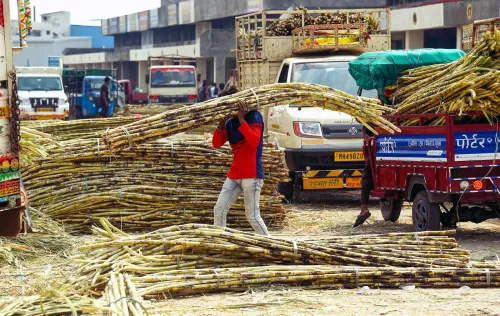
Demonstrations have broken out in key sugarcane belts spanning Karnataka, Haryana, and Maharashtra. Growers are demanding not just a substantial FRP revision, but also a greater share of profits that sugar mills earn from sugar, ethanol, and other by-products — a reflection of the growing value of the cane-to-ethanol supply chain under India's ethanol blending programme.
Other demands raised by farmer groups include fixing procurement prices at the farm gate — so that harvesting and transport costs are not borne by farmers — reducing the basic sugar recovery benchmark used in FRP calculations, ensuring transparent cane weighing, and enforcing timely payments from mills.
What Farmer Leaders Said
AIKS President Rajan Kshirsagar alleged that the current pricing structure amounts to 'punishment to farmers' while 'pockets of the corporates and the sugar mill owners have been filled.'
Guni Prakash Thakur, president of the Haryana BKU (Mann) unit, announced on Thursday that a delegation would meet the state's Chief Minister to press the issue. 'Raising the price by a mere ₹15 (for SAP) is a joke on farmers, where input costs have gone up significantly, whether it is labour, fertiliser, pesticide, diesel, or whatever,' Thakur said.
What Happens Next
The high-powered committee chaired by Ramesh Chand is expected to consolidate representations from farmer bodies and industry stakeholders before submitting its findings. With the crushing season imminent, any delay in resolution risks disrupting cane supply to mills. This is not the first time FRP revisions have triggered protests — similar standoffs erupted ahead of the 2023-24 and 2024-25 seasons, with states eventually stepping in with higher SAPs to defuse tensions. Whether that pattern repeats itself will depend on how quickly state governments respond to escalating farmer pressure.
Point of View
States top up with SAPs, and the structural dispute over the cost formula is deferred to the next season. What is different this time is the ethanol dimension: mills are earning handsomely from the government's blending mandate, yet that revenue stream does not feed back into the cane price farmers receive. As long as the FRP formula remains anchored to A2+FL rather than the fuller C2 measure, the Swaminathan Commission's core recommendation stays on paper. The high-powered committee's mandate is a constructive step, but committees have been appointed before without altering the formula. The real test is whether Ramesh Chand's panel has the political backing to recommend a methodology change — not just a price tweak.
NationPress
19 Nov 2026
Frequently Asked Questions
What is the Fair and Remunerative Price (FRP) for sugarcane in 2026-27?
The Centre has fixed the FRP at ₹365 per quintal for the 2026-27 sugar season, applicable to cane with a basic recovery rate of 10.25 per cent. This represents an increase of ₹10 per quintal over the previous season, with incentives for higher recovery and deductions for lower recovery.
Why are sugarcane farmers protesting against the FRP revision?
Farmer organisations argue that the ₹10/quintal hike does not cover rising input costs — labour, fertiliser, pesticide, and diesel — and that the FRP is calculated using the A2+FL formula, which excludes land rental value and interest on fixed capital. They demand pricing based on the C2 cost-plus-50% formula recommended by the Swaminathan Commission.
Which states are seeing protests over sugarcane prices?
Active protests have been reported in Karnataka, Haryana, and Maharashtra — all major sugarcane-producing states. The Haryana BKU (Mann) unit has separately announced plans to meet the state Chief Minister to press for a higher State Advised Price (SAP).
What is the difference between FRP and SAP for sugarcane?
The FRP (Fair and Remunerative Price) is set by the Union government and is the minimum price sugar mills must pay to farmers. The SAP (State Advised Price) is a higher, state-specific price that individual state governments may announce on top of the FRP; Haryana's SAP revision of ₹15 per quintal has also drawn farmer criticism as inadequate.
What is the high-powered committee examining sugarcane issues?
The Ministry of Consumer Affairs, Food and Public Distribution has constituted a high-powered committee chaired by Ramesh Chand, former member of NITI Aayog, to examine issues concerning sugarcane farmers and the sugar industry. The All India Kisan Sabha submitted a memorandum to this committee on 19 November 2026.