Supreme Court Dismisses Criminal Charges Against Elvish Yadav in Snake Venom Case

Synopsis
The Supreme Court has overturned the criminal case against Elvish Yadav, a YouTuber and reality show winner, related to snake venom procurement for rave parties in Noida. The court deemed the legal basis for the charges under the NDPS and Wildlife Protection Acts unsustainable.
Key Takeaways
The Supreme Court quashed the criminal case against Elvish Yadav.
The court found the charges under the NDPS and Wildlife Protection Acts legally unsustainable.
No recovery was made from Elvish Yadav himself.
The complaint was filed by an individual from an animal welfare organization, not an authorized officer.
The ruling allows for further legal actions by competent authorities.
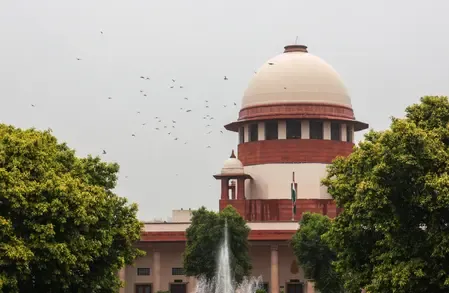
New Delhi, March 19 (NationPress) In a significant ruling, the Supreme Court has dismissed the criminal case against popular YouTuber and reality show champion Elvish Yadav, which involved allegations of acquiring and utilizing snake venom at rave parties in Noida and the NCR. The court determined that the application of provisions from the Narcotic Drugs and Psychotropic Substances (NDPS) Act and the Wildlife (Protection) Act was not legally valid.
A panel comprised of Justices M.M. Sundresh and N. Kotiswar Singh accepted Yadav's special leave petition (SLP) and overturned the prior decision made by the Allahabad High Court, which had declined to dismiss the ongoing criminal proceedings in the Gautam Buddha Nagar court.
The case stemmed from an FIR lodged in November 2023 at the Sector 49 police station in Noida, following a complaint from the animal rights group People for Animals (PFA), which claimed that snake venom was being sourced and used in rave parties within the National Capital Region.
In its ruling, the Justice Sundresh-led panel emphasized that their examination focused solely on specific legal matters and did not delve into the merits of the allegations. They identified two primary questions: the relevance of Section 2(23) of the NDPS Act and the legitimacy of actions under Section 55 of the Wildlife (Protection) Act.
Upon review, the Supreme Court concluded that the substance allegedly seized from a co-accused party did not qualify as a psychotropic substance as outlined in the NDPS Act's schedule.
“Regarding Section 2(23) of the NDPS Act, it is clear that the substance recovered from the co-accused does not fit the definition of psychotropic substances in the statutory schedule,” noted the Justice Sundresh-led panel.
The court also pointed out that no seizure had occurred from Yadav himself, with accusations against him limited to the act of placing orders via an associate.
Turning to the Wildlife (Protection) Act, the panel scrutinized the stipulations under Section 55, which requires that prosecutions be initiated only through complaints made by authorized personnel.
The Supreme Court indicated that the complaint in this instance was filed by an individual linked to an animal welfare organization, rather than a designated authority as mandated by the statute.
“We conclude that Section 55 of the Act necessitates a complaint from a recognized authority,” the Justice Sundresh-led panel stated, declaring that the current form of the FIR lacked legal standing.
Simultaneously, the Supreme Court clarified that it was not exonerating Yadav and had not assessed the allegations based on their substance.
It permitted the appropriate authorities to initiate necessary legal actions, including the possibility of filing a formal complaint under Section 55 of the Wildlife (Protection) Act.
Prior to this, the Supreme Court had suspended the trial court's proceedings against Yadav while addressing his SLP that contested the Allahabad High Court’s denial to dismiss the case pre-trial.
Point of View
It's crucial to highlight that the Supreme Court's ruling reflects a significant judicial review of the application of laws regarding narcotics and wildlife protection. This case underscores the importance of legal procedures and the need for clear authority when filing complaints in such sensitive matters.
NationPress
24 Sept 2026
Frequently Asked Questions
What was the case against Elvish Yadav about?
Elvish Yadav faced criminal charges related to the procurement and use of snake venom at rave parties in Noida, which were alleged violations of the NDPS and Wildlife Protection Acts.
What did the Supreme Court rule regarding the case?
The Supreme Court quashed the criminal proceedings against Elvish Yadav, stating that the legal basis for the charges was not sustainable.
Who filed the complaint against Elvish Yadav?
The complaint was filed by the animal rights organization People for Animals (PFA).
What legal provisions were discussed in the ruling?
The ruling focused on Section 2(23) of the NDPS Act and Section 55 of the Wildlife (Protection) Act.
Does this ruling exonerate Elvish Yadav?
No, the Supreme Court clarified that it did not grant a clean chit to Yadav and did not evaluate the allegations on their merits.