Did the Supreme Court Issue Notice on Tasleem Ahmed's Bail Plea in the Delhi Riots Case?
Synopsis
The Supreme Court has taken a significant step by issuing a notice on Tasleem Ahmed's bail plea in connection to the Delhi riots case. This development raises questions about the judicial process and the implications of the stringent UAPA. Stay tuned for more details as the case unfolds.
Key Takeaways
Supreme Court issues notice on Ahmed's bail plea.
Case involves serious charges under the UAPA .
High Court emphasizes gravity of the offense in bail decisions.
Several individuals are implicated in the alleged conspiracy.
Upcoming hearing scheduled for April 6, 2026.
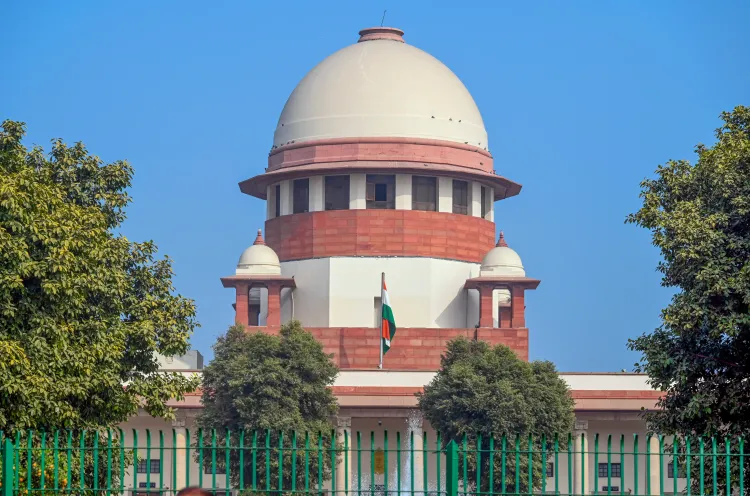
New Delhi, Feb 11 (NationPress) - On Wednesday, the Supreme Court issued a notice regarding a bail plea from Tasleem Ahmed, who is implicated in the 2020 riots as part of a "larger conspiracy case." This plea challenges the Delhi High Court ruling that denied him bail under the strict Unlawful Activities (Prevention) Act (UAPA).
A panel comprising Justices Aravind Kumar and Prasanna B. Varale has requested a response from the Delhi Police on Ahmed's special leave petition (SLP), which contests the September 2, 2025 ruling that upheld the trial court's rejection of his third bail application.
The case is tentatively scheduled for a hearing on April 6, 2026, as indicated by the computerized case status on the apex court's website.
Since his arrest on June 24, 2020 by the Crime Branch, Ahmed has been in judicial custody related to the violence that erupted in North-East Delhi between February 23 and 25, 2020, during protests against the Citizenship (Amendment) Act.
He faces multiple charges, including violations of the IPC, the Arms Act, the Prevention of Damage to Public Property Act, and various sections of the UAPA (Sections 13, 16, 17, and 18).
The prosecution alleges that Ahmed was involved in a broader scheme aimed at inciting violence in areas like Jafrabad, Maujpur, Chand Bagh, and Gokulpuri.
Ahmed claims he merely protested against the CAA and contends that his arrest is based on terrorism allegations.
Other individuals implicated in the alleged conspiracy include Umar Khalid, Sharjeel Imam, Meeran Haider, Gulfisha Fatima, Shifa-ur-Rehman, Mohd Saleem Khan, Shadab Ahmed, Athar Khan, Abdul Khalid Saifi, and others.
The Delhi High Court determined in its comprehensive judgment that bail under Section 43D(5) of the UAPA cannot be granted simply due to trial delays.
The panel of Justices Subramonium Prasad and Harish Vaidyanathan Shankar stated, "Factors such as prolonged incarceration or trial delays cannot solely warrant bail without considering the seriousness of the offense or the accused's role."
Rejecting Ahmed's argument regarding his lengthy custody without trial initiation, the Delhi High Court noted that the delay in proceedings is primarily due to the accused's own actions. It emphasized that despite orders for continuous hearings, the accused's legal representatives were "unprepared to present arguments" and cautioned that "any delay will be viewed seriously by the court."
Moreover, the Delhi High Court stated that, except in cases of "clear violations of fundamental rights," bail under Section 43D(5) of the UAPA cannot be granted merely due to extended detention, particularly when the accused has not argued the merits of the case.
Recently, the Supreme Court denied bail requests from co-accused Sharjeel Imam and Umar Khalid, stating that the cumulative evidence presented by the prosecution provides reasonable grounds for believing that the charges are prima facie valid under Section 43D(5) of the UAPA.
However, the apex court did grant bail to five other accused individuals—Gulfisha Fatima, Meeran Haider, Shifa Ur Rehman, Mohd Saleem Khan, and Shadab Ahmed—while denying relief to Imam and Khalid.
The Delhi Police has asserted that numerous student activists and others were involved in a premeditated conspiracy to incite violence during the February 2020 riots, which resulted in 53 fatalities and over 700 injuries, with protests coinciding with the visit of then U.S. President Donald Trump to attract international scrutiny.
Point of View
The developments surrounding Tasleem Ahmed’s bail plea reflect significant legal and social issues at play. The case highlights the tensions between public safety and individual rights, which are crucial in a democratic society. As the situation evolves, it is imperative to observe the balance between justice and the rule of law.
NationPress
23 Sept 2026
Frequently Asked Questions
What is the basis of Tasleem Ahmed's bail plea?
Tasleem Ahmed's bail plea is based on challenging the Delhi High Court's refusal to grant bail under the UAPA, asserting that his detention has been prolonged without trial.
What are the charges against Tasleem Ahmed?
He faces multiple charges including violations of the IPC, Arms Act, Prevention of Damage to Public Property Act, and various sections of the UAPA.
What has the Delhi High Court concluded regarding bail under UAPA?
The Delhi High Court concluded that bail under Section 43D(5) of the UAPA cannot be granted solely due to delays in trial without considering the gravity of the offense.
Who else is implicated in the larger conspiracy case?
Other accused include Umar Khalid, Sharjeel Imam, Meeran Haider, Gulfisha Fatima, and several others.
What was the outcome of the recent bail pleas in the case?
The Supreme Court denied bail to Sharjeel Imam and Umar Khalid, but granted bail to five other accused individuals.