Tamil Nadu sets up TNIPC to fast-track investments, targets $1.5 trillion economy by 2036

Synopsis
Tamil Nadu has formalized its investment push with a new high-level commission — TNIPC — bringing together over a dozen departments under one roof to cut clearance delays and chase a $1.5 trillion economy target by 2036. With a $72 billion export goal for 2026-27 and district-level targets across all 38 districts, the state is betting that institutional coordination can convert signed agreements into running factories.
Key Takeaways
Tamil Nadu established the Tamil Nadu Investment Promotion Commission (TNIPC) under the Tamil Nadu Business Facilitation (Amendment) Act, 2026 , effective 3 November 2026 .
The commission is headed by the Chief Secretary , with the Industries Secretary as member-convener and officials from over 12 departments as members.
Tamil Nadu has set a merchandise export target of $72 billion for 2026-27 , up from the current $59 billion .
District-specific export targets have been set for all 38 districts to broaden participation across manufacturers, farmers and small businesses.
The TNIPC is a key plank in Tamil Nadu's goal to become a $1.5 trillion economy by 2036 .
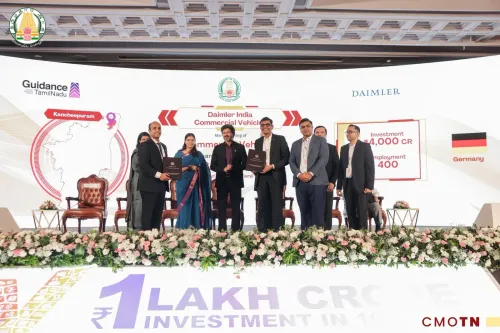
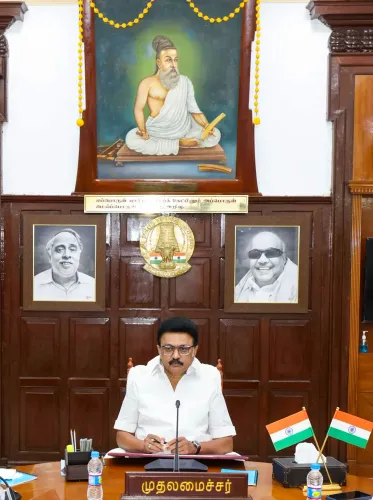
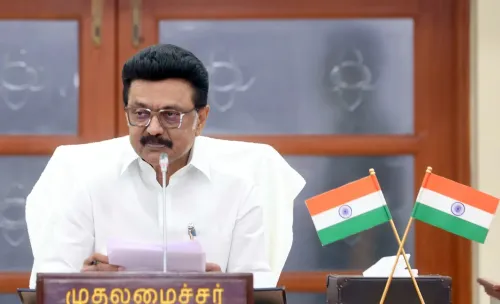
The Tamil Nadu government, led by Chief Minister C. Joseph Vijay, has established the Tamil Nadu Investment Promotion Commission (TNIPC) — a high-level body headed by the Chief Secretary — to accelerate industrial project implementation and attract both domestic and global investments. The commission was constituted under the Tamil Nadu Business Facilitation (Amendment) Act, 2026, which came into force on 3 November 2026.
Structure and Composition
The Industries Secretary will serve as member-convener of the TNIPC. Senior officials from departments covering finance, industries, energy, environment, revenue, housing, urban development and information technology will function as members. The commission will also draw in representatives from departments handling MSMEs, taxation, labour, skill development, water resources and municipal administration.
Officials from land administration, land reforms, the Tamil Nadu Pollution Control Board and Guidance Tamil Nadu — the state's nodal investment promotion agency — will additionally be part of the body. The wide cross-departmental coverage is designed to eliminate the coordination gaps that routinely delay project commencement after investment agreements are signed.
Key Objectives and Mandate
The TNIPC's primary mandate is to coordinate investment proposals, expedite administrative clearances and facilitate projects emerging from India's Free Trade Agreements (FTAs). The commission will also prioritise attracting investments from the Tamil diaspora worldwide, an increasingly significant capital pool that the state has sought to leverage through successive Global Investors Meet editions.
The government has explicitly acknowledged that securing investment commitments alone is insufficient; the new institutional mechanism is intended to ensure proposed projects are implemented within stipulated timelines — a persistent challenge that has seen a gap between announced and commissioned projects.
Tamil Nadu's $1.5 Trillion Economy Goal
The TNIPC forms a central pillar of Tamil Nadu's plan to become a $1.5 trillion economy by 2036. The state has set an ambitious merchandise export target of $72 billion for 2026-27, up from the current level of $59 billion. To ensure broad-based participation, district-specific export targets have been formulated for all 38 districts, covering manufacturers, farmers, entrepreneurs and small businesses.
Notably, this initiative comes as India's expanding network of international trade agreements opens new export corridors, and Tamil Nadu — already among the country's top industrial states — is positioning itself to capture a disproportionate share of incoming FTA-driven investment.
What This Means for Investors and Industry
The commission is expected to provide a unified administrative framework for land allocation, infrastructure development, electricity, water supply and environmental clearances — bottlenecks that have historically slowed project commissioning. Industry observers note that Tamil Nadu's existing investor-friendly track record, combined with a formal fast-track body, could strengthen its competitive position against rival states such as Telangana, Karnataka and Maharashtra in the race for large-scale manufacturing investments.
With the TNIPC now operational, the state's next test will be translating institutional intent into measurable reductions in project clearance timelines.
Point of View
But institutional breadth can also mean diffused accountability — the same coordination failure the body is designed to fix. The $72 billion export target for 2026-27 represents a significant 22% jump from current levels; whether district-level targets translate into ground-level export activity or remain statistical aspirations depends entirely on implementation rigour. Tamil Nadu's real competitive edge will be tested not at ribbon-cutting ceremonies, but in whether the TNIPC measurably compresses clearance timelines against states like Telangana and Karnataka that are aggressively courting the same pool of global capital.
NationPress
7 Nov 2026
Frequently Asked Questions
What is the Tamil Nadu Investment Promotion Commission (TNIPC)?
The TNIPC is a high-level investment body established by the Tamil Nadu government in November 2026, headed by the Chief Secretary, to coordinate investment proposals, expedite administrative clearances and facilitate projects linked to India's Free Trade Agreements. It was constituted under the Tamil Nadu Business Facilitation (Amendment) Act, 2026.
Why has Tamil Nadu set up the TNIPC?
The commission was set up to bridge the gap between investment commitments and actual project implementation — a persistent challenge where administrative delays between signing agreements and commencing operations have held back industrial growth. It is also central to the state's $1.5 trillion economy target by 2036.
What is Tamil Nadu's merchandise export target for 2026-27?
Tamil Nadu has set a merchandise export target of $72 billion for 2026-27, compared with the current level of $59 billion. District-specific targets have also been formulated for all 38 districts to encourage broader participation.
Who are the members of the TNIPC?
The commission includes senior officials from over 12 departments — finance, industries, energy, environment, revenue, housing, urban development, IT, MSMEs, taxation, labour, skill development, water resources and municipal administration — along with officials from the Tamil Nadu Pollution Control Board and Guidance Tamil Nadu.
How does TNIPC relate to Tamil Nadu's $1.5 trillion economy goal?
The TNIPC is a core institutional mechanism in Tamil Nadu's plan to reach a $1.5 trillion economy by 2036. By reducing clearance delays and coordinating land, infrastructure, energy and environmental approvals, it aims to accelerate the conversion of investment proposals into operational industrial projects.