Panna tigress dies in wire snare, poaching probe launched in MP
Synopsis
A young tigress in Madhya Pradesh's Panna forests likely starved to death after a clutch wire snare stayed locked around her neck for days. Officials are treating it as poaching and checking whether she left behind cubs. An activist calls North Panna ‘a death trap for tigers’.
Key Takeaways
A young tigress was found dead in the Manki beat of the North Panna Forest Division , Madhya Pradesh , on 26 November 2026 .
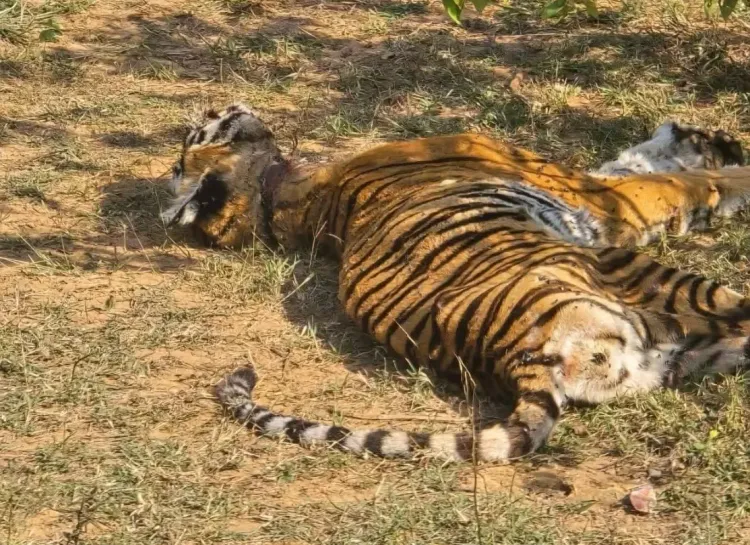
A clutch wire snare was found wrapped tightly around her neck.
SDO Krishna Maravi said she likely could not hunt and died of starvation , and the case is being probed as poaching .
Officials are checking M-STrIPES records to find out whether the tigress had cubs .
Activist Ajay Dube alleged negligence, calling North Panna ‘a death trap for tigers’.
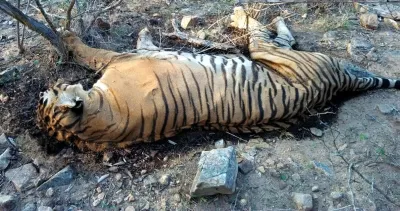
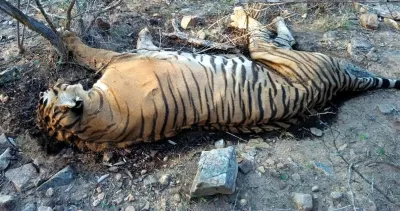
A young tigress has died after being caught in a clutch wire snare in the forests of Madhya Pradesh's Panna district. The Forest Department suspects she stayed trapped for several days and eventually died of starvation. Officials recovered the carcass on Thursday, 26 November 2026, and have registered the case as suspected poaching.
Key Developments
The carcass was found in the Manki beat of the Panna forest range, which falls under the North Panna Forest Division. Forest officials reached the spot after receiving information and found a clutch wire snare wrapped tightly around the tigress's neck.
Krishna Maravi, Sub-Divisional Officer (SDO) of the North Panna Forest Division, said the local Forest Range Officer informed him by telephone between 11.30 a.m. and noon.
“After receiving the information, I reached the spot along with the Forest Range Officer and other staff. During the inspection, a clutch wire snare was found around the tigress's neck,” Maravi said.
What the Forest Department Said
Maravi said the tigress appeared to be young. Officials suspect the snare had been around her neck for several days, which would have made it difficult for her to hunt.
“It is suspected that the tigress was unable to hunt because of the snare and eventually died of starvation. The presence of a clutch wire snare around her neck is a criminal act, and we are investigating the incident as a case of poaching,” he said.
If confirmed, this would mean the animal suffered a slow death. It would also mean the snare went unnoticed by field staff for days in a monitored forest area.
Investigation and the Question of Cubs
The Forest Department has launched an investigation to identify those who set the snare. Officials are also trying to find out whether the tigress had any cubs. Any surviving cubs would be extremely vulnerable without their mother.
According to Maravi, the department will examine its earlier records and data on the M-STrIPES (Monitoring System for Tigers – Intensive Protection and Ecological Status) system. The aim is to determine whether the tigress was previously spotted with cubs.
Activists Allege Protection Lapses
Wildlife activist Ajay Dube alleged serious lapses in wildlife protection in the North Panna division. He questioned how poachers could operate in an area adjoining a tiger reserve.
“This is not an accident. This is murder by negligence. North Panna Division has become a death trap for tigers,” Dube said.
He alleged that poachers were operating openly near the reserve. He also questioned why the Forest Department had failed to prevent such incidents.
Why It Matters
Snares made of clutch wire are cheap, easy to hide and indiscriminate, which makes them a persistent threat to large carnivores in forest buffer areas. This case raises two questions: whether patrolling in territorial divisions bordering protected areas matches the risk, and whether monitoring tools such as M-STrIPES are catching threats early enough.
The investigation's findings, and whether any cubs are traced, will shape how the Forest Department responds to mounting scrutiny over tiger safety in North Panna.
Point of View
Which makes a slow starvation death in a poacher's snare especially damning. The snare reportedly stayed on the animal for days, so the failure is not just the crime but the detection gap in a forest supposedly covered by M-STrIPES monitoring. Territorial divisions bordering reserves often get less protection than the core, yet tigers do not respect those boundaries. Unless the probe leads to arrests and visible changes in patrolling, activists' charge of ‘murder by negligence’ will be hard to dismiss.
NationPress
26 Nov 2026
Frequently Asked Questions
How did the tigress die in Panna?
The young tigress died after a clutch wire snare got trapped around her neck in the Manki beat of the North Panna Forest Division. Forest officials suspect the snare stayed on for several days, leaving her unable to hunt, and that she died of starvation.
Is the Panna tigress death being treated as poaching?
Yes, the Forest Department is investigating it as a case of poaching. SDO Krishna Maravi said the presence of the snare is a criminal act, and officials are trying to identify those responsible.
Did the dead tigress have cubs?
This is not yet known. Officials are examining previous records and M-STrIPES monitoring data to find out whether the tigress was earlier spotted with cubs.
What have wildlife activists said about the incident?
Activist Ajay Dube alleged serious lapses in wildlife protection, calling the incident ‘murder by negligence’. He said North Panna Division has become ‘a death trap for tigers’ and alleged that poachers operate openly near the reserve.