What Are the Implications of Tripura's MoU with the National Bureau of Soil Survey for Agriculture?
Synopsis
Tripura's recent MoU with the National Bureau of Soil Survey marks a pivotal moment in enhancing agricultural output. This collaboration promises detailed research on the state's soil resources, aiming for self-sufficiency in food production. With a focus on sustainable practices, the initiative could revolutionize farming in Tripura.
Key Takeaways
MoU signed to boost agricultural productivity.
Focus on sustainable farming practices.
Research to assess soil quality in Tripura.
Initial surveys in South Tripura and Gomati.
Collaboration with NBSS&LUP for strategic planning.
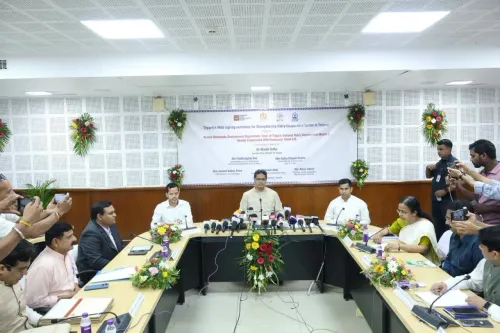
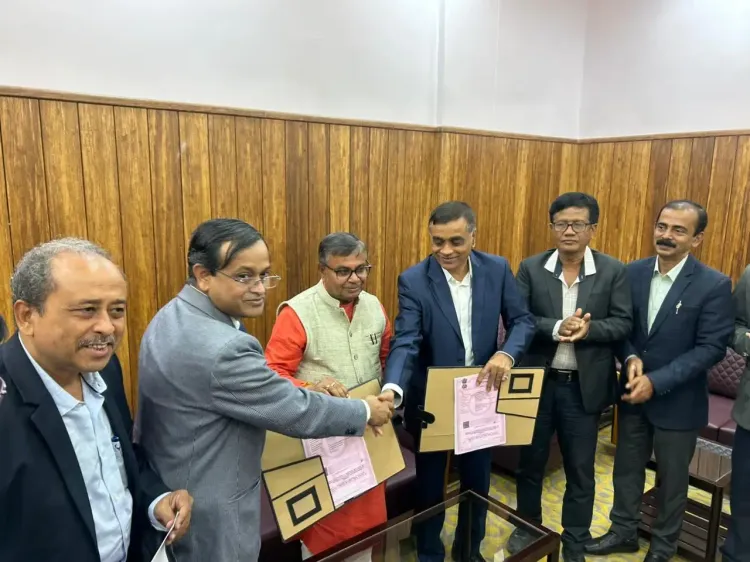
Agartala, Dec 17 (NationPress) In a significant move aimed at improving agricultural productivity and achieving self-sufficiency in food grain production, the Tripura Agriculture Department has formalized a Memorandum of Understanding (MoU) with the Nagpur-based National Bureau of Soil Survey and Land Use Planning (NBSS&LUP) on Wednesday.
The Tripura Agriculture and Farmers’ Welfare Minister Ratan Lal Nath stated that this partnership seeks to conduct extensive research on the arable land in various districts of the state, thereby paving the way for sustainable farming practices and a more robust agricultural future for Tripura.
During the inauguration of a workshop focused on the Land Resource Inventory of Tripura using Geospatial Techniques at Pragya Bhawan, the Minister remarked, “We frequently discuss self-reliance in agriculture, but scientific research on land is crucial for that.”
He emphasized that land is the primary component in agriculture, followed by seed quality, water availability, and scientific cultivation practices.
“Three years ago, we began evaluating the conditions of various soil layers. The Agriculture Department devised a strategy to make Tripura self-reliant in agriculture. Consequently, South Tripura and Gomati districts were prioritized for the survey,” Nath explained.
The Minister reported that soil scientists from NBSS&LUP assessed these districts and presented their findings, leading to the MoU being extended to three additional districts: North Tripura, Dhalai, and Unakoti.
On Wednesday, NBSS&LUP scientists shared their results, while surveys in the remaining three districts—West Tripura, Sepahijala, and Khowai—are still pending. The NBSS&LUP operates under the Indian Council of Agricultural Research (ICAR).
The Minister noted that such scientific planning was previously absent.
“Having been in politics for over 30 years, I recall when agriculture or food ministers discussed making Tripura self-sufficient in food grains, yet no concrete plans existed. Now, soil scientists can inform us about the types of soil we have and where crops like palm oil, rubber, millets, and paddy can be effectively cultivated,” he stated.
Nath highlighted that palm oil saplings were previously planted at the Nagicherra Horticulture Research Centre in West Tripura, but without scientific assessment, the attempt was largely unsuccessful.
Following the MoU, the Agriculture Department will develop a comprehensive strategy in collaboration with soil scientists to assist farmers in adopting crop patterns that align with local soil conditions.
“A thorough discussion took place with officials on Wednesday. We are striving for 100% success in the near future,” he added.
The Minister also mentioned that before the BJP government took power in 2018, only 22 blocks in the state achieved self-sufficiency in food grain production. “Since our government came into power, this number has risen to 30 blocks, with five more expected to reach self-sufficiency this year. Additionally, more agricultural products from Tripura will receive GI tags in the future,” he said.
Present at the event were Agriculture Department Secretary Apurba Roy, Director Fani Bhushan Jamatia, State Nodal Officer Uttam Saha, and several other officials.
Point of View
The signing of the MoU between Tripura and the NBSS&LUP is a significant step towards improving agricultural sustainability. It reflects a growing recognition of the importance of scientific research in farming, which is essential for achieving self-sufficiency in food production. This initiative could serve as a model for other states looking to enhance their agricultural frameworks.
NationPress
8 Oct 2026
Frequently Asked Questions
What is the MoU between Tripura and NBSS&LUP about?
The MoU aims to conduct in-depth research on the cultivable land in Tripura to enhance agricultural productivity and achieve self-sufficiency in food grain production.
What districts are involved in the initial survey?
The initial survey focuses on South Tripura and Gomati districts, with plans to extend the research to North Tripura, Dhalai, and Unakoti.
Who is responsible for conducting the soil surveys?
Soil scientists from the National Bureau of Soil Survey and Land Use Planning (NBSS&LUP) are conducting the surveys.
How will this MoU benefit farmers in Tripura?
The MoU will allow for a scientific assessment of soil conditions, which will enable farmers to adopt suitable crop patterns that optimize yields.
What are the expected outcomes of this collaboration?
The collaboration is expected to enhance agricultural productivity, improve food security, and promote sustainable farming practices in Tripura.