Will 2026 Mark a Major Shift in AI Usage as per Satya Nadella?
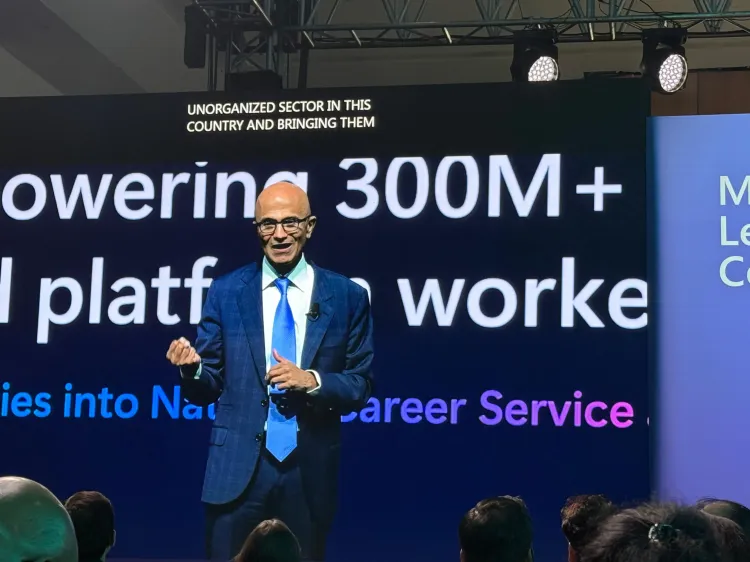
Synopsis
As we approach 2026, Microsoft CEO Satya Nadella highlights the pivotal transition in artificial intelligence from hype to real-world applications. Discover how AI's future hinges on effective human collaboration and the necessity of robust systems to harness its potential.
Key Takeaways
2026 will be crucial for AI adoption.
Shift from hype to real-world applications .
AI should enhance human capabilities .
Focus on integrated systems around AI.
Current models have limitations that need management.
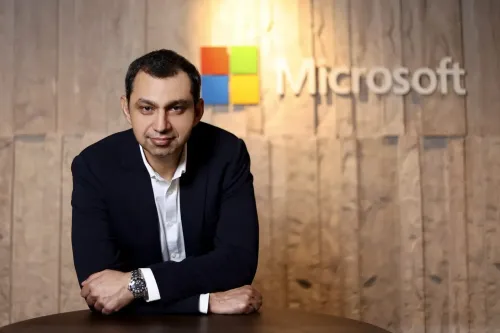
New Delhi, Dec 30 (NationPress) The CEO of Microsoft, Satya Nadella, has stated that the year 2026 will be pivotal for artificial intelligence, signaling a transition from mere experimentation and excitement to broader, real-world adoption of this technology.
In a recent blog entry, Nadella noted that the AI industry is moving past flashy exhibitions and starting to differentiate between “spectacle” and “substance” to identify areas where AI can provide significant benefits.
He acknowledged that while the development pace of AI has been remarkably swift, the application of these potent systems in practical scenarios has not matched that speed.
Nadella characterized the present scenario as a phase of “model overhang”, where AI models are advancing faster than our capacity to utilize them effectively in daily life, business, and society.
He remarked, “We are still in the opening miles of a marathon,” emphasizing that although progress is impressive, the future of AI remains largely unpredictable.
He stated, “Many of today’s AI capabilities have not yet translated into substantial outcomes that enhance productivity, decision-making, or human well-being on a large scale.”
Drawing a parallel with the inception of personal computing, Nadella referenced Steve Jobs’ well-known analogy of computers as “bicycles for the mind,” tools designed to augment human thought and productivity.
He asserted, “This concept must evolve in the era of AI,” emphasizing that AI should not aim to replace human cognition but rather to support and enhance it, serving as cognitive tools that empower individuals to achieve their goals more efficiently.
Nadella pointed out that the true value of AI lies not in the power of the model itself, but in how individuals opt to utilize it.
He suggested that the conversation should shift from evaluating AI outputs as either low-quality or highly advanced, to focusing on how humans adapt to these new tools in everyday interactions and decision-making processes.
The Microsoft leader highlighted that for AI to truly make a difference, the industry must move beyond merely creating sophisticated models.
He expressed the increasing necessity to develop comprehensive systems around AI, including software, workflows, and safeguards that ensure the technology can be deployed reliably and ethically.
While AI is progressing at an extraordinary pace, he admitted that existing systems still have imperfections and limitations that require careful oversight.
Point of View
It is critical to recognize the transformative potential of AI as highlighted by Satya Nadella. His insights stress the importance of responsible and effective use of AI systems, ensuring that they enhance human capabilities rather than overshadow them. This perspective aligns with the Nation's commitment to informed and ethical technological advancement.
NationPress
7 Oct 2026
Frequently Asked Questions
Why is 2026 significant for AI?
According to Satya Nadella, 2026 will represent a shift from experimentation to real-world applications of AI, moving beyond mere excitement to practical use.
What does 'model overhang' mean?
'Model overhang' refers to a situation where AI models are developing faster than our ability to apply them effectively in various sectors.
How can AI enhance human productivity?
Nadella suggests that AI should act as a cognitive tool that supports human thinking, helping people achieve their goals more effectively.
What key issues does Nadella raise about current AI capabilities?
He points out that many current AI capabilities have yet to translate into substantial outcomes that improve productivity or well-being at scale.
What does Nadella suggest for the future of AI systems?
He advocates for creating complete systems around AI, including software, workflows, and safeguards to ensure responsible usage.