Bairabi-Sairang railway line: One year on, Mizoram's logistics leap

Synopsis
A year after PM Modi inaugurated the Bairabi-Sairang line, Mizoram's rail debut has exceeded expectations — 15 lakh passengers, ₹54 crore in ticket sales, and direct trains to Delhi, Kolkata and Guwahati. For a state that was road-only for generations, the numbers signal more than connectivity: they mark an economic turning point.
Key Takeaways
The 51.38-km Bairabi-Sairang railway line was inaugurated by PM Narendra Modi on 13 September 2025 , completing Mizoram's first rail link to capital Aizawl .
In one year, services carried over 15 lakh passengers and generated ₹54 crore in ticket revenues for Indian Railways.
Sairang station recorded more than 5.54 lakh passenger movements , averaging 3,300 passengers per day .
The corridor features 153 bridges and 45 tunnels ; the tallest bridge stands at 114 metres — 42 metres higher than Delhi's Qutub Minar.
Three long-distance services now connect Aizawl with New Delhi , Kolkata and Guwahati ; a fourth service to Silchar was added in January 2026 .
Freight movement of essential commodities, automobiles and construction materials to Aizawl has become safer and more cost-effective.
The 51.38-km Bairabi-Sairang railway line, inaugurated by Prime Minister Narendra Modi on 13 September 2025, has fundamentally reshaped Mizoram's connectivity and logistics landscape in its first year of operation, railway officials said on Sunday, 13 September 2026. The line — the first to bring the rail network to the doorstep of state capital Aizawl — has drawn over 15 lakh passengers and generated ₹54 crore in ticket sales for Indian Railways within twelve months.
An Engineering Marvel in the Hills
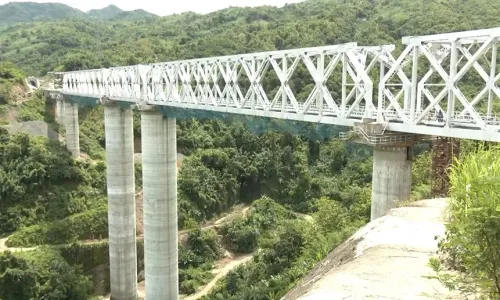
Running through steep hills, deep valleys and gorges, the Bairabi-Sairang corridor stands as one of northeast India's most challenging civil engineering achievements. The alignment incorporates 153 bridges — comprising 55 major bridges, 88 minor bridges, and 10 Road Over Bridges or Road Under Bridges — along with 45 tunnels stretching across nearly 16 kilometres.
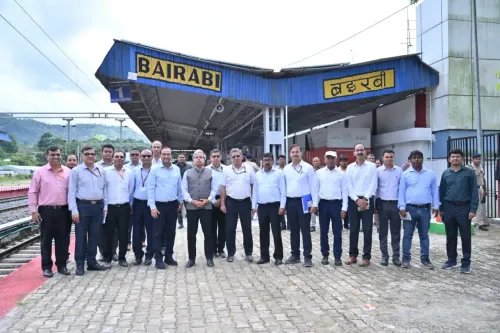
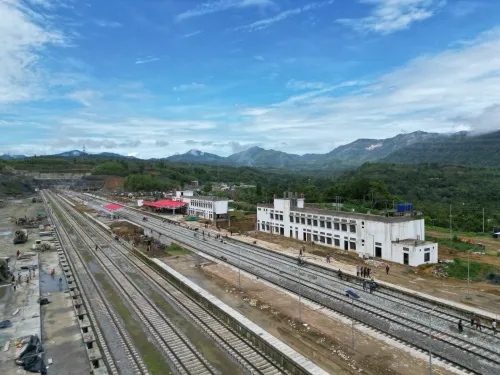
Six of the bridges soar beyond 70 metres in height, with the tallest reaching 114 metres — 42 metres taller than Delhi's Qutub Minar. The rail corridor links the national network at Bairabi in southern Assam to four newly developed stations — Hortoki, Kawnpui, Mualkhang — before terminating at Sairang railway station, just outside Aizawl.
Passenger Services Transforming Daily Life
Three long-distance train services now connect Mizoram's capital with major Indian cities. The Sairang-Anand Vihar Rajdhani Express gave the state its first direct premium rail link with New Delhi, while dedicated services to Guwahati and Kolkata opened dependable corridors to key educational, commercial and medical centres. In January 2026, Railway Minister Ashwini Vaishnaw separately inaugurated the Sairang-Silchar passenger service, connecting the station with southern Assam.
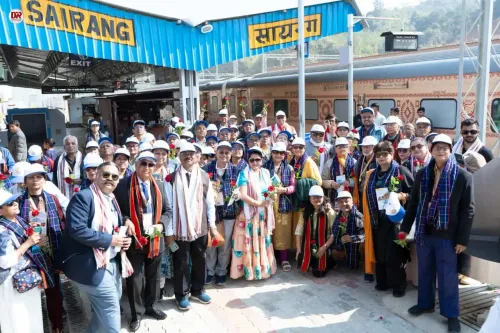
Collectively, these services have completed more than 1,100 trips in the past year. Sairang railway station alone recorded over 5.54 lakh passenger movements, averaging 3,300 passengers per day. Notably, local residents have also embraced the station as a community space, organising tree-plantation drives and environmental initiatives around the complex.
Freight and Commerce: Widening the Lifeline
For generations, Mizoram's mountainous terrain made the state almost entirely road-dependent for goods movement — a situation that left supply chains vulnerable to landslides, monsoon disruptions and high freight costs. The Bairabi-Sairang line has altered that equation, enabling essential commodities, automobiles and construction materials to reach Aizawl in a safer, more time-bound and cost-effective manner, according to officials.
This comes amid a broader Centre push to integrate the Northeast into India's national infrastructure grid — a priority that has seen significant rail investment across Assam, Manipur and Meghalaya over the past decade. Mizoram, which remained without a functional rail link to its capital until 2025, was among the last major gaps in that network.
What Comes Next
Railway officials indicate that the line's first year has validated the investment case, with ridership and freight volumes surpassing initial projections. With Aizawl now on India's railway map, attention shifts to whether additional services and eventual extension of the network deeper into the state can sustain and accelerate the connectivity dividend. Analysts note that improved logistics access could unlock tourism and agricultural supply-chain opportunities that the region's road-only past had constrained.
Point of View
Validating the Northeast integration logic. Yet the harder question is freight: road cartels and contractor networks in hilly states have historically resisted rail disruption to their margins, and whether the line meaningfully lowers commodity prices in Aizawl's markets remains unverified. The Centre's pattern of inaugurating northeastern rail links without publishing granular freight-rate and commodity-price impact data means the connectivity narrative, however compelling, runs ahead of the accountability one.
NationPress
13 Sept 2026
Frequently Asked Questions
What is the Bairabi-Sairang railway line?
The Bairabi-Sairang railway line is a 51.38-km rail corridor connecting Bairabi in southern Assam to Sairang, near Mizoram's capital Aizawl, inaugurated by Prime Minister Narendra Modi on 13 September 2025. It was the first railway link to bring the national rail network to the doorstep of Aizawl, ending generations of road-only connectivity for the state.
How many passengers has the Bairabi-Sairang line served in its first year?
More than 15 lakh passengers have used the train services operating on the Bairabi-Sairang corridor in its first year of operation. Sairang railway station alone recorded over 5.54 lakh passenger movements, averaging 3,300 passengers per day.
Which cities are now directly connected to Aizawl by train?
Aizawl's Sairang station is now directly connected to New Delhi via the Sairang-Anand Vihar Rajdhani Express, and to Kolkata and Guwahati through dedicated long-distance services. A fourth service connecting Sairang to Silchar in southern Assam was inaugurated by Railway Minister Ashwini Vaishnaw in January 2026.
What makes the Bairabi-Sairang line an engineering achievement?
The line traverses steep hills, valleys and gorges through 153 bridges and 45 tunnels spanning nearly 16 kilometres. The tallest bridge on the route stands at 114 metres — 42 metres higher than Delhi's Qutub Minar — with six bridges exceeding 70 metres in height.
How has the railway line changed freight movement in Mizoram?
The Bairabi-Sairang line has enabled essential commodities, automobiles and construction materials to reach Aizawl more safely, predictably and cost-effectively compared to road transport. Previously, Mizoram's mountainous terrain made freight almost entirely road-dependent, leaving supply chains vulnerable to seasonal disruptions.