Adi Vaani: AI platform bridging digital divide for 10.45 crore tribal Indians

Synopsis
Adi Vaani, a Ministry of Tribal Affairs AI platform built by IIT Delhi and partner institutes, is quietly doing something remarkable — using community-recorded voice data from tribal speakers to train language models in 13 languages, reaching over 10.45 crore Scheduled Tribe people historically locked out of digital services. With 13.9 lakh sentences and 300 hours of speech already collected, the platform is growing fast.
Key Takeaways
Adi Vaani was launched by the Ministry of Tribal Affairs on 1 September 2025 , developed by a consortium led by IIT Delhi .
The platform now covers 13 tribal languages including Santali , Bhili , Mundari , and Gondi , with text translation in nine languages .
As of 15 October 2026 , state TRIs contributed 13.9 lakh text sentences and around 300 hours of speech data .
The platform has over 35,000 Android downloads and roughly 6,500 monthly users .
India has approximately 10.45 crore Scheduled Tribe people , accounting for 8.6% of the population, per Census 2011 .
Each language follows five phases from data collection to AI model integration, with continuous retraining as community data grows.
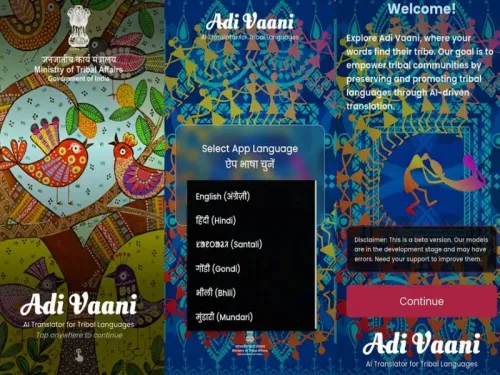
Adi Vaani, an AI-powered translation and language platform launched by the Ministry of Tribal Affairs, is working to close the digital and linguistic divide for India's tribal communities — covering 13 tribal languages and reaching over 35,000 Android downloads as of November 2026. A government factsheet released on Sunday, 15 November 2026, outlined the platform's expanding reach and community-driven model, underscoring its role in preserving languages spoken by roughly 10.45 crore Scheduled Tribe people, or about 8.6% of India's population according to Census 2011.
How Adi Vaani Was Built
Launched on 1 September 2025, Adi Vaani was developed by a national consortium led by IIT Delhi, with contributions from BITS Pilani, IIIT Hyderabad, IIIT Nava Raipur, and the Tribal Research Institutes (TRIs) of Jharkhand, Odisha, Madhya Pradesh, Chhattisgarh, and Meghalaya. Over time, several additional state TRIs joined the initiative, broadening its collaborative footprint across the country.
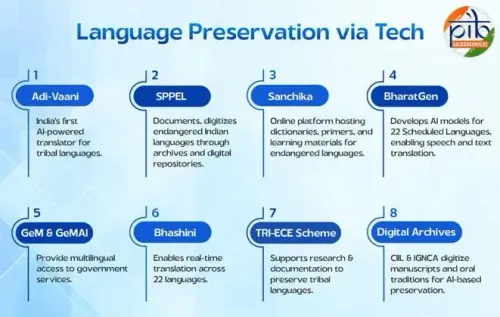
The platform began with four languages — Santali, Bhili, Mundari, and Gondi — and has since expanded text translation to nine tribal languages. Beyond text, it offers speech translation, Optical Character Recognition (OCR), video subtitling, and access to more than 300 language primers designed to help new learners understand and practice tribal languages.
Community-Driven Data and AI Training
'What makes Adi Vaani different is its community-based approach. Native speakers contribute words, sentences, and voice recordings through TRIs and AdiKosh. These are checked by language experts before being used to train AI models. The project aims to collect around 1,00,000 sentence pairs and 100 hours of speech recordings per language,' the government factsheet stated.
As of 15 October 2026, state TRIs had contributed approximately 13.9 lakh text sentences across ten languages and around 300 hours of speech data. Each language passes through five phases — from data collection to platform integration — and AI models are retrained continuously as communities add more data.
Scale and Reach
The platform has recorded over 35,000 Android downloads and approximately 6,500 monthly active users, according to the factsheet, signalling measurable uptake in a segment of the population historically underserved by mainstream digital tools. Notably, Adi Vaani works across 13 tribal languages spanning multiple regions, making it one of the broader multilingual AI initiatives targeting India's indigenous linguistic heritage.
Why This Matters
India's tribal population, numbering over 10.45 crore as per Census 2011, has long faced structural barriers in accessing government services, education, and digital infrastructure in their native tongues. Adi Vaani's approach — combining modern AI with community-sourced linguistic knowledge — represents an attempt to address that gap at scale. This comes amid a broader national push on digital inclusion, with language access increasingly recognised as a precondition for equitable service delivery in tribal-dominated districts of central and eastern India.
As the platform's dataset and user base grow, its ability to sustain and deepen community participation will determine whether it evolves into a durable tool for tribal language preservation or remains a promising but limited pilot.
Point of View
But asks communities to build the tool. That community-sourcing model is both its strength and its vulnerability: if TRI participation stalls or funding cycles break, so does the data pipeline. The platform's 6,500 monthly users are an encouraging early signal, but they represent a fraction of the 10.45 crore tribal citizens it ultimately serves. The harder question is whether Adi Vaani can move from a linguistic archive to a living, everyday-use platform — one that powers government service delivery and education in tribal languages, not just translation demos. That transition requires sustained political will beyond the current ministry's term.
NationPress
15 Nov 2026
Frequently Asked Questions
What is Adi Vaani and who launched it?
Adi Vaani is an AI-powered translation and language platform for tribal communities, launched by the Ministry of Tribal Affairs on 1 September 2025. It was developed by a national consortium led by IIT Delhi, alongside BITS Pilani, IIIT Hyderabad, IIIT Nava Raipur, and multiple state Tribal Research Institutes.
Which tribal languages does Adi Vaani support?
Adi Vaani currently works with 13 tribal languages across India, beginning with Santali, Bhili, Mundari, and Gondi. Text translation is available in nine of these languages, with features including speech translation, OCR, video subtitling, and over 300 language primers.
How does Adi Vaani train its AI models?
The platform uses a community-based approach where native speakers contribute words, sentences, and voice recordings through Tribal Research Institutes and AdiKosh. These contributions are verified by language experts before being used to train AI models, with a target of 1,00,000 sentence pairs and 100 hours of speech per language.
How many people use Adi Vaani so far?
As of November 2026, Adi Vaani has recorded over 35,000 Android downloads and approximately 6,500 monthly active users, according to the government factsheet. State TRIs have collectively contributed around 13.9 lakh text sentences and 300 hours of speech data as of 15 October 2026.
Why is a tribal language AI platform significant for India?
India's Scheduled Tribe population numbers approximately 10.45 crore people — about 8.6% of the total population per Census 2011 — many of whom have historically lacked access to government services and education in their native languages. Adi Vaani aims to address this structural exclusion using AI, making it one of the more ambitious digital inclusion efforts targeting indigenous linguistic communities in India.