Ahmedabad Metro Phase 2A: Cabinet clears ₹2,169 crore, 6 km airport link
Synopsis
The Union Cabinet has greenlit a ₹2,169 crore metro corridor in Ahmedabad that finally connects the city's rail network to its airport — and sits squarely in the path of two global sporting events, the World Police Games 2029 and Commonwealth Games 2030. When complete, the Ahmedabad-Gandhinagar network will span 77.63 km, one of the largest urban rail grids in western India.
Key Takeaways
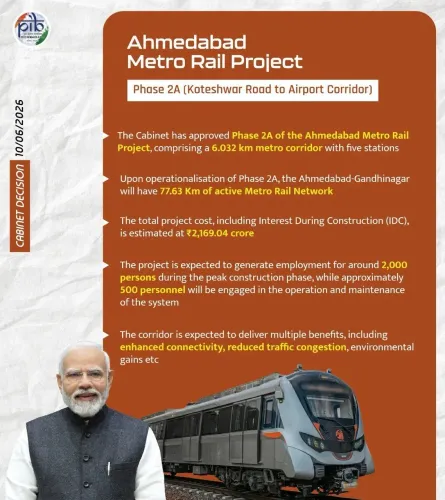
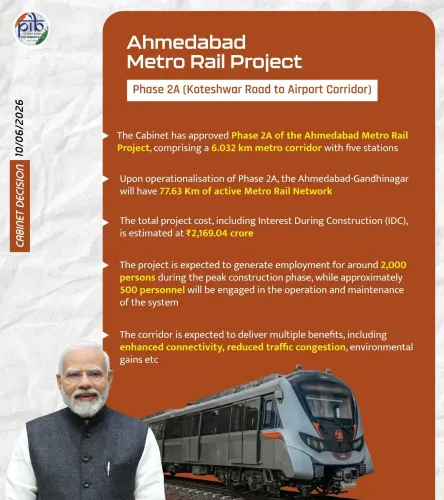
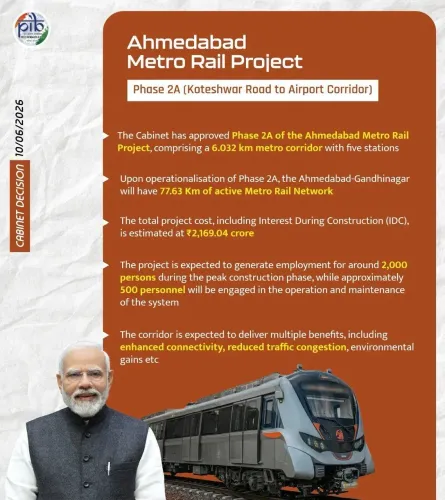
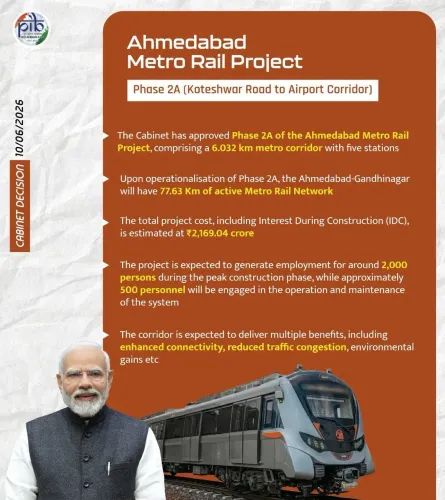
The Union Cabinet approved Ahmedabad Metro Phase 2(A) on Wednesday, 10 June at a total cost of ₹2,169.04 crore .
The new corridor spans 6.032 km with five stations — four elevated and one underground .
Stations include Ashram Road , Koteshwar Prachin Mandir , Sabarmati River , Sardar Nagar , and Airport .
On completion, the Ahmedabad-Gandhinagar metro network will extend to 77.63 km .
The project is expected to create 2,000 jobs during construction and 500 permanent roles in operations.
Sports facilities for the World Police Games 2029 and Commonwealth Games 2030 may be developed near the corridor.
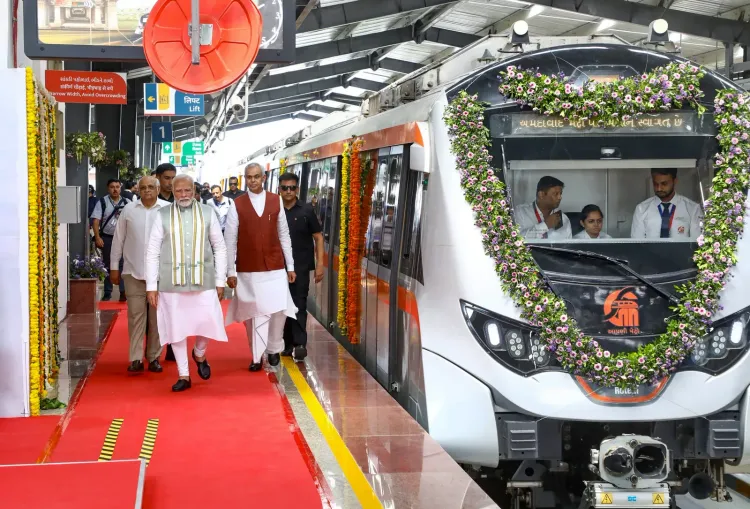
The Union Cabinet, chaired by Prime Minister Narendra Modi, on Wednesday approved Phase 2(A) of the Ahmedabad Metro Rail Project — a new 6.032 km corridor with five stations at a total completion cost of ₹2,169.04 crore, including interest during construction. The corridor will connect key urban nodes and, critically, extend the metro network directly to Ahmedabad Airport.
Corridor Layout and Stations
Of the five stations on the Phase 2(A) alignment, four will be elevated and one underground. The stations are named Ashram Road, Koteshwar Prachin Mandir, Sabarmati River, Sardar Nagar, and Airport. The corridor is designed to bridge residential and commercial zones that currently lack efficient public transit access, according to the official Cabinet communiqué.
Network Expands to 77.63 km
Once Phase 2(A) is operationalised, the combined Ahmedabad-Gandhinagar metro rail network will stretch to 77.63 km — making it one of the more extensive urban rail grids in western India. The expansion builds on existing phases already in service and is positioned as a long-term urban mobility investment for the twin-city region.
Airport Link and Broader Urban Impact
The airport connectivity component is expected to reduce road congestion on one of Ahmedabad's busiest arterial stretches. The Cabinet statement noted that the extension will cut travel time, improve road safety, and lower carbon emissions as more commuters shift from private vehicles to metro. Notably, the government also flagged a likelihood of sports infrastructure being developed nearby in connection with the World Police Games 2029 and the Commonwealth Games 2030 — events that could significantly amplify footfall on this corridor.
Jobs and Economic Spillover
Phase 2(A) is projected to generate employment for approximately 2,000 persons during peak construction activity, with around 500 permanent positions expected during operations and maintenance. The Cabinet communiqué also cited potential economic stimulus for businesses near new stations, particularly in areas that have historically been less accessible to metro infrastructure. Enhanced connectivity to the airport, railway stations, and bus depots is expected to improve workforce productivity across the city.
What Comes Next
With Cabinet clearance secured, the project now moves toward detailed execution planning and tendering. The corridor's alignment through commercially significant zones, combined with its proximity to upcoming international sporting venues, positions Phase 2(A) as a high-priority infrastructure delivery ahead of 2029-30.
Point of View
But as event-readiness ahead of the World Police Games 2029 and Commonwealth Games 2030. Ahmedabad's metro has expanded steadily, but the airport gap has long been its most glaring omission; closing it now, years before peak tourist and athlete footfall, is sound planning. The harder question is execution speed: metro projects in India routinely overrun timelines, and a 2029 deadline for associated sports infrastructure leaves little buffer. Whether the ₹2,169 crore envelope holds through construction will be the real test of project governance.
NationPress
23 Sept 2026
Frequently Asked Questions
What is Ahmedabad Metro Phase 2A?
Ahmedabad Metro Phase 2(A) is a new 6.032 km metro corridor approved by the Union Cabinet, featuring five stations including a direct link to Ahmedabad Airport. The project costs ₹2,169.04 crore including interest during construction.
Which stations are included in the Phase 2A corridor?
The five stations are Ashram Road, Koteshwar Prachin Mandir, Sabarmati River, Sardar Nagar, and Airport. Of these, four will be elevated and one will be underground.
How large will the Ahmedabad metro network be after Phase 2A?
Once Phase 2(A) is operationalised, the combined Ahmedabad-Gandhinagar metro rail network will span 77.63 km, making it one of the largest urban rail grids in western India.
How many jobs will the project create?
The project is expected to generate approximately 2,000 jobs during peak construction activity and around 500 permanent positions during operations and maintenance of the system.
What is the connection between Phase 2A and the Commonwealth Games 2030?
The Cabinet communiqué noted a likelihood of sports facilities being developed near the Phase 2(A) corridor for the World Police Games 2029 and Commonwealth Games 2030, both of which are expected to bring significant footfall to Ahmedabad.