Should AI Be Multilingual and Voice-Enabled for Enhanced Healthcare Services?
Synopsis
In a diverse country like India, ensuring that AI in healthcare is multilingual and voice-enabled is crucial for accessibility. Amitabh Nag from Digital India BHASHINI outlines the importance of overcoming language barriers in healthcare services. Discover how AI can transform citizen engagement and improve health service delivery across linguistic divides.
Key Takeaways
AI must be multilingual and voice-enabled to enhance healthcare accessibility.
Language AI improves citizen engagement and grievance resolution.
Digital health systems require AI integration as they expand.
The MoU between NHA and DIBD aims for multilingual support .
AI tools can improve efficiency in patient-doctor interactions .
New Delhi, Jan 20 (NationPress) To provide significant public value in a linguistically varied nation such as India, artificial intelligence (AI) must be both multilingual and voice-enabled, ensuring that language does not impede access to healthcare services, stated Amitabh Nag, CEO of the Digital India BHASHINI Division (DIBD).
Nag emphasized that language AI has the potential to greatly improve citizen engagement, grievance resolution, clinical documentation, and the overall accessibility of digital public health platforms.
He spoke at an event organized by DIBD in Bhubaneswar, which convened senior officials from both Union and state governments, along with technical institutions and implementing agencies to evaluate progress and promote the uptake of digital health initiatives nationwide.
Nag pointed out that as digital health systems expand throughout the country, the integration of artificial intelligence is a natural evolution.
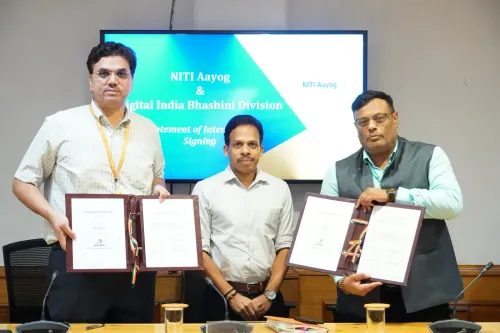
A significant moment was the signing of a Memorandum of Understanding (MoU) between the National Health Authority and the Digital India BHASHINI Division to facilitate multilingual translation services and AI-driven language support across the NHA’s digital health platforms, including AB PM-JAY and ABDM.
Kiran Gopal Vaska, Joint Secretary of the Ayushman Bharat Digital Mission (ABDM), noted the practical advantages of language AI in healthcare delivery.
He mentioned that AI-driven tools like voice-to-text and natural language processing can alleviate the time constraints faced by doctors, allowing for seamless interactions with patients and automatic creation of electronic health records, thus enhancing efficiency and bolstering digital health systems.
The Digital India BHASHINI Division will assist the National Health Authority in rolling out multilingual and voice-enabled solutions across beneficiary-facing and administrative platforms, ensuring responsible data governance, secure system integration, and continuous enhancement of language models through real-world usage and feedback.
The discussions at the event were in line with the national goal of advancing digital health through AI-powered innovation and inclusive language access, focusing on making digital health platforms usable, accessible, and effective across linguistic and geographic boundaries.
Point of View
I emphasize the importance of AI in modern healthcare. Ensuring that these technologies are accessible in multiple languages is not just a technological challenge but a humanitarian necessity. It aligns with our commitment to inclusivity and innovation, making healthcare accessible for all citizens, regardless of their linguistic background.
NationPress
19 Sept 2026
Frequently Asked Questions
Why is multilingual AI important in healthcare?
Multilingual AI is crucial in healthcare because it ensures that language barriers do not hinder access to medical services, allowing all citizens to engage with digital health platforms effectively.
What are the benefits of voice-enabled AI in healthcare?
Voice-enabled AI facilitates seamless interactions between patients and doctors, streamlining communication and improving the efficiency of clinical documentation.
How does AI enhance citizen engagement in health services?
AI enhances citizen engagement by providing accessible platforms for feedback and grievance redressal, making it easier for patients to connect with healthcare providers.
What initiatives are being taken by the Digital India BHASHINI Division?
The Digital India BHASHINI Division is working to implement multilingual and voice-enabled solutions across various health platforms to improve accessibility and usability.
What is the significance of the MoU signed between NHA and DIBD?
The MoU is significant as it aims to provide multilingual translation services and AI support, ensuring that health services are accessible to a wider population.