How Can We Deliver Sustainability at Scale and Speed? - Pralhad Joshi
Synopsis
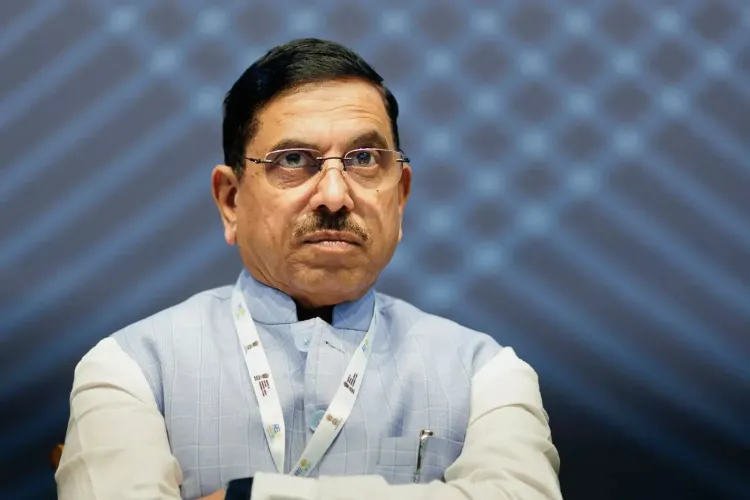
At the World Economic Forum, Pralhad Joshi asserts that the challenge lies not in discussing sustainability but in implementing it effectively. With India on track to meet its energy targets, Joshi emphasizes the significance of resilience and collaboration in fostering a sustainable future.
Key Takeaways
Sustainability is a crucial element of economic growth.
Resilient infrastructure is essential for attracting long-term investments.
India's energy transition is supported by strong policies and innovative solutions.
Collaboration among various stakeholders is vital for an inclusive transition.
India is committed to achieving net-zero emissions by 2070.
Davos, Jan 20 (NationPress) The primary challenge we face is not about whether to transition, but rather how to achieve sustainability at scale and speed, stated Pralhad Joshi on Tuesday.
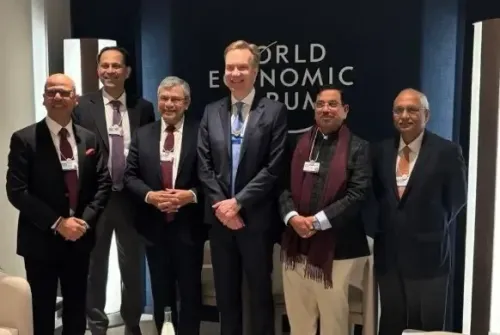
During the World Economic Forum Annual Meeting 2026, Union Minister for New and Renewable Energy Pralhad Joshi emphasized that the key issue of this decade is not whether to embrace sustainability, but how to implement it effectively while enhancing the economy.
In various high-level discussions, Joshi pointed out that sustainability has evolved from merely an environmental issue to a fundamental element of economic growth and global competitiveness.
"Nations must now prioritize the development of infrastructure that is resilient, scalable, and equipped to attract long-term investments," Joshi remarked.
During the session titled "Resilient Infrastructure for Growth," Joshi showcased India’s journey in integrating extensive growth with system resilience.
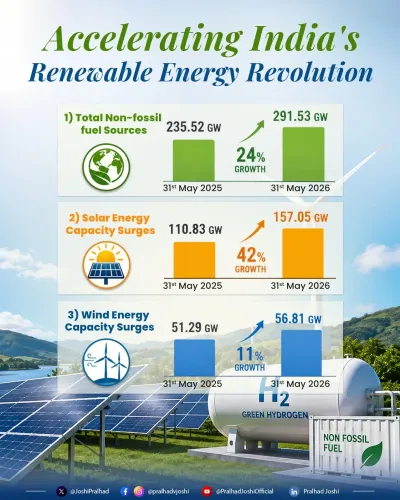
"India has already reached 267 GW of non-fossil fuel capacity by December 2025 and is well-positioned to meet its 2030 goals," he affirmed.
"This advancement is backed by robust policies, domestic manufacturing, grid modernization, energy storage solutions, and ongoing initiatives in geothermal and nuclear energy," Joshi added.
The minister highlighted that the global energy transition cannot be successful without patient capital, blended finance, and strong collaboration among governments, private enterprises, and multilateral development banks.
"These collaborations are crucial to ensuring that the transition remains inclusive and affordable for developing countries," he stated.
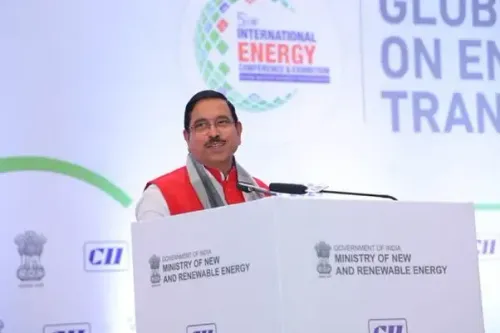
In his keynote address at the roundtable on "Delivering Sustainability at Scale," Joshi noted that sustainability is now pivotal to long-term growth, resilience, and competitiveness.
He elaborated that India perceives sustainability not merely as a technological shift, but as a profound transformation of both the economy and society.
Reiterating India’s pledge to achieve net-zero emissions by 2070, Joshi mentioned that the country’s approach is inspired by the principle of Vasudhaiva Kutumbakam—One Earth, One Family, One Future.
Point of View
I believe the discourse on sustainability is crucial for our nation. Pralhad Joshi's insights at the World Economic Forum highlight the urgency and importance of transitioning to sustainable practices. With India's commitment to achieving net-zero emissions by 2070, our approach should be inclusive, innovative, and geared towards long-term economic growth.
NationPress
2 Oct 2026
Frequently Asked Questions
What is the main challenge in achieving sustainability?
The main challenge is not whether to transition to sustainability, but how to implement it effectively at scale and speed.
How has India progressed towards non-fossil fuel capacity?
India has achieved 267 GW of non-fossil fuel capacity by December 2025 and is on track to meet its 2030 targets.
Why is collaboration important in the energy transition?
Collaboration among governments, private companies, and multilateral banks is essential to ensure that the transition remains inclusive and affordable for developing nations.