Unlocking $150 Billion: How AI Can Transform Manufacturing MSMEs by 2035
Synopsis
Discover how artificial intelligence could add between $135.6 and $149.9 billion to the manufacturing sector's value creation journey for MSMEs by 2035, highlighting a roadmap for growth and innovation in India's economy.
Key Takeaways
AI could significantly boost the manufacturing value of MSMEs by $135.6–$149.9 billion by 2035.
MSMEs are projected to raise their contribution to manufacturing from 35.4% to 50% by 2047.
AI applications include predictive maintenance and quality control to enhance productivity.
Investment in non-tech-intensive goods can open substantial opportunities for MSMEs.
Collaboration between industry, policy, and civil society is crucial for AI adoption.
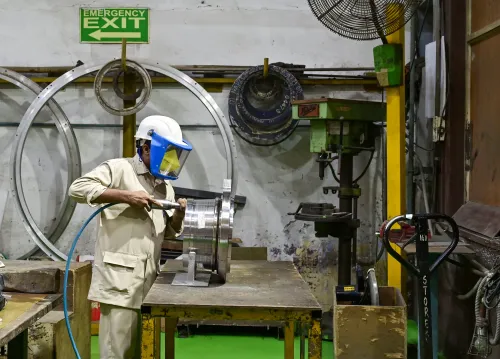
New Delhi, March 7 (NationPress) The emergence of artificial intelligence (AI) is set to play a pivotal role in enhancing the value creation journey for manufacturing MSMEs, with projections suggesting an impact of $135.6–$149.9 billion by 2035. This forecast is based on a scenario where MSMEs contribute to 50% of India's gross manufacturing value added, as detailed in a recent report.
According to a collaborative study by PwC India and the Observer Research Foundation (ORF), if India aims to elevate manufacturing's GDP share to 25%, and if MSMEs can increase their contribution from 35.4% in FY 2023–24 to 50% by 2047, they could unlock growth opportunities worth $3.13–$3.21 trillion by 2047.
“AI is no longer limited to large corporations. As a supportive tool rather than a substitute, it can empower MSMEs to escape low productivity levels and enhance their competitiveness regarding quality, speed, and innovation, while also bolstering job security and supply chain durability,” stated Sanjeev Krishan, Chairperson of PwC in India.
“We are dedicated to promoting an approach centered on human values and ecosystem collaboration, ensuring AI is accessible, cost-effective, and actionable for businesses of all sizes. By serving as a catalyst for employees and productivity, AI can assist MSMEs in overcoming structural challenges and integrating more effectively into global value chains,” he added.
The report emphasizes AI's capacity to revolutionize MSMEs throughout the manufacturing value chain—encompassing predictive maintenance, energy efficiency, vision-based quality inspection on production floors, AI-driven credit evaluations, multilingual customer interactions, compliance automation, and generative design.
By lowering barriers to capability and minimizing scaling costs, AI can enable smaller firms to enhance consistency, comply with global standards, and accelerate their production rates.
With substantial investments anticipated in data centers and semiconductor ecosystems, MSMEs can also engage by supplying non-tech-intensive capital goods such as harnesses, cooling systems, and industrial components, thus creating a manufacturing opportunity ranging from $100 to $150 billion over time.
“India's AI evolution will be determined not just by groundbreaking advancements but by the depth and fairness of AI's spread across the industrial economy. MSMEs are at the core of this evolution. Our collaboration with PwC India presents a pragmatic, bottom-up strategy aligning policy, industry, and civil society to ensure AI adoption enhances competitiveness, preserves jobs, and fosters inclusive growth,” remarked Samir Saran, President of ORF.
Point of View
I observe that the integration of AI in manufacturing MSMEs is not just a technological shift but a necessary evolution for sustainable growth. This detailed report highlights the potential for significant economic impact and emphasizes the need for inclusive strategies to ensure that smaller enterprises can harness these innovations effectively.
NationPress
5 Oct 2026
Frequently Asked Questions
What is the expected economic impact of AI on MSMEs by 2035?
AI is projected to contribute between $135.6 and $149.9 billion to the value creation journey of manufacturing MSMEs by 2035.
How can AI help MSMEs improve their operations?
AI can assist MSMEs by enhancing productivity, quality, speed, and innovation while also improving job security and supply chain resilience.
What role do MSMEs play in India's manufacturing sector?
MSMEs currently contribute 35.4% to India's manufacturing and aim to increase this to 50% by 2047, unlocking substantial growth opportunities.
What are some applications of AI in manufacturing?
AI can be utilized for predictive maintenance, energy optimization, quality control, credit assessment, customer engagement, compliance automation, and generative design.
What investment opportunities exist for MSMEs in the AI ecosystem?
MSMEs can engage in opportunities related to data centers and semiconductor ecosystems by supplying non-tech-intensive capital goods, potentially creating a $100-$150 billion market.