Anand Mahindra hails Bihar Museum's global top-10 ranking
Synopsis
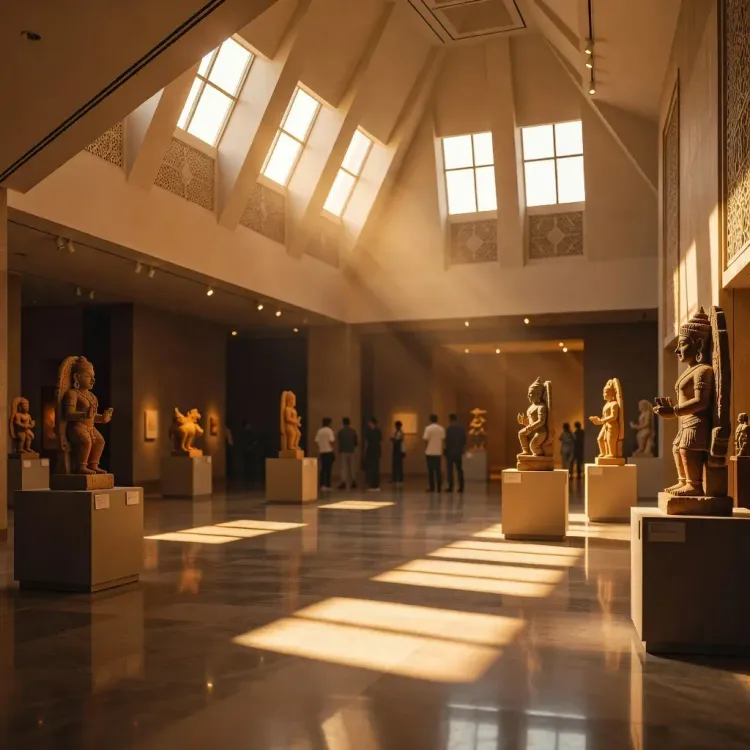
Mahindra Group chairman Anand Mahindra has hailed the Bihar Museum in Patna's reported global top-10 and best-in-Asia ranking as a 'seminal moment' and a potential launchpad for a museum renaissance across India, crediting former CM Nitish Kumar's original vision.
Key Takeaways
Mahindra Group chairman Anand Mahindra posted on 29 October 2026 praising the Bihar Museum's reported ranking of 9th globally and best in Asia .
The Bihar Museum is located in Patna and was inaugurated in 2018 to modernise the display of the state's archaeological collections.
The project was conceived by former Bihar Chief Minister Nitish Kumar and executed by the Bihar government over multiple administrative tenures.
Mahindra called it a 'new gold standard' that raises the bar for every existing and future museum in India.
The recognition aligns with a broader wave of museum modernisation across Indian states since the 2010s , extending quality cultural infrastructure beyond metro cities.
A museum in the heart of Patna has just redrawn the map of world-class cultural institutions — and Mahindra Group chairman Anand Mahindra wants every Indian to notice. On Thursday, 29 October 2026, Mahindra took to X to celebrate the Bihar Museum being ranked 9th globally and the best in Asia, calling the achievement 'simply staggering' and a potential 'game changer for the museum-going experience in India.'
A ranking that rewrites India's cultural ambitions
For decades, Indians travelling abroad have stood in patient queues outside the Louvre, the British Museum, and the Smithsonian — absorbing world-class storytelling about other civilisations. Mahindra's post puts a sharp point on a long-standing irony: that a country with one of the world's deepest archaeological and historical legacies has rarely offered its own citizens comparable museum experiences at home. The Bihar Museum's global ranking, he argues, changes that calculus. 'It raises the bar for EVERY museum that exists in this country, and every museum yet to be built,' he wrote. 'A new gold standard.'
From Nitish Kumar's vision to Bihar government's decade of execution
The museum's origins trace back to a deliberate political and administrative decision. Former Bihar Chief Minister Nitish Kumar conceived and championed the project, and the Bihar government carried it through sustained administrative effort. The institution was inaugurated in 2018 in Patna — Bihar's capital and one of India's most historically layered cities, once the seat of the Maurya and Gupta empires. Mahindra described the achievement as 'a great example of vision, administrative determination and world-class creative collaboration.' The museum was built to house and display state archaeological holdings that had long been stored in older, inadequate facilities.
Why this matters beyond Bihar's borders
India's museum modernisation push has been building quietly since the 2010s, with several states investing in upgraded infrastructure to retain cultural artefacts domestically and attract both domestic and international tourists. The Bihar Museum's international recognition gives that movement its sharpest proof point yet — a tier-2 city institution outranking far better-funded counterparts across the globe. Mahindra explicitly framed the stakes: 'The biggest beneficiaries will be the Indian public, who have long deserved museum experiences comparable to those they queue up for when travelling overseas.' He closed with a call for wider transformation — 'May this be the beginning of a museum renaissance in India' — and extended a 'standing ovation for EVERYONE who had a hand in making the Bihar Museum a reality.'
Point of View
Amplifying such achievements serves a dual purpose: it signals to state governments that world-class design and curation are bankable investments, and it builds the domestic cultural tourism pipeline that feeds everything from hospitality to handicraft exports. The post also implicitly benchmarks Indian public institutions against global peers — a pressure tactic that can accelerate upgrades elsewhere far more effectively than policy circulars.
NationPress
29 Oct 2026
Frequently Asked Questions
What is the Bihar Museum and where is it located?
The Bihar Museum is a modern cultural institution in Patna , the capital of Bihar. It was inaugurated in 2018 to house and display the state's extensive archaeological and historical collections in a contemporary setting.
What global ranking did the Bihar Museum receive?
According to Anand Mahindra's post on 29 October 2026 , the Bihar Museum was ranked 9th globally and the best museum in Asia . The specific ranking body was not named in the post.
Who was behind the Bihar Museum project?
The museum was conceived and championed by former Bihar Chief Minister Nitish Kumar and brought to completion through the sustained efforts of the Bihar government and its administrators over several years.
Why did Anand Mahindra call the Bihar Museum a 'game changer'?
Mahindra argued that a world-class ranking for a state museum in India sets a 'new gold standard' that raises expectations for every existing museum and every future one to be built, potentially triggering a broader museum renaissance in the country.
Is India investing more in museum modernisation?
Yes. Several Indian states have pursued museum upgrades since the 2010s to improve visitor experience and retain cultural artefacts domestically, with a growing focus on developing quality cultural infrastructure in tier-2 cities beyond major metros.