Should India Establish a Dedicated Department for Critical Minerals and Pursue Strong Mineral Diplomacy?
Synopsis
The PHD Chamber of Commerce and Industry pushes for a dedicated government body for critical minerals to combat global supply-chain issues. With experts advocating strategic partnerships and holistic development, India aims to secure its mineral supply chain in the face of rising global demands.
Key Takeaways
Establishment of a dedicated Department of Critical Minerals is vital for India's mineral strategy.
Increased focus on the entire supply chain from exploration to commercialization is necessary.
Strategic partnerships with resource-rich countries can reduce dependence on China.
Holistic approaches like Mission Agni can guide development.
Energy transition will be critical mineral-intensive .
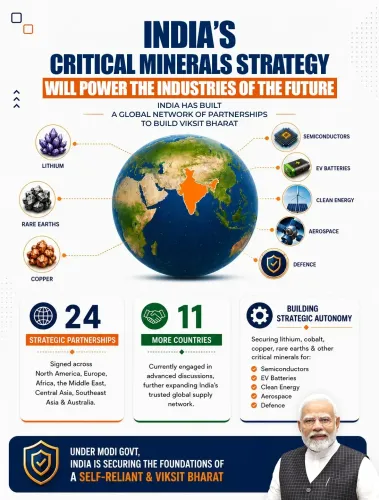
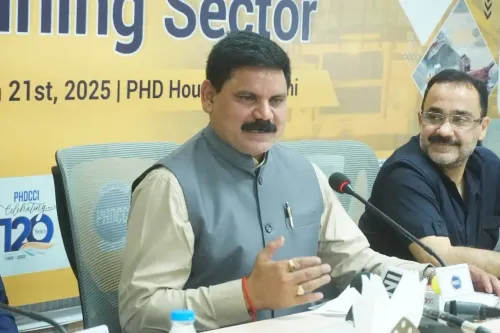
New Delhi, Nov 3 (NationPress) The PHD Chamber of Commerce and Industry (PHDCCI) urged the government to create a dedicated Department of Critical Minerals and adopt a strategy of aggressive mineral diplomacy to safeguard India against global supply-chain vulnerabilities.
During a brainstorming session held by the industry association, experts advocated for an intensified focus on developing a comprehensive critical minerals supply chain—encompassing exploration, extraction, processing, value-added development, commercialization, and marketing—similar to the approach taken by China through its National Mission.
Anil Chaudhary, Senior Member of the Minerals & Metals Committee at PHDCCI and former Chairman of SAIL, praised the government for identifying 30 critical minerals and urged the addition of coking coal to this list.
India currently imports 90% of its coking coal needs, costing around $15 billion annually, a figure expected to double in the next 10-12 years, he highlighted.
Speakers at the session stressed the necessity for inter-ministerial coordination, stockpiling, and maintaining buffer inventories, similar to the practices of the US in the oil and gas sectors. They also called for reducing bureaucratic hurdles and providing incentives for private investments in critical mineral exploration and processing.
Chaudhary pointed out that supplies of critical minerals are vulnerable to trade and geopolitical issues, advocating for India to establish strategic alliances with smaller, resource-rich nations such as Congo, Mozambique, Afghanistan, and various Latin American countries to lessen dependence on China.
Deepak Bhatnagar, Secretary General of the Pellet Manufacturers’ Association of India, recommended a holistic and time-bound mission-mode strategy for critical mineral development, reminiscent of the Mission Agni initiative launched by former President Dr. APJ Abdul Kalam.
Abhinav Sengupta, Associate Director at PricewaterhouseCoopers, emphasized that the energy transition will rely heavily on critical minerals, as electric vehicles (EVs) demand six times more minerals than traditional vehicles (due to batteries), while solar PV and onshore wind technology require about three times more minerals than conventional energy sources.
Point of View
It is vital that India prioritizes the establishment of a dedicated Department of Critical Minerals. This move not only aligns with global trends but is essential for safeguarding India's economic interests. The proactive approach advocated by PHDCCI reflects a commitment to innovation and strategic partnerships, ensuring that India remains resilient in the face of global supply-chain challenges.
NationPress
6 Oct 2026
Frequently Asked Questions
Why is a dedicated Department of Critical Minerals needed in India?
A dedicated Department is essential to effectively manage and develop India's critical mineral resources, safeguarding the nation from global supply-chain risks.
What are the potential benefits of aggressive mineral diplomacy?
Aggressive mineral diplomacy can help India secure strategic partnerships, reduce dependency on specific countries, and enhance its domestic supply chain for critical minerals.
How does India's reliance on coking coal impact its economy?
India's heavy reliance on imported coking coal, costing around $15 billion annually, poses significant economic risks, especially as demand is expected to double in the coming years.
What role does inter-ministerial coordination play in mineral development?
Inter-ministerial coordination is crucial for streamlining policies, reducing bureaucratic hurdles, and ensuring the efficient development of critical minerals in India.
How mineral-intensive is the energy transition?
The energy transition is highly mineral-intensive, with electric vehicles and renewable energy technologies requiring significantly more minerals than traditional energy sources.