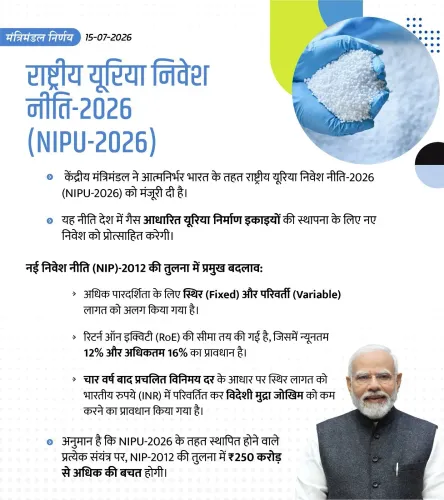
Centre clears 6 urea plants under NIPU-2026, ₹54,000 crore
Synopsis
The Centre cleared six brownfield urea plants under NIPU-2026, committing about ₹54,000 crore to replace ageing units at Chennai and Nangal and expand four other sites. With demand near 400 LMT and 2025-26 output at 293.30 LMT, the nod is a capacity bet — not yet self-reliance.
Key Takeaways
The Centre approved six brownfield urea plants under NIPU-2026 with an estimated outlay of around ₹54,000 crore .
Each plant is planned at 12.7 LMT a year; sites include Chennai , Nangal , Shahjahanpur , Panagarh , Gadepan and Jagdishpur .
MFL-Chennai and NFL-Nangal are replacements of ageing, high-energy units; Nangal consumes 6.498 Gcal/tonne versus a new-norm 5 Gcal/tonne .
India's annual urea demand is about 400 LMT ; production was 293.30 LMT in 2025-26 after a 314.07 LMT peak in 2023-24 .
Indigenous reassessed capacity has risen from 207.54 LMT in 2014-15 to 269.42 LMT in 2026-27 .
The Centre on Wednesday approved six new brownfield urea plants under the National Investment Policy for Urea (NIPU-2026), involving an estimated investment of around ₹54,000 crore, to strengthen fertiliser security, cut import dependence and push self-reliance in urea production. The Ministry of Chemicals and Fertilizers said the package aligns with the Atmanirbhar Bharat vision and will add substantial domestic capacity through projects in the public, private and cooperative sectors.
Six projects across five states
The approved slate includes replacement of the ageing Madras Fertilizers Ltd (MFL) plant in Chennai, Tamil Nadu, and the National Fertilizers Ltd (NFL) unit at Nangal in Punjab. Both facilities are several decades old and face high production costs, elevated energy consumption and operational safety concerns. Each new plant will have an annual installed capacity of 12.7 lakh metric tonnes (LMT), replacing older units with lower capacities and weaker efficiency.
Cooperative major KRIBHCO will expand its Shahjahanpur unit in Uttar Pradesh. Private-sector brownfield expansions are planned at Matix Fertilisers' Panagarh facility in West Bengal, Chambal Fertilisers and Chemicals Ltd's Gadepan complex in Rajasthan, and Indian Potash Ltd's Jagdishpur plant in Uttar Pradesh. Each of these projects is also planned at 12.7 LMT a year.
Why ageing plants are being replaced
Modernisation of ageing units is a core objective of NIPU-2026. The ministry noted that older plants such as MFL-Madras and NFL-Nangal consume significantly more energy than newer facilities. The Nangal plant, for instance, operates at 6.498 Gcal per tonne, compared with the industry's weighted average of 5.95 Gcal per tonne and the prescribed new energy norm of 5 Gcal per tonne.
Officials said the brownfield route will let developers use existing land, infrastructure, utilities, logistics networks and skilled manpower, which should accelerate execution and reduce costs relative to greenfield construction. This comes amid a wider push to retire inefficient capacity rather than keep high-cost plants running on subsidy.
India's urea demand-supply gap
The expansion drive is aimed at narrowing the gap between domestic output and consumption. India's annual urea demand is around 400 LMT. Domestic production rose from 225 LMT in 2014-15 to a record 314.07 LMT in 2023-24, but stood at 293.30 LMT during 2025-26. Indigenous reassessed capacity has increased from 207.54 LMT per annum in 2014-15 to 269.42 LMT per annum in 2026-27.
Notably, reassessed capacity remains well below annual demand even after more than a decade of additions. Two of the six approvals replace existing plants rather than open entirely new sites, so the net gain in tonnes will depend on how much extra output the new 12.7 LMT units deliver over the older, smaller facilities they displace.
Impact on fertiliser security
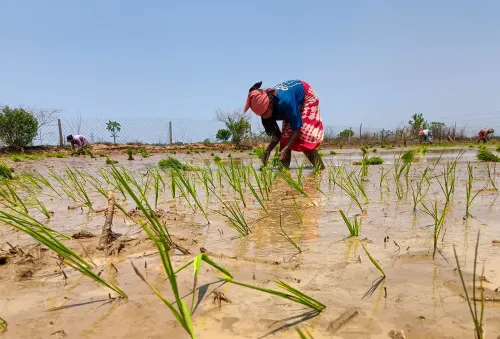
Urea is central to India's farm-nutrient subsidy system. Persistent import dependence leaves supply exposed to global gas prices, shipping disruptions and currency swings. By clustering investment at sites already tied into rail, road and pipeline networks, the Centre is betting that capacity can come online faster than through greenfield plants.
Public-sector units (MFL and NFL), a cooperative (KRIBHCO) and private players (Matix, Chambal Fertilisers and Indian Potash Ltd) share the slate, spreading execution across ownership models. Farmers in Tamil Nadu, Punjab, Uttar Pradesh, West Bengal and Rajasthan will be closest to the new capacity, though urea is pooled nationally under the subsidy regime.
What happens next
Developers will now have to convert NIPU-2026 approvals into financial closure, statutory clearances and construction timelines. Energy-norm compliance at 5 Gcal per tonne will be a key test for the replacement units at Chennai and Nangal. Whether the six plants add physical tonnes — and whether output recovers from the 2025-26 level of 293.30 LMT toward the 400 LMT demand mark — will decide if this round of investment actually narrows India's urea deficit.
Point of View
Not greenfield additions, so 12.7 LMT nameplate capacity should not be read as a straight surplus of more than 70 LMT. Domestic production actually slipped from a 314.07 LMT peak in 2023-24 to 293.30 LMT in 2025-26, even as demand stays near 400 LMT. Reassessed indigenous capacity of 269.42 LMT in 2026-27 remains far below consumption. NIPU-2026 will be judged on energy-norm delivery at 5 Gcal per tonne and on whether extra tonnes actually reach farms — not on the ₹54,000 crore headline.
NationPress
25 Nov 2026
Frequently Asked Questions
What did the government approve under NIPU-2026?
The Centre approved six new brownfield urea plants under the National Investment Policy for Urea (NIPU)-2026, with an estimated investment of around ₹54,000 crore. The Ministry of Chemicals and Fertilizers said the projects span public, private and cooperative sectors and are aimed at cutting import dependence.
Which companies and locations are covered by the six urea plants?
The six sites are MFL in Chennai, NFL at Nangal in Punjab, KRIBHCO at Shahjahanpur in Uttar Pradesh, Matix Fertilisers at Panagarh in West Bengal, Chambal Fertilisers at Gadepan in Rajasthan, and Indian Potash Ltd at Jagdishpur in Uttar Pradesh. Each plant is planned with 12.7 LMT of annual capacity.
How much urea does India produce versus demand?
India's annual urea demand is around 400 LMT. Domestic production rose from 225 LMT in 2014-15 to a record 314.07 LMT in 2023-24, but stood at 293.30 LMT in 2025-26, while reassessed indigenous capacity is 269.42 LMT per annum in 2026-27.
Why are the MFL Chennai and NFL Nangal plants being replaced?
Both plants are several decades old and face high production costs, greater energy use and operational safety challenges. NFL-Nangal, for example, consumes 6.498 Gcal per tonne against a new energy norm of 5 Gcal per tonne, which is why they are being replaced with 12.7 LMT modern units.
What is a brownfield urea plant under NIPU-2026?
A brownfield plant is built by expanding or replacing capacity at an existing site rather than on a new greenfield plot. The government said this lets developers reuse land, utilities, logistics and skilled manpower, which should speed execution and lower costs.