India's fertiliser self-reliance shields farmers from West Asia price shock
Synopsis
Even as the West Asia crisis sent global urea prices past ₹4,100 a bag, Indian farmers are still paying ₹266.5 — held there by a decade-long domestic capacity build that pushed urea output to a record 314 LMT. With Kharif 2026 stocks already at 51% of projected need, India's fertiliser self-reliance bet appears to be paying off precisely when it was needed most.
Key Takeaways
India's domestic urea production rose from 225 LMT in 2014-15 to a record 314.07 LMT in 2023-24 , aided by six new mega plants .
Two additional urea plants with combined capacity of 25.4 LMT are set to begin production shortly.
P&K fertiliser output hit a record 211.22 LMT in 2024-25 , up from 159.54 LMT in 2014-15 .
Kharif 2026 opening stock stands at 200.98 LMT against a projected need of 383.9 LMT — over 51% advance availability, above the 33% buffer norm.
Retail urea price for farmers remains ₹266.5 per 45-kg bag versus a global price exceeding ₹4,100 ; DAP stays at ₹1,350 per bag against a global price above ₹5,000 .
Eco-friendly alternative fertiliser sales rose seven times in 2025-26 ; green manuring covered a record 1.84 lakh hectares .
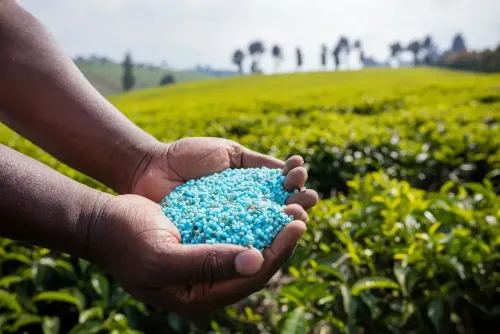
India's Atmanirbhar Bharat push in the fertiliser sector has provided a critical buffer for farmers amid global supply disruptions triggered by the West Asia crisis, according to an official statement released on Sunday, 15 June 2026. The Department of Fertilisers says the country's domestic production capacity has expanded sharply over the past decade, enabling the government to maintain stable retail prices and adequate stocks for the Kharif 2026 season despite soaring international prices.
Production Milestones Since 2014
Six new mega urea plants commissioned since 2014 have added an annual capacity of 76.2 lakh metric tonnes (LMT) to India's production base. Domestic urea output climbed from 225 LMT in 2014-15 to an all-time high of 314.07 LMT in 2023-24, settling at 306.67 LMT in 2024-25. Two additional high-capacity urea plants with a combined annual capacity of 25.4 LMT are set to begin production shortly, according to the statement.
Phosphatic and potassic (P&K) fertiliser manufacturing also hit a record 211.22 LMT in 2024-25, up from 159.54 LMT in 2014-15. Both public and private sector players are reportedly continuing to invest in new P&K production facilities.
How the Government Responded to the West Asia Crisis
Shipping disruptions around the Strait of Hormuz — a critical chokepoint for fertiliser raw materials — prompted the Centre to rapidly explore alternative transit routes and engage diplomatic channels to source inputs directly from global producers. According to the official statement, seven Empowered Groups of Secretaries were constituted under direct government oversight, with the Fertiliser Secretary conducting 10 high-level reviews to ensure inter-ministerial coordination. Natural gas supply issues were resolved in coordination with the Ministry of Petroleum and Natural Gas.
Post-crisis domestic production stood at 118.15 LMT. Combined with strategic imports and jointly concluded global tenders, total post-crisis fertiliser availability recorded a net addition of 153.79 LMT.
Kharif 2026 Stock Position
Against a total projected requirement of 383.9 LMT — as reassessed by the Department of Agriculture and Farmers Welfare (DA&FW) — India held an opening stock of nearly 200.98 LMT, with available stock as of Sunday at around 195.79 LMT. Officials say this represents an advance availability of more than 51% of the season's projected need, well above the traditional buffer standard of 33%.
Farmer Prices Held Despite Global Surge
The Centre has not raised retail fertiliser prices for farmers despite a sharp rise in global commodity costs. While the international market price of urea exceeds ₹4,100 per bag, Indian farmers continue to purchase a 45-kg bag at ₹266.5. For Di-Ammonium Phosphate (DAP), the global price has crossed ₹5,000 per 50-kg bag, yet the subsidised domestic price remains at ₹1,350 per bag.
Push Toward Eco-Friendly Alternatives
The government is also promoting alternatives to chemical fertilisers. Combined sales of fortified organic manure and phosphate-rich organic manure reportedly surged seven times in 2025-26 compared to the previous year. Ammonium sulphate consumption rose by nearly 60,000 tonnes, and green manuring was introduced across a record 1.84 lakh hectares under the technical guidance of Krishi Vigyan Kendras (KVKs), according to the statement.
With two more large urea plants nearing commissioning, India's fertiliser self-sufficiency trajectory is set to deepen further — a development that will be closely watched as global geopolitical risks remain elevated.
Point of View
But they rest on a subsidy architecture that costs the exchequer tens of thousands of crores annually — a figure the official statement does not mention. The ₹266.5 urea price has not moved in years, which insulates farmers in the short run but also removes any price signal that might encourage more efficient use. India's fertiliser consumption intensity per hectare remains among the highest in the world, and the seven-fold jump in organic alternatives — while welcome — starts from a very low base. The real test of Atmanirbhar in fertilisers is not just production volume but whether India can reduce its dependence on imported raw materials like rock phosphate and potash, which still leave the P&K segment structurally exposed to the same geopolitical shocks the government is currently managing around.
NationPress
15 Sept 2026
Frequently Asked Questions
How has India protected farmers from the West Asia fertiliser crisis?
The Centre held retail fertiliser prices steady — urea at ₹266.5 per 45-kg bag and DAP at ₹1,350 per 50-kg bag — despite global prices rising sharply. It also sourced alternative supply routes around the Strait of Hormuz and built up Kharif 2026 stocks to over 51% of projected seasonal need.
What is India's current fertiliser stock for Kharif 2026?
As of 15 June 2026, India holds an opening stock of nearly 200.98 LMT, with available stock at around 195.79 LMT, against a projected Kharif 2026 requirement of 383.9 LMT. This represents more than 51% advance availability, well above the traditional 33% buffer standard.
How much has India's urea production grown since 2014?
Domestic urea production grew from 225 LMT in 2014-15 to a record 314.07 LMT in 2023-24, driven by six new mega urea plants that added 76.2 LMT of annual capacity. Two more plants with a combined capacity of 25.4 LMT are expected to come online shortly.
What is the subsidised price of urea and DAP for Indian farmers?
Indian farmers pay ₹266.5 for a 45-kg bag of urea, compared to a global market price exceeding ₹4,100. DAP is available at ₹1,350 per 50-kg bag against an international price of more than ₹5,000 per bag.
What eco-friendly fertiliser alternatives is the government promoting?
Sales of fortified organic manure and phosphate-rich organic manure rose seven times in 2025-26 compared to 2024-25. Ammonium sulphate consumption increased by nearly 60,000 tonnes, and green manuring was rolled out across a record 1.84 lakh hectares with support from Krishi Vigyan Kendras.