Is foreign ownership in the South Korean stock market at its highest level in nearly 6 years?
Synopsis
Discover the latest trends in foreign investment in South Korea's stock market, with ownership reaching unprecedented levels. This surge reflects increased confidence in the country's equity landscape amid a booming semiconductor sector. What does this mean for investors and the future of the market?
Key Takeaways
Foreign ownership in South Korea reached 32.9 percent in December.
Investors purchased a net 3.5 trillion won in local shares.
Significant investments were made in the electronics sector.
SK Hynix and Samsung Electronics saw increased foreign stakes.
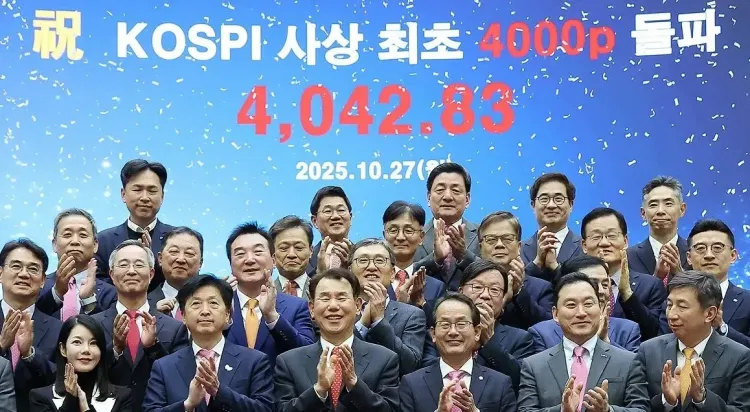
The KOSPI index closed at an all-time high of 4,309.63 .
Seoul, Jan 4 (NationPress) The proportion of foreign ownership in South Korea's stock market surged to its highest level in nearly six years as of December, driven by a robust rally in the nation's equity landscape, according to a report released on Sunday.
In December alone, foreign investors purchased a net 3.5 trillion won (approximately US$2.4 billion) in local equities, pushing their total stockholdings to 32.9 percent of the overall market capitalisation, marking the highest point since April 2020, as reported by the Korea Center for International Finance (KCIF) and cited by Yonhap news agency.
Additional data from the Financial Supervisory Service (FSS) indicated that foreign ownership was at 29.6 percent as of November, a slight decrease from 31.5 percent in April 2020. The FSS has yet to publish December figures.
According to the KCIF report, foreign investors notably acquired a net 4.5 trillion won worth of shares in the electronics sector during December, including 2.2 trillion won in SK Hynix and 1.4 trillion won in Samsung Electronics.
This resulted in foreign ownership of SK Hynix increasing to 53.8 percent in December from 53.2 percent the previous month, while foreign stakes in Samsung Electronics also rose slightly to 52.3 percent from 52.2 percent.
In the bond market, foreign investors acquired a net 8.8 trillion won worth of bonds last month, as noted in the report.
The KCIF attributes this significant uptick in foreign investments to expectations of strong global demand for memory chips, which are poised to benefit South Korean semiconductor manufacturers.
The Korean government's initiatives to reform the stock market and enhance corporate value have also played a crucial role in attracting foreign investors, the report highlighted.
South Korea's benchmark stock index concluded at 4,214.17 on December 30, reflecting a 75.7 percent increase since the year's first trading day.
Moreover, South Korean stocks soared over 2 percent on Friday, achieving an all-time high, largely driven by substantial gains in major semiconductor stocks. Concurrently, the local currency experienced depreciation against the U.S. dollar.
The benchmark Korea Composite Stock Price Index (KOSPI) increased by 95.46 points, or 2.27 percent, closing at 4,309.63, surpassing the 4,300 mark for the first time in history.
Point of View
It's essential to recognize the significance of this surge in foreign ownership within South Korea's stock market. This trend not only highlights the growing confidence in the nation's economic recovery but also reflects the effectiveness of government policies aimed at enhancing corporate value. The influx of foreign investments is a positive sign for the market, indicating a promising future for both local and international investors.
NationPress
24 Sept 2026
Frequently Asked Questions
What is the current foreign ownership percentage in South Korea's stock market?
As of December, foreign ownership reached 32.9 percent of total market capitalisation.
How much did foreign investors purchase in December?
In December, foreign investors bought a net 3.5 trillion won (approximately US$2.4 billion ) worth of local shares.
Which sectors saw significant foreign investment?
The electronics sector saw substantial foreign investment, with 4.5 trillion won worth of shares purchased in December.
What is the significance of the KOSPI index closing at an all-time high?
The KOSPI index closing at 4,309.63 indicates strong market performance and investor confidence.
What factors contributed to the rise in foreign investments?
The increase in foreign investments is attributed to expectations of strong global demand for memory chips and government reforms aimed at improving corporate value.